
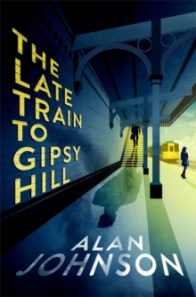
#BookReview The Late Train to Gipsy Hill by Alan Johnson @Wildfirebks

The Late Train to Gipsy HillAbout the Book

Gary Nelson has a routine for the commute to his rather dull job in the city. Each day, he watches as a woman on the train applies her make up in a ritual he now knows by heart. He’s never dared to strike up a conversation…but maybe one day.

Then one evening, on the late train to Gipsy Hill, the woman invites him to take the empty seat beside her. Fiddling with her mascara, she holds up her mirror and Gary reads the words ‘HELP ME’ scrawled in sticky black letters on the glass.

From that moment, Gary’s life is turned on its head. He finds himself on the run from the Russian mafia, the FSB and even the Metropolitan Police – all because of what this mysterious young woman may have witnessed. In the race to find out the truth, Gary discovers that there is a lot more to her than meets the eye . . .

Format: eARC (352 pages)                     Publisher: Wildfire Books
Publication date: 2nd September 2021 Genre: Thriller

Find The Late Train to Gipsy Hill on Goodreads

Pre-order/Purchase links
Bookshop.org
Disclosure: If you buy a book via the above link, I may earn a commission from Bookshop.org, whose fees support independent bookshops

Hive | Amazon UK
Links provided for convenience only, not as part of an affiliate programme


My Review

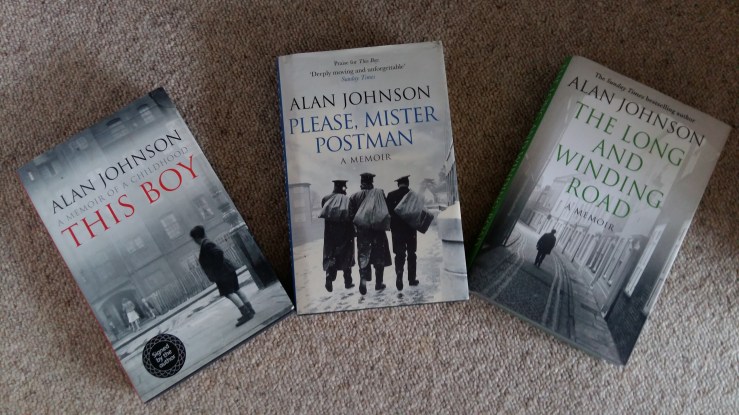
I’m a great fan of Alan Johnson, both as a former politician and as an author of a fabulous series of memoirs – This Boy, Please, Mr Postman, and The Long and Winding Road. For those who don’t know or haven’t guessed from the titles, he’s a lifelong fan of The Beatles. When I heard him speak at Henley Literary Festival in 2018 about his then recently published book, In My Life: A Music Memoir, he mentioned that his next book was likely to be fiction, probably historical fiction. He obviously decided to switch genre because The Late Train to Gipsy Hill fulfils all the requirements of a crime thriller with its intricate plot, cast of shady characters and frequent action scenes.

The storyline couldn’t be more up-to-date either, set in a London in which football clubs are owned by rich Russians while their fellow countrymen use the buying and selling of property as a way of laundering dirty money. As the author notes, ‘Amongst the Russian criminal fraternity, London had become known as the world’s laundromat, washing billions of pounds of dirty cash every year‘.

Through a chivalrous act of kindness towards a damsel in distress, poor Gary, the book’s hero, finds himself plunged into a world in which Russian secret service agents, with or without the knowledge of the Russian President, may be carrying out killings in a particularly dangerous way (echoes of the real life murder of Alexander Litvinenko). At the same time, rival gangs of criminals engaged in prostitution, drug and people smuggling, fight for precedence.

If, like Gary, you’re in danger of becoming confused by the twists and turns of the plot – of which there are many – as well as the many Russian characters with difficult to pronounce names, the author thoughtfully provides periodic recaps of the events that have taken place. However, also like Gary, you’ll have to wait until the very end to get the whole picture.

The book contains convincing detail about the structure and operations of the intelligence services and the Metropolitan Police no doubt gleaned from the author’s time as Home Secretary. I just hope that some of what Gary discovers doesn’t hold true in real life. There’s also an impressive knowledge of the London Underground and bus network on display, and even a fleeting role for a vehicle linked to one of the author’s former occupations.

At the Henley Literary Festival event I mentioned earlier, Alan said one of the reasons he wanted to turn to fiction was because he relished the idea of being able to control plot and characters, something not possible in non-fiction. In The Late Train to Gipsy Hill he has certainly demonstrated the ability to craft an intricate plot. During his talk, Alan also paid tribute to the English teacher who first encouraged him to write so it was lovely to see the dedication to, I assume, the same teacher at the beginning of the book.

I thoroughly enjoyed The Late Train to Gipsy Hill and thought it was an impressive debut. Alan is just one of the fantastic selection of authors appearing at this year’s Henley Literary Festival. His event, like many others, will also be live-streamed so if you can’t get there in person you can still listen to Alan talk about the book. At the time of writing, tickets are still available and can be booked via the Henley Literary Festival website.

In three words: Ingenious, convincing, assured

Try something similar: Killing State by Judith O’Reilly

Follow this blog via Bloglovin


alan johnsonAbout the Author

Alan Johnson’s childhood memoir This Boy was published in 2013. It won the Royal Society of Literature Ondaatje Prize, and the Orwell Prize, Britain’s top political writing award. His second volume of memoirs, Please, Mr Postman (2014) won the National Book Club award for Best Biography. The final book in his memoir trilogy, The Long And Winding Road (2016), won the Parliamentary Book Award for Best Memoir.

Alan was a Labour MP for 20 years before retiring ahead of the 2017 general election. He served in five cabinet positions in the Governments of Tony Blair and Gordon Brown including Education Secretary, Health Secretary and Home Secretary. He and his wife Carolyn live in East Yorkshire. (Photo/bio credit: Publisher author page)

Connect with Alan
Website | Goodreads
Top Ten Tuesday About A Boy Please Mr Postman The Long and Winding Road

#BookReview End of Summer by Anders de la Motte @ZaffreBooks

End of SummerAbout the Book

You can always go home. But you can never go back…

Summer 1983: Four-year-old Billy chases a rabbit in the fields behind his house. But when his mother goes to call him in, Billy has disappeared. Never to be seen again.

Today: Veronica is a bereavement counsellor. She’s never fully come to turns with her mother’s suicide after her brother Billy’s disappearance. When a young man walks into her group, he looks familiar and talks about the trauma of his friend’s disappearance in 1983. Could Billy still be alive after all this time?

Needing to know the truth, Veronica goes home – to the place where her life started to fall apart. But is she really prepared for the answers that wait for her there?

Format: Paperback (480 pages)        Publisher: Zaffre
Publication date: 19th August 2021 Genre: Crime, Mystery

Find End of Summer on Goodreads

Purchase links
Bookshop.org
Disclosure: If you buy a book via the above link, I may earn a commission from Bookshop.org, whose fees support independent bookshops

Hive | Amazon UK
Links provided for convenience only, not as part of an affiliate programme


My Review

End of Summer was first published in Sweden in 2016 where it was shortlisted for Novel of the Year in the Swedish Crime Writers’ Academy Awards. Now available in English, it’s the second book in the ‘Seasons Quartet’ with Dead of Winter and Deeds of Autumn due out in January and October 2022 respectively, joining Rites of Spring which was published in April 2021, although each book is a standalone story.

End of Summer unfolds in alternating chapters, moving between past and present – the summer of 1983 and the present day. For me this structure really worked as I was constantly wondering what was going to happen next in the other timeline, although later in the book, one of the timelines predominates. Throughout the book the author’s  ability to deliver a teasing last line adds to the suspense, as does the occasional inclusion of a series of letters from an undisclosed correspondent, the significance of which only becomes evident in the closing chapters.

As the mystery of Billy Nilsson’s disappearance remains unresolved, the reader sees played out the disturbing effect it has on the family, the small community of Reftinge in which they live, and the police officer charged with investigating it, Chief of Police Månsson. Unfamiliar with investigating a crime of this magnitude, Månsson feels out of his depth but deeply conscious of his obligation to provide an answer for the Nilsson family. Månsson can’t help imagining what it would be like if it was one of his own sons who had gone missing. At one point he reflects, “I’m doing my best… I’m trying to be a good husband, a good father. A good police officer.” I found him a very empathetic character. The pressure on Månsson only increases when what evidence there is seems to point to a particular individual.

Moving to the present day, Billy’s sister, Vera, has reinvented herself as Veronica. The reasons for this remain tantalizingly unclear for much of the book; all the reader knows is that she seems to have experienced more than one traumatic event in her life. Ironically, Veronica is now working as a bereavement counsellor running grief therapy sessions at which those attending share the impact of their loss. The author shows a deft touch here, one phrase in particular sticking in my mind: the description of the tears shed by a member of the group as being ‘tiny, translucent pearls of grief’. An unxpected arrival at one of Veronica’s sessions triggers disturbing memories and sets in motion a chain of events which increasingly spirals out of control, triggering feelings of panic and paranoia.

When Veronica returns home to the family farm at the urging of her brother Mattias, Reftinge seen through her eyes is rather rundown. However, that feeling is soon replaced by the spine-tingling atmosphere the author creates as Veronica pursues her own investigation into the disappearance of her brother, heedless to the risks she runs in doing so. But how much of what she experiences is imagined, how much is real?

The author lays down plenty of false trails that certainly had me foxed. I developed several theories but the answer to the question ‘Where is Billy?’ when it is finally revealed definitely wrong-footed me. The solution was both more complex and more heartrending than anything I could have come up with.

End of Summer is a compelling mystery but also an absorbing and insightful picture of a family coping with the disappearance of a child: the unanswered questions, the dashed hopes, and the sense of absence. I found it absolutely gripping from start to finish and it’s a book I definitely won’t forget in a hurry.  I must also commend the translator, Neil Smith. If I hadn’t known, I certainly wouldn’t have guessed the book was originally written in Swedish.

My thanks to Clare Kelly at Zaffre for my proof copy of End of Summer. I shall certainly be looking out for future books in the series.

In three words: Gripping, moving, masterful

Try something similar: The Missing Girl by Jenny Quintana

Follow this blog via Bloglovin


Anders de la MotteAbout the Author

Anders de la Motte is the bestselling author of the ‘Seasons Quartet’; the first three of which – End of Summer, Deeds of Autumn and Dead of Winter – have all been number one bestsellers in Sweden and have been shortlisted for the Swedish Academy of Crime Writers’ Award for Best Crime Novel of the Year. Anders, a former police officer, has already won a Swedish Academy of Crime Award for his debut, Game, in 2010 and his second standalone, The Silenced, in 2015.
To date, the first three books in the ‘Seasons Quartet’ have sold over half a million copies, with the fourth, Rites of Spring, publishing in Sweden in 2020. Set in Southern Sweden, all four books can be read as standalone novels.
Connect with Anders