#BlogTour #BookReview A Single Rose by Muriel Barbery, translated by Alison Anderson @BelgraviaB

Welcome to today’s stop on the blog tour for A Single Rose by Muriel Barbery, translated from French by Alison Anderson. My thanks to Isabelle at Gallic Books for inviting me to take part in the tour and for my review copy.
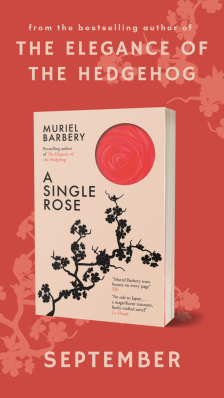

A Single Rose Blog Tour CoverAbout the Book

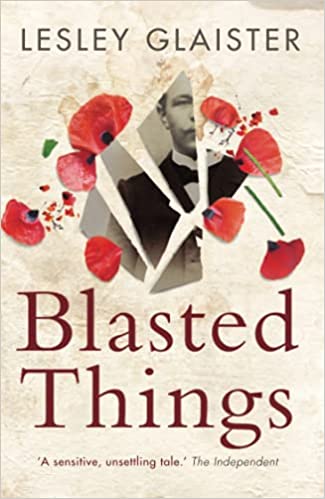
Rose has turned 40, but has barely begun to live. When the Japanese father she never knew dies and she finds herself an orphan, she leaves France for Kyoto to hear the reading of his will.

In the days before Haru’s last wishes are revealed, Rose is led around the city of temples by his former assistant, Paul. Initially a reluctant tourist, Rose gradually comes to discover her father’s legacy through the itinerary he set for her, finding gifts greater than she had ever imagined.

Format: Paperback (144 pages)               Publisher: Gallic Books
Publication date: 23rd September 2021 Genre: Contemporary Fiction, Literature in Translation

Find A Single Rose on Goodreads

Purchase links
Bookshop.org
Disclosure: If you buy a book via the above link, I may earn a commission from Bookshop.org, whose fees support independent bookshops

Publisher | Hive | Amazon UK
Links provided for convenience only, not as part of an affiliate programme


My Review

From the start of the book the reader, like Rose, is immersed in the culture of Japan: its food, its customs and traditions, even its weather. Each chapter of the book is preceded by a Japanese folk tale or legend which subtly, often obliquely, informs the content of the chapter that follows. There are trees and flowers everywhere – carnations, peonies, magnolia, azaleas – often in hues of red. You would expect their presence to excite Rose’s interest, being a botanist by profession, but her reaction is more ambivalent.  She is seemingly unmoved by their beauty but drawn to their shapes and symbolism. This is reflected in the story of Issa, a famous Japanese poet, who, when asked why he only visited a plum orchard famed for its blossom when the trees were bare replied, ‘I have waited a long time in a state of deprivation; now the plum blossom is inside me’.

To some extent this also describes Rose’s mood when she arrives in Kyoto for the reading of her father’s will; the father she never met. She is full of repressed anger towards her father. ‘What can he give me now?’ she asked. ‘What can absence and death give me? Money? An apology? Lacquered tables?’ Much of her angst is experienced by Paul, her father’s assistant, charged with accompanying Rose on an intinerary compiled by her father shortly before his death.  Poor Paul, who has known loss of his own, puts up with this out of loyalty to Rose’s father.  For a long time, Rose actively resists being drawn to any aspect of her father’s life, resenting rather than appreciating the evidence that emerges of his interest in her life, even if from afar.  Gradually she starts to soften as she absorbs the atmosphere of the temples and gardens she and Paul visit.  The sake helps a little too and soon self-deprecating humour replaces her previous abrasive and petulant nature.

Muriel Barbery’s writing has an etheral, almost dreamlike quality, carefully preserved in Alison Anderson’s translation. I especially liked the evocative descriptions of the temples and gardens Rose visits, the landscape in and around Kyoto, and the weather. Waking up to heavy rain one morning, Rose observes ‘The mountains of the East steamed with mist rising into a diaphonous sky; the river was silenced by the downpour.’ On another morning, the view from her window is of mountain slopes ‘bathed in thick mist that rose in successive exhalations towards a transparent sky’.

By the end of her stay, Rose finds she has become a different person, able to put past disappointments behind her and look to a future that offers so much more than she might have imagined.

A Single Rose is the sort of book you need to linger over, much as you might a cup of fragrant Japanese tea, gradually taking in and appreciating its delicate, subtle features.

In three words: Profound, lyrical, sensuous

Follow this blog via Bloglovin


Muriel-Barbery-©-Catherine-Hélie-Editions-GallimardAbout the Author

Muriel Barbery is the author of four previous novels, including the IMPAC-shortlisted multimillion-copy bestseller The Elegance of the Hedgehog. She has lived in Kyoto, Amsterdam and Paris, and now lives in the French countryside. (Photo credit: Publisher author page)

About the Translator

Alison Anderson is an author and the translator of around 100 books from French, including Muriel Barbery’s previous novels and works by Amélie Nothomb and J. M. G. Le Clézio.

#BlogTour #BookReview Blasted Things by Lesley Glaister @sandstonepress

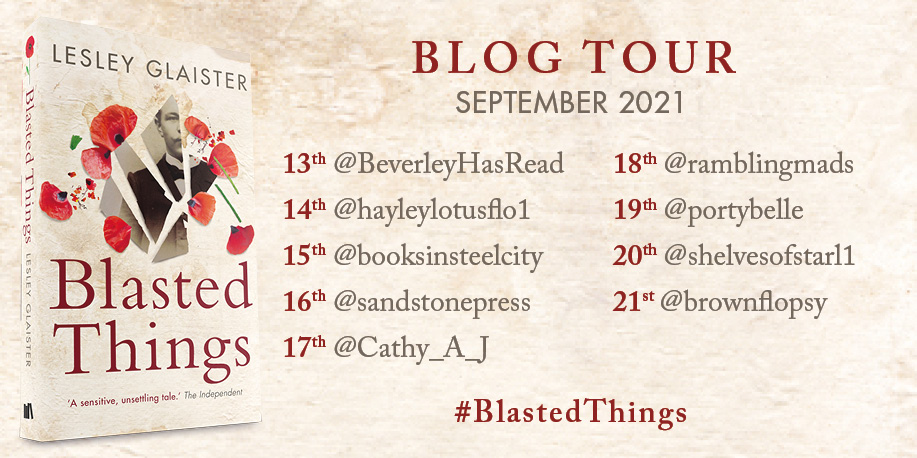
Blasted things blog tour twitter banner

Welcome to today’s stop on the blog tour for Blasted Things by Lesley Glaister. My thanks to Ceris and Niki at Sandstone Press for inviting me to take part in the tour and for my review copy.


Blasted ThingsAbout the Book

1920: Britain is trying to forget the Great War.

Clementine, who nursed at the front and suffered losses, must bury the past. Then she meets Vincent, an opportunistic veteran whose damage goes much deeper than the painted tin mask he wears.

Their deadly relationship will career towards a dark and haunting resolution.

Format: Paperback (352 pages)              Publisher: Sandstone Press
Publication date: 16th September 2021 Genre: Historical Fiction

Find Blasted Things on Goodreads

Purchase links
Bookshop.org
Disclosure: If you buy a book via the above link, I may earn a commission from Bookshop.org, whose fees support independent bookshops

Hive | Amazon UK
Links provided for convenience only, not as part of an affiliate programme


My Review

Structured in three parts – Before, During and After – the opening chapters of Blasted Things transports the reader to the mayhem and horror of a Casualty Clearing Station close to the Front and the Allied trenches in 1918. The job of nurses like Clementine (Clem) and the other medical staff is to ‘patch up’ the wounded for the journey to hospital; many of them will not make it, dying on the operating table or from infection. The sheer awfulness of what Clem witnesses – the results of what human beings can do to other human beings – is vividly depicted. I loved the imaginative metaphors, such as the descrption of the sounds Clem hears as she lies exhausted on her bunk in her cramped quarters: ‘the rat-tat-tat of gunfire, rapid and snippy like the keys of two vast, duelling typewriters battering out threats to each other in a paper sky’.  Snatched moments of joy are intense and serve as a temporary distraction. Just how temporary, the reader will discover. The dramatic event which ends part one of the book is conveyed in a quite remarkable way. 

Part two of the book, set in 1920, sees Clem, now married and with a young child, suffering the after-effects of her wartime experiences. Taking the form of something between shellshock and post-natal depression, it brings Clem to the brink of a monstrous act. She spends the next few months confined to bed, isolated and in a drug-fuelled haze as a result of the medication prescribed by her doctor husband, Dennis. ‘Months, months after months, a blur. Fingers on the arms, a steel shaft in a vein, sparkle of drug in blood, limbs loose, child cries, someone always looking in…’  Clem imagines her brain as ‘a house with an upstairs room and a basement: the basement locked with a long, serious key’ containing the traumatic memories she dare not face, the memories Dennis urges her to put behind her.  Gradually, Clem recovers but she finds herself restless – ‘There is not enough – though enough of what she was not clear’ – and finally determined to assert herself. 

Chance brings an encounter with Vincent Fortune, left with severe facial wounds by his time in the trenches. Clem is drawn to him by a resemblence – real or imagined – to someone she once cared about deeply.  The mask Vincent wears seems as much a way of concealing the baser aspects of his nature as a means of hiding his injuries. Yet, as we learn more about his background, his wartime experiences and impact of his injuries, he becomes a slightly more sympathic character.  I was especially touched by his pathetic devotion to his landlady, Doll, imagining his feelings are returned despite all evidence to the contrary.  The events that follow will have consequences for Clem, revealing an unexpected source of love and loyalty, but even more so for Vincent.  His is a story of misfortune, not fortune, and the final sections of the book will surely tug at the heartstrings.

As Clem observes at one point, ‘It was normal to be damaged these days, visibly or not’. Blasted Things explores the multiple ways in which that damage can manifest itself and the struggle to overcome it, if indeed it ever can be. The book left a deep impression on me both for the quality of the writing and the power of the story it tells. 

In three words: Intense, compelling, moving

Try something similar: The Winter Soldier by Daniel Mason

Follow this blog via Bloglovin


Lesley Glaister (c) Gayle McIntyre - University of St AndrewsAbout the Author

Lesley Glaister is a fiction writer, poet, playwright and teacher of writing. She has published fourteen adult novels, the first of a YA trilogy and numerous short stories. She received both a Somerset Maugham and a Betty Trask award for Honour Thy Father (1990), and has won or been listed for several literary prizes for her other work. She has three adult sons and lives in Edinburgh (with frequent sojourns to Orkney) with husband Andrew Greig. She teaches creative writing at the University of St Andrews and is a Fellow of the Royal Society of Literature.

Connect with Lesley
Twitter | Facebook | Goodreads