
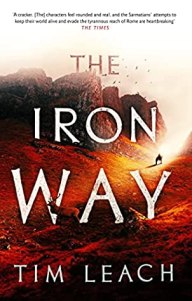
 About the Book
In the hard, unforgiving land at the northernmost point of the Roman Empire lies a great wall. Once, the edge had been but a thing of thought and dreams, but one day the great Emperor from across the water had grown tired of borders made from thoughts and dreams. So, a wall was raised from the earth at his command. From afar, it looked invincible.
Yet every wall has its weaknesses – if one looks close enough.
In its shadow, gather five thousand fearsome soldiers. Men bred to fight and kill. The Sarmatians have suffered capture and defeat, but under a new command they are prepared to fight again.
For of the other side of the wall there are rumours. Of men closer to giants, of warriors who fight without fear or restraint. And the Sarmatians are called to defend against them.
To stand and fight, to die for Rome.
Format: Hardback (320 pages) Publisher: Head of Zeus
Publication date: 4th August 2022 Genre: Historical Fiction
Find The Iron Way on Goodreads
Pre-order/Purchase links
Bookshop.org
Disclosure: If you buy a book via the above link, I may earn a commission from Bookshop.org, whose fees support independent bookshops
Hive | Amazon UK
Links provided for convenience only, not as part of an affiliate programme
My Review
I really enjoyed Tim Leach’s The Last King of Lydia when I read it way back in 2013 and I loved The Smile of the Wolf, published in 2018, which I reviewed as part of the blog tour. Therefore I have no idea how I missed the fact he had a new series on the way – The Sarmatian Trilogy – or the publication of the first book, A Winter War, in September last year. The Iron Way is the second book in the trilogy, set in 2nd century Britain. It can definitely be read without having read the first book – as I did – however, although there are references to events in the first book, I felt I missed out by not knowing more of the back stories of the main characters. (Reader, I may just have ‘happened’ to be in Waterstones yesterday and found myself at the till with a copy of A Winter War.)
I confess I had never heard of the Sarmatians before reading this book but it seems I can be forgiven because in his Historical Note the author reveals that very little is known for certain about them. A nomadic, warlike people, they left no written records and minimal archaeological evidence. However, the events in the first book – their defeat by the Romans and a peace settlement the terms of which saw thousands of their warriors sent to the north of Britain – are based on fact.
The book focuses on one band of Sarmatians, made up of five hundred warriors, under their Roman commander, Lucius, who as a result of previous events has become a sort of ‘honorary’ Sarmatian. He’s described at one point as having the soul of a Sarmatian locked in a Roman body. Bound by an oath to serve as part of the Roman army for twenty-five years, the Sarmatians find themselves guarding one of the forts along Hadrian’s Wall against the threat of attack from tribes to the north. It’s not where they want to be. They pine for the wide open spaces of their homeland, ‘the long grass dancing with the wind, the wildflowers shining under the sun, the world open before them beneath an endless sky’. Instead they find themselves confined to the settlement around the fort, in the shadow of Hadrian’s Wall. ‘They saw their prison, the chain of stone that bound them, the symbol of a shameful defeat.’
The author gives the reader a fascinating insight into the Sarmatian people. What we learn is that they are bound together not just by ties of kinship but by sacred oaths and the belief that to die in battle is glorious. Their philosophy? ‘Given the choice between two paths, between safety and danger, one must always go toward sword and spear, and choose the iron way.’ And that’s not just the men because the Sarmatian women are warriors too.
The story is told from the point of view of three main characters – Lucius, his Sarmatian comrade Kai and Arite, the wife of Kai’s former friend. None of them is where they want to be. Lucius recognises his posting to the Wall is a sign of his fall from grace. And he soon discovers he is pawn in the hands of powerful and ambitious men. Kai longs to return to his homeland and see his daughter once again. Arite finds herself unable to use her skills as a warrior, consigned instead to a life of household drudgery. The frustration felt by the Sarmatians creates an atmosphere of extreme tension. Unused to the discipline of a Roman army, there are drunken brawls and petty rivalries.
There are some terrific action scenes that put the reader in the heart of the battle and reveal some quite remarkable aspects of the Sarmatians as a fighting force. But the writing throughout flows beautifully giving a real insight into the thoughts and feelings of a people quite different from ourselves – or at least those of us who don’t gallop across the steppes on huge heavily armoured horses trained to kill.
Having endured one betrayal, the end of the book sees Lucius come to the realisation that what lies ahead for the Sarmatians is a conflict not of their own making but one driven by the personal ambition of others.
I thought The Iron Way was brilliant. Its blend of fascinating historical detail, absorbing storyline, interesting characters and full-on action made it a thoroughly engrossing read. Roll on book three.
My thanks to Head of Zeus for my digital review copy via NetGalley.
In three words: Compelling, pacy, immersive
Try something similar: The Capsarius by Simon Turney
 About the Author
Tim Leach is a graduate of the Warwick Writing Programme, where he now teaches as an Assistant Professor. His first novel, The Last King of Lydia, was shortlisted for the Dylan Thomas Prize. (Photo credit: Emma Leach)
Connect with Tim
Website | Twitter

 About the Book
 About the Author
 What Cathy Read Next...