
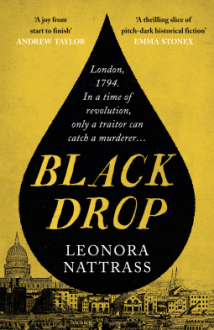
 About the Book
This is the confession of Laurence Jago. Clerk. Gentleman. Reluctant spy.
July 1794, and the streets of London are filled with rumours of revolution. Political radical Thomas Hardy is to go on trial for treason, the war against the French is not going in Britain’s favour, and negotiations with the independent American colonies are on a knife edge.
Laurence Jago – clerk to the Foreign Office – is ever more reliant on the Black Drop to ease his nightmares. A highly sensitive letter has been leaked to the press, which may lead to the destruction of the British Army, and Laurence is a suspect. Then he discovers the body of a fellow clerk, supposedly a suicide.
Blame for the leak is shifted to the dead man, but even as the body is taken to the anatomists, Laurence is certain both of his friend’s innocence, and that he was murdered. But after years of hiding his own secrets from his powerful employers, and at a time when even the slightest hint of treason can lead to the gallows, how can Laurence find the true culprit without incriminating himself?
Format: Hardcover (352 pages) Publisher: Viper
Publication date: 14th October 2021 Genre: Historical Fiction, Crime
Find Black Drop on Goodreads
Purchase links
Bookshop.org
Disclosure: If you buy a book via the above link, I may earn a commission from Bookshop.org, whose fees support independent bookshops
Hive | Amazon UK
Links provided for convenience only, not as part of an affiliate programme
My Review
Black Drop makes use of that favourite device of authors – a diary or letters in which a character gives a first-hand account of events they have witnessed. In this case, it’s the written confession of Laurence Jago, a clerk at the Foreign Office (who obviously has a remarkable ability to recall conversations verbatim).
The suicide of his friend, which Laurence quickly becomes convinced is actually murder, is just the first in a series of grisly deaths. However, perhaps these are in keeping with a period in which many of the populace’s idea of entertainment is pelting muck at the unfortunate occupants of the pillory, watching the hanging of some poor individual, visiting a museum displaying specimens of human anatomy or viewing an exhibition of grisly waxworks. From this will you gather that Black Drop simply oozes – sometimes quite literally – atmosphere. As Laurence notes ‘The city is excessively rough, and there are pimps and whores and thieves everywhere, with an unwholesome interest in your pockets.’ Not to mention dark alleys and unspeakable substances thrown from windows into the streets below.
Laurence’s increasingly confused view of events is not helped by his growing reliance on the ‘black drop’ of the title, a concoction liberally laced with laudanum, which at times makes it difficult for him to discern what is real and what is imagined. In fact, he starts off on something with the innocent sounding name of Godfrey’s Cordial until he is persuaded by an apothecary that he should try the stronger Kendal’s Black Drop. ‘Tis a hearty medicine’ says the apothecary proudly.
Laurence becomes convinced he knows the identity of the person responsible for his friend’s murder and those that follow. But is that person too obvious a candidate or is the author building up to an audacious double bluff? You’ll have to read the book to find out. If I’m honest, one of the characters who plays a significant role in the plot felt a little under-developed; I really couldn’t picture them in my mind’s eye from the description provided. However, I accept this may have been deliberate on the author’s part to maintain an element of mystery about them. My favourite character – apart from Laurence’s dog, Mr Gibbs – was the irrepressible William Philpott, journalist and newspaper editor. He proves a good friend to Laurence and, although I may be mistaken, I wonder if there could be more of their partnership to come?
I’ll confess I knew little detail about the political situation in England at the time of the French Revolution or the attitude of the Government towards it so the author’s Historical Note at the end of the book was extremely useful for putting this into context, and for distinguishing between the real and fictional characters who appear in the book.
Black Drop is an engaging historical mystery with a plot that has plenty of twists and turns, all set against the backdrop of a time of political unrest and growing calls for societal change.
I received an advance review copy courtesy of Viper Books via NetGalley.
In three words: Intriguing, atmospheric, suspenseful
Try something similar: Rags of Time by Michael Ward
Follow this blog via Bloglovin
 About the Author
Leonora Nattrass studied eighteenth-century literature and politics, and spent ten years lecturing in English and publishing works on William Cobbett. She then moved to Cornwall, where she lives in a seventeenth-century house with seventeenth-century draughts, and spins the fleeces of her traditional Ryeland sheep into yarn. Black Drop is her first novel. (Photo/bio credit: Author website)
Connect with Leonora
Website | Twitter

 About the Book
 About the Author
 What Cathy Read Next...