
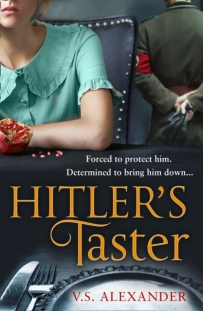
#BookReview Hitler’s Taster by V. S. Alexander @AvonBooksUK 

Hitler's TasterAbout the Book

Forced to protect him. Determined to bring him down…

Germany, 1943. Magda Ritter longs for a peaceful life. But war is drawing closer, and soon she is forced to serve the one man she hoped never to encounter – Hitler.

Taken to his mountain retreat, she is assigned the most dangerous job of all. She is to be the Führer’s ‘taster’ and check his food for poison. Desperate to escape, Magda joins an underground resistance group intent on ending Nazi rule.

To stop the atrocities around her, Madga must risk everything – her position, her family, and even her life.

Format: Paperback (400 pages)  Publisher: Avon Books
Publication date: 3rd May 2018 Genre: Historical Fiction

Find Hitler’s Taster on Goodreads

Purchase links
Bookshop.org
Disclosure: If you buy a book via the above link, I may earn a commission from Bookshop.org, whose fees support independent bookshops

Hive | Amazon UK
Links provided for convenience only, not as part of an affiliate programme


My Review

Her Hidden LifeI’ve been attempting to continue the good work started whe I took part in NetGalley November by reading some of the older books on my NetGalley To-Read shelf. Hitler’s Taster is one of those having been on my shelf for so long that it was originally published as Her Hidden Life.

Hitler’s Taster is described as ‘a poignant tale of hope, danger and betrayal from the heart of history’s darkest moments’. The fact that Hitler employed a number of women to taste his food for fear of poison was a surprise to me, although not that he was paranoid enough to do so or that he was willing to have others die instead of him. After all, many millions did as a result of his actions.

Having arrived at Berghof, Hitler’s mountain retreat, Magda quickly forms a relationship with Captain Karl Weber, an SS officer in charge of security in the kitchen where she and the other tasters perform their duties. From Karl she learns about the realities of the Nazi regime – the persecution of Jews and other minorities, the concentration camps and countless other atrocities. This is information which, for propaganda purposes, is being kept hidden from the German population, as is the truth about how badly things are really going in the war. Magda realises that not all Germans support Hitler’s regime, even within the ranks of his own army.

It was interesting to get a ‘behind the scenes’ look at what it was like to be close to the Führer and the rather bizarre nature of life in his household. At one point, Magda is invited to take tea and his favourite apple cake with Adolf Hitler, there are dances organised and showings of films such as Gone With The Wind for those stationed at Berghof. As she observes, ‘We were trapped in a make-believe world propagated by the Reich while all around us battles were being fought, troops slaughtered and innocents butchered’.

On a brief trip to Berlin to visit her family Magda discovers the reality of what ordinary Germans are experiencing: food shortages, nightly bombing raids, buildings reduced to rubble, hospitals overwhelmed by the injured and the dying. It’s this, along with other events, that makes her determined that Hitler must die. She fantasises about the ways she personally might achieve this. Some are rather outlandish, others are no doubt similar to those being considered by the Allies. However, all of them are likely to end in her own demise.

At this point in the book, any notion the focus will mainly be on Magda and Karl’s relationship is rudely shattered as the story gets progressively darker with Magda experiencing first-hand the worst aspects of the Nazi regime. If anything, it becomes darker still including nightmare scenes as the soldiers of the Red Army overrun Berlin and take their revenge on German citizens.   Students of history will know how Hitler’s reign of terror ends but perhaps cannot quite imagine what it would have been like to witness it in person.

Hitler’s Taster surprised me. It took a direction I was not expecting with some scenes that were distressing to read, not least of which because they depict things that happened in real life to real people. In fact, no doubt those real life experiences were worse than described in the book. I don’t think any of us would disagree with the author when he writes in his afterword, ‘Another global war would surely lead to annihilation; therefore, we must maintain a constant vigil against those who would use their power to destroy’.

I received a review copy courtesy of Avon Books via NetGalley.

In three words: Dramatic, emotional, intense

Try something similarPeople Like Us by Louise Fein

Follow this blog via Bloglovin


V S AlexanderAbout the Author

V. S. Alexander is an ardent student of history and the arts and loves writing historical fiction with strong women protagonists. The author of several novels and short stories, Alexander’s first novel was The Magdalen Girls, an Amazon best seller, set in 1962 Dublin. Her Hidden Life is V. S. Alexander’s second book. The author lives in South Florida where summer is never far away. (Photo: Goodreads author page)

Connect with V. S. Alexander
Goodreads | Twitter

Hitler's Taster

#BookReview The Alphabet of Heart’s Desire by Brian Keaney @hhousebooks

The Alphabet of Heart's DesireAbout the Book

In 1802 Thomas de Quincey, a young man from a comfortable middle-class background who would go on to become one of the most celebrated writers of his day, collapsed on Oxford Street and was discovered by a teenage prostitute who brought him back to her room and nursed him to health.

It was the beginning of a relationship that would introduce Thomas to a world just below the surface of London’s polite society, where pleasure was a tradeable commodity and opium could seem the only relief from poverty. Yet it is also a world where love might blossom, and goodness survive.

The lives of a street girl, an aspiring writer, and a freed slave cross and re-cross the slums of London in this novel about the birth of passion, the burden of addiction, and the consolations of literature.

Format: Paperback (392 pages)              Publisher: Holland House
Publication date: 16th November 2017 Genre: Historical Fiction

Find The Alphabet of Heart’s Desire on Goodreads

Purchase links
Bookshop.org
Disclosure: If you buy a book via the above link, I may earn a commission from Bookshop.org, whose fees support independent bookshops

Hive | Amazon UK
Links provided for convenience only, not as part of an affiliate programme


My Review

I’ve been attempting to continue the good work started through taking part in NetGalley November by reading some of the older books on my NetGalley To-Read shelf. The Alphabet of Heart’s Desire is one of those, having been on my shelf for, um… quite a few years.

Set in Georgian London, the book follows the lives of three people: Anne, a young woman forced into prostitution in order to escape a violent stepfather; Tuah, captured by Dutch slavers and brought to England by the captain of a trading ship; and aspiring writer, Thomas De Quincey.  Their parallel stories are told in alternating chapters, in the first person in the case of Anne and Tuah, and in the third person in the case of Thomas.

Thomas comes across as naïve and something of a dreamer, creating imaginary worlds in which everyday practicalities do not exist. As Anne later observes, ‘He looked at the world but all he ever saw was his own strange thoughts’. In fact, imaginary worlds are something of a theme of the book. For example, Anne, focussing on a stain on the ceiling of her dingy room, imagines herself on a ship travelling the seas to distract herself whilst servicing customers. Meanwhile, Tuah has dreams in which he is back on the island of his birth, an island he doesn’t even know the name or location of. At other times, he loses himself in books.

For much of the book, the lives of Thomas, Anne and Tuah unfold quite separately with only the occasional ‘near miss’ or the revealing of a shared acquaintance with a third party. Gradually, their lives begin to interconnect more significantly. One connection between them is opium. The naval captain who brought Tuah to London was involved in the opium trade whilst Anne and Thomas both become consumers of the drug in the form of laudanum. For Anne, initially this is to relieve physical pain but increasingly it becomes a refuge, a way to distance herself from what she is forced to endure. For Thomas, it’s a way to escape the harsh realities of his existence which has left him homeless and penniless. However, as Thomas discovers, excessive use of the drug can unearth nightmarish memories.

Although I thought Thomas and Tuah were wonderful characters, my favourite was Anne. I loved her fortitude and determination, despite all the disappointments and obstacles thrown in her way. ‘I would find a ledge to stand on and keep standing there, whatever winds might buffet, whatever rain might fall.’ I also liked the distinctive, spirited voice the author created for her, describing her first client as ‘a great fat, red-faced gundiguts with lips as thick as rope and eyes like a pig’.  Having fallen so low herself, she offers Thomas a lifeline just when he needs it most and is rewarded with the prospect of a different future.

I loved the way the author created a vivid picture of the London of the period: its sights, sounds… and smells. With the eyes and ears of a newcomer, Tuah likens the hubbub of the city to bees at work in a giant hive. ‘A great welter of human voices and animal cries all mixed up with the trundling of cart wheels, the grinding of stone, the hammering of metal, the banging of timber and the mighty creaking and groaning of all those buildings as the restless population swarmed back and forth in their constant frenzy of activity.’ Or how about this description of London in the heat of June: ‘The nights were sticky, full of the smells of the city: beer and dung, smoke and tallow, meat and tar, bread and grease, blood and fish and, hanging over everything, the great stink of the river’.  

I had heard of Thomas De Quincey but knew little about his life and, although The Alphabet of Heart’s Desire is fiction, much of it is based on known facts, as the author’s historical note explains.  Anne existed in real life too although she quickly disappears from the historical record. So, as well as the author’s own imagining of how things may have played out for her, there’s also space for the reader to reach their own conclusion.

The Alphabet of Heart’s Desire is a wonderfully imagined story that blends fact and fiction, and positively oozes period atmosphere. I received a review copy courtesy of Holland House via NetGalley and am only  sorry it’s taken me this long to get around to reading it.

In three words: Immersive, atmospheric, enthralling

Try something similar: Blackberry & Wild Rose by Sonia Velton

Follow this blog via Bloglovin


Brian KeaneyAbout the Author

Brian Keaney is an award-winning author, best known for his young adult and children’s fantasy novels Jacob’s Ladder, The Hollow People and The Magical Detectives. For a number of years he was Royal Literary Fund Fellow at Goldsmiths College and at the London College Of Fashion and he taught creative writing on the Pembroke College Cambridge summer programme.

He has a house in the west of Ireland where he spends as much time as possible. His writing has been translated into twenty languages. (Photo: Author website)

Connect with Brian
Website | Twitter | Goodreads