
 About the Book
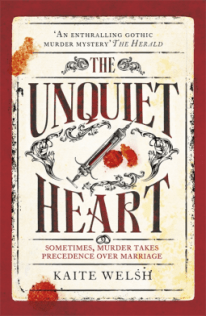
Sarah Gilchrist has no intention of marrying her dull fiancé Miles, the man her family hope will restore her reputation and put an end to her dreams of becoming a doctor, but when he is arrested for a murder she is sure he didn’t commit she finds herself his reluctant ally.
Beneath the genteel façade of upper class Edinburgh lurks blackmail, adultery, poison and madness, and Sarah must return to Edinburgh’s slums, back alleys and asylums as she discovers the dark past about a family where no one is what they seem, even Miles himself.
It also brings her back into the orbit of her mercurial professor, Gregory Merchiston – he sees Sarah as his protegee, but can he stave off his demons long enough to teach her the skills that will save her life?
Format: Hardcover (288 pages) Publisher: Tinder Press
Publication date: 30th May 2019 Genre: Historical Fiction, Mystery, Crime
Find The Unquiet Heart (Sarah Gilchrist #2) on Goodreads
Purchase links
Bookshop.org
Disclosure: If you buy a book via the above link, I may earn a commission from Bookshop.org, whose fees support independent bookshops
Hive | Amazon UK
Links provided for convenience only, not as part of an affiliate programme
My Review
The Unquiet Heart is the second in the author’s historical mystery series featuring medical student turned detective, Sarah Gilchrist. Like its predecessor, The Wages of Sin, it is set in Victorian Edinburgh. There are some references to events and characters in the previous book but it would be possible to read The Unquiet Heart as a standalone.
Sarah Gilchrist continues to resist the expectations of her family – and of society – that she will marry and give up her ambition to qualify as a doctor. She frequently rails against the restrictions placed upon her as a woman. ‘I’m sick of being told that women are weak – too weak for surgery, too weak for intellectual thought.’ And she is roused to anger by the double standards that mean, had she been a man, her medical studies would be ‘the object of praise rather than disgust’. Added to this is the unfairness that, because of previous traumatic events, she is considered ‘damaged goods’, including by her family, even though the damage in question was not of her own making and has had lasting consequences.
Despite a number of suspicious deaths early on, the pace of the book is a little on the slow side for those interested mainly in the mystery element. In addition, for a lot of the time the action moves largely between the houses of Sarah’s friend, Elizabeth Chalmers, her aunt Emily and the University where Sarah attends lectures, meaning it’s only later in the book that one gets a glimpse of the seamier side of Edinburgh. I would have liked a bit more of the latter, to be honest.
However, readers like me who were intrigued by the relationship between Sarah and Professor Gregory Merchiston that featured in the first book will enjoy the simmering sexual tension between them that continues in this one. But will it ignite into a conflagration or fizzle out? And are they destined to remain merely pupil and tutor?
Despite the prejudice displayed by others, Merchiston is willing to introduce Sarah to the techniques of forensic medicine, even if this does demand a strong stomach. “Our bodies tell stories, Miss Gilchrist. The language may be foreign to most but learn to translate it and you will be privy to all the secrets of our species, living or dead.” By the way, I think we really need to learn more about how Merchiston’s housekeeper, Mrs Logan, came to be, in her words, ‘in a music hall dressing room stripped down to my unmentionables armed with nothing but a prop knife’.
By the end of the book, Sarah seems faced with a choice between marriage to a wealthy if unremarkable man and the end of her medical career before it’s even begun, or a less socially acceptable relationship with a man who will preserve, even actively encourage, her ambitions. Unfortunately the latter is also likely to cause a potentially irreconcilable breach with her mother. But are those the only choices available to Sarah?
I received a review copy courtesy of Headline via NetGalley.
In three words: Well-crafted, engaging, intriguing
Try something similar: A Corruption of Blood by Ambrose Parry
Follow this blog via Bloglovin
 About the Author
Kaite Welsh is an author, critic and journalist and the former Literature Officer at Creative Scotland. Her work has appeared in various newspapers and magazines from The Times Literary Supplement to Cosmopolitan. Her short fiction, featuring roller derby, Greek myths and ghosts, has been published in several anthologies and she guest lectures on Creative Writing at universities around the UK. She is the author of the Sarah Gilchrist series, and lives in Edinburgh with her wife, cats and a lot of books (Bio/photo: Agent author page)
Connect with Kaite
Website | Twitter | Goodreads | Instagram

 About the Book
 About the Author
 What Cathy Read Next...