#BlogTour #BookReview The Language of Food by Annabel Abbs @RandomTTours @SimonSchusterUK

The Language of Food BT Poster

Welcome to today’s stop on the blog tour for The Language of Food by Annabel Abbs. My thanks to Anne at Random Things Tours for inviting me to take part in the tour and to Simon & Schuster for my advance reader copy. Do be sure to check out the posts by my tour buddies for today, Mia at Paradise is a Library and Emma at Biblio Treasures.
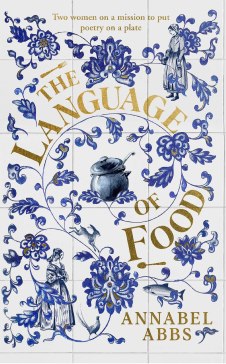

The Language of Food CoverAbout the Book

Eliza Acton is a poet who’s never boiled an egg. But she’s about to break the mould of traditional cookbooks. And change the course of cookery writing forever.

England 1835. Eliza Acton is a poet who dreams of seeing her words in print. But when she takes a new manuscript to a publisher, she’s told that ‘poetry is not the business of a lady.’ Instead, she’s asked to write a cookery book.

Eliza is horrified but her financial situation leaves her no choice. Although she’s never cooked before, she is determined to learn and to discover, if she can, the poetry in recipe writing. To assist her, she hires seventeen-year-old Ann Kirby, the daughter of local paupers. Over the next ten years, Eliza and Ann change the course of cookery writing forever

Format: Hardcover (416 pages)         Publisher: Simon & Schuster
Publication date: 3rd February 2022 Genre: Historical Fiction

Find The Language of Food on Goodreads

Purchase links
Bookshop.org
Disclosure: If you buy a book via the above link, I may earn a commission from Bookshop.org, whose fees support independent bookshops

Hive | Amazon UK
Links provided for convenience only, not as part of an affiliate programme


My Review

The Language of Food is definitely a book for food lovers, perhaps best consumed with a plate of spiced biscuits to hand. It is lavishly sprinkled with descriptions of dishes of all kinds, some of the ingredients being surprisingly exotic – the huge range of different spices, for example – and the pairings of fish and meat with citrus and other fruit quite unusual.  The range of game and meat used was also surprising, although some of it didn’t sound that appetising to me and I can’t say I’d ever imagined a recipe which included the ingredient swan’s eggs.  The inclusion of a selection of Eliza’s recipes at the end of the book is a nice touch although I don’t think I’ll be attempting her ‘Tonbridge Brawn’ any time soon.

Although there is plenty of historical evidence around which to construct the life of Eliza Acton – albeit with a few elements open to speculation – there is little known about her assistant, Ann Kirby.  The author has therefore used her imagination to create a backstory for Ann which I found extremely affecting, if anything more so than Eliza’s.  Ann’s family situation is one of extreme poverty and deprivation. Although some of her actions may seem naive, I think it showed how those who expect nothing often get nothing and are open to manipulation by those with ulterior motives. The appalling treatment of Ann’s mother was sickening but unfortunately all too reflective of attitudes towards mental illness at the time. (My ‘Try something similar’ suggestion below reflects this element.)

For me, Ann’s story only emphasised the gulf between her situation and Eliza’s. Although Eliza finds herself, as an unmarried woman, facing a lack of independence and the inability to express her creativity, her experience is nothing compared to that of Ann. This is another reason why I felt more sympathy for Ann. Indeed, I found it difficult to understand why Eliza made so little effort to enquire into Ann’s circumstances and, even when she did find out, contemplated making it the basis of a play seemingly unconcerned about how Ann might feel about the ‘plundering’ of her story, even if with the best of intentions. Indeed, Eliza shows how out of touch she and others of her social class are from the realities of life for the poor when on a visit to Ann’s home she notes, ‘I expected a cottage, with chickens scratching in a small but well-tended vegetable garden, perhaps a munching goat, a decent window at the very least’. Poetic idyll confronts real life, if you will. And, however much Eliza might have been a pioneer of cookery writing – and I’m sure she was – I found the juxtaposition of the lavish ingredients used in Eliza’s recipes with the reliance of Ann and her father on thin gruel and nubs of bread for sustenance rather difficult to stomach (if you’ll pardon the pun).

Although for me, it was a little overshadowed by the emotional power of Ann’s story, The Language of Food is a meticulous account of the life of a woman who transformed the way people wrote about and thought about food. It’s clear Eliza Acton anticipated many of the trends we see today such as a focus on seasonality, the reduction of food waste and an emphasis on healthy nutritious home-cooked food.

In three words: Well-researched, absorbing, illuminating

Try something similar: The Hidden Child by Louise Fein

Follow this blog via Bloglovin
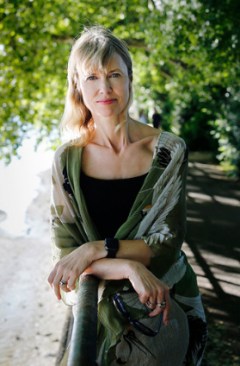

Annabel Abbs Author PicAbout the Author

Annabel Abbs is the rising star of biographical historical novels. She grew up in Bristol, Sussex and Wales before studying English Literature at the University of East Anglia. Her debut novel The Joyce Girl won the Impress Prize and was a Guardian Reader’s Pick and her second novel Frieda: The Original Lady Chatterley was a Times 2018 Book of the Year. She regularly appears on national and regional media, with recent appearances on Radio 4 Woman’s Hour and Sky News, and is popular on the literary festival circuit. She was longlisted for the Bath Novel Award, the Caledonia Novel Award and the Waverton GoodRead Award. Annabel lives in London with her husband and four children.

Abbs’s third novel, The Language of Food, the story of Eliza Acton, Britain’s first domestic goddess, publishes in the UK in February 2022 and is currently being translated into 14 languages.

Connect with Annabel
Website | Twitter | Facebook
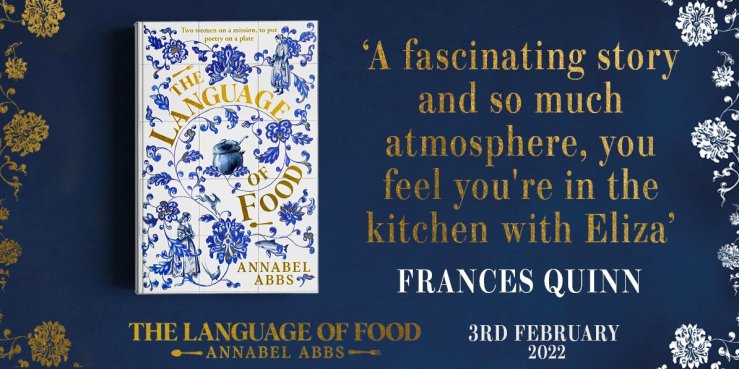
Language of Food Graphic3

#BookReview The Silver Wolf by J. C. Harvey @AllenAndUnwinUK @ReadersFirst1

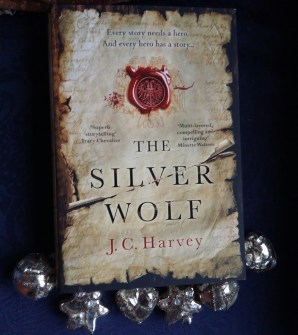
The Silver WolfAbout the Book

The extraordinarily rich, dark, panoramic tale of an orphaned boy’s quest for truth and then for vengeance as war rages across 17th-century Europe.

Amidst the chaos of the Thirty Years’ War, Jack Fiskardo embarks upon a quest that will carry him inexorably from France to Amsterdam and then onto the battlefields of Germany. As he grows to manhood will he be able to unravel the mystery of his father’s death? Or will his father’s killers find him first?

Format: Hardback (560 pages)          Publisher: Allen & Unwin
Publication date: 3rd February 2022 Genre: Historical Fiction

Find The Silver Wolf on Goodreads

Purchase links
Bookshop.org
Disclosure: If you buy a book via the above link, I may earn a commission from Bookshop.org, whose fees support independent bookshops

Hive | Amazon UK
Links provided for convenience only, not as part of an affiliate programme


My Review

The Silver Wolf is the first book in a planned trilogy featuring the feisty and resourceful Jack Fiskardo. He’s on a mission of vengeance and, as soon becomes apparent, it’s best not to get in his way. For those like me who’ve heard of the Thirty Years War but must have been asleep the day it was covered in their history class, the author provides a useful introduction to the political situation at the time. And, joy of joys, there’s a map as well showing Europe looking very different from the way it does today.

At first I wasn’t sure about the non-chronological structure of the book, which is divided into three parts, but it soon made sense. It’s May 1619 when the reader is first introduced to Jack. He’s a waif and stray, alone in the world but evidently capable of looking after himself if needed.  In part two, the reader is taken back in time, finding out more about Jack’s childhood and the events that shaped him. These include the origin of his proficiency with a sword or knife, and his natural horsemanship. We also learn about the events that will fuel his relentless quest for revenge, a quest that will take him across the war-torn continent of Europe.

There’s a picaresque quality to the novel with Jack encountering many colourful characters during his adventures. Some of my favourites were tavern owner Magda and her partner Paola, or to address her by her full name, Paola di Benedetta di Silvia. ‘Woman soldier. Hippolyte. Battle-bitch. Freak.’ An elite swordswoman herself, Paola plays an important role in honing Jack’s swordsmanship, building on the natural talent that is already evident. She provides him with some life lessons as well.

The Silver Wolf positively oozes period atmosphere such as this description of the cosmopolitan clientele of The Carpenter’s Hat inn. ‘As they make their way across the room the two men pass a game of dice, another of backgammon, a dinner-party of Venetian merchants crooning madrigals a cappella, a pedlar attempting to sell the dinner-party a tiny trembling monkey in a tasselled bolero’ as well as the innkeeper’s daughter with her ‘face bright with fiery rouge’ and ‘breasts bared almost to the nipple’.

The third and final part of the book, set between the years 1623 and 1630, picks up the story from the end of part one. Having attached himself to a company in the army of General Tilly, commander of the Catholic League’s forces, Jack has his first experience of battle, and a bloody business it is too. The author conjures up the sights and sounds of the battlefield through the eyes of army sutler (victualler), Cyrius.

‘Nothing of it is as he had expected…. These roiling clouds of grey and white. These whirling clots and straggling lines of men. The appalling lightning-like flashes in the smoke. The riderless horses, seeming in their terror not even to know to put the battlefield behind them. The cannon, there on the bald rise, hurling their shot overhead; the crowd at the battlefield’s edge, God above, as if this was a prize-fight at a fair; and all about him, everywhere, this terrible noise, which is both one sound and has somehow distinguishable within it every scream and detonation of which it is made up… This is hell, Cyrius thinks. This is what it sounds like down in hell.’

In the years that follow, Jack’s prowess on the battlefield, in hand-to-hand combat and his seeming invincibility earn him a fearsome reputation as a so-called ‘hard out man’, marked by the silver pendant he wears around his neck. The desire to avenge his father spurs him on, determined that nothing or no-one will stop him, even if it takes years. He has a job to do and, have no doubt, he’s going to do it.

The Silver Wolf is a rip-roaring adventure story with a fabulous central character who, with his facility for getting himself out of tight spots, is a sort of 17th century James Bond. The book is jam-packed with historical detail, has some lively touches of humour and a compelling plot. At over 500 pages, it’s a chunky read but well worth the time investment as far as I’m concerned. I shall be eagerly awaiting the next instalment, an extract from which is included at the end of the book and which has the brilliant first line ‘Now – where were we?’

I received an advance reader copy courtesy of Allen & Unwin via Readers First.

In three words: Action-packed, lively, dramatic

Try something similar: Master of War by David Gilman

Follow this blog via Bloglovin


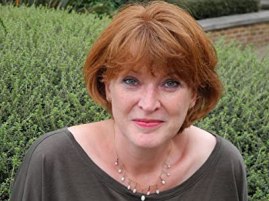
Jacky Colliss HarveyAbout the Author

J. C. Harvey is the fiction pen-name for best-selling non-fiction author Jacky Colliss Harvey. After studying English at Cambridge, and History of Art at the Courtauld Institute of Art, Jacky worked in museum publishing for twenty years, first at the National Portrait Gallery and then at the Royal Collection Trust, where she set up the Trust’s first commercial publishing programme.

The extraordinary history of the Thirty Years War (1618-48) and of 17th-century Europe has been an obsession of hers for as long as she can remember, and was the inspiration behind the Fiskardo’s War series, which begins now with The Silver Wolf, marking her fiction debut.

Connect with Jacky
Twitter