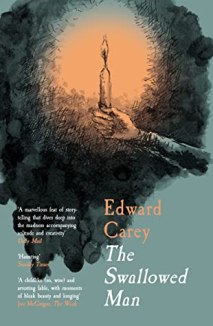
#BookReview The Swallowed Man by Edward Carey @BelgraviaB

The Swallowed ManAbout the Book

‘I am writing this account, in another man’s book, by candlelight, inside the belly of a fish. I have been eaten. I have been eaten, yet I am living still.’

Trapped inside a giant sea beast with only the contents of the swallowed schooner Maria to sustain him, Geppetto yearns for the wooden boy he created out of greed but came to cherish as a son. The ship provides materials for the carpenter to make art in memory of Pinocchio and the other loves of his life. But the candles are running out, and the mind can only survive for so long without company.

Drawing upon the classic Pinocchio story while creating something entirely his own, Carey tells an unforgettable tale of fatherly love and loss, of pride and regret, and of the sustaining power of art and imagination.

Format: Paperback (176 pages)   Publisher: Gallic Books
Publication date: 4th April 2022 Genre: Fantasy

Find The Swallowed Man on Goodreads

Purchase links
Bookshop.org
Disclosure: If you buy a book via the above link, I may earn a commission from Bookshop.org, whose fees support independent bookshops

Hive | Amazon UK
Links provided for convenience only, not as part of an affiliate programme


My Review

I was first introduced to Edward Carey’s quirky and inventive writing when I read his historical novel, Little at the end of last year. It quickly found a place on the list of my favourite books of 2021.

The Swallowed Man is the author’s retelling of the story of Pinocchio, the wooden boy created by the carpenter Geppetto who comes to life. In the author’s version, Pinocchio (a rather recalcitrant child it has to be said) is shunned by the local people because he is different. They call him a heathen, unholy, the Devil’s work. Geppetto is told, ‘He was not one of us, you do see that?’

Geppetto’s imprisonment within the belly of the fish gives him time for reflection. He recalls the many disappointments in his life but more than anything he mourns the loss of Pinocchio, berating himself for having viewed him initially as just proof of his own skill or as a means of making money. ‘And I own it: I was expecting not just a boy, but a fortune. I was wishing not just for family but for fame…’ Now that it is too late to rectify his mistakes, he reflects sadly ‘My past and present are not friends’.  I don’t think it’s necessary to believe, as Geppetto does, that Pinocchio was a living boy in order to feel sympathy for his loss. Any parent mourning a lost child I’m sure would identify with Geppetto’s observation, ‘He cannot grow, my boy… Not like all the others. Wherever he is, he stays as he is’.

I was struck by the idea of Geppetto’s confinement inside the great fish being a metaphor for lockdown. For example, he welcomes the objects he receives in the ‘post’ (random items which have been swallowed by the fish) and passes the time on projects such as painting, carving and, of course, writing in his journal, the former logbook of the captain of the Maria.  As time goes by his solitary existence brings on a kind of madness; he starts to have disturbing visions and even comes to believe someone is writing in his journal.  The epilogue provides yet another pandemic parallel as a community is forced to exclude themselves ‘for a time, from the rest of humanity’ in order to prevent the spread of a contagion.

The book’s short sentences give the impression that we are privy to Geppetto’s random thoughts and to phrases he’s trying out in his head, sometimes playfully. For instance, with no way to rid himself of the awful stink of the fish’s insides, he considers rechristening himself ‘Josephus Odorous. Joey ‘The Kipper’ Lorenzini. Putrefaction ‘Petto’. There are other brilliant touches of humor such as when Geppetto recalls purchasing his first wig and explaining euphemistically – much to the wigmaker’s confusion – that ‘The garden atop me has gone barren’, ‘I wilt in the north’ and ‘I have been abandoned, hairly’.  And as always with one of Edward Carey’s books, there are wonderful illustrations and lovely little touches such as smudge marks on some of the pages suggesting ink blots or drops of candle wax.

The Swallowed Man is a delightfully bizarre gem of a book. I thoroughly enjoyed it. (In fact, I’ve yet to read a book published by Gallic Books that I haven’t enjoyed.)

I received an advance review copy courtesy of Isabelle at Gallic Books.

In three words: Touching, witty, inventive

Follow this blog via Bloglovin


Edward Carey NewAbout the Author

Edward Carey is a novelist, visual artist and playwright. He is the author of three acclaimed novels, Observatory Mansions, Alva and Irva and Little.

Born in England, he teaches at the University of Texas in Austin. (Photo: Publisher author page)

Connect with Edward
Website | Twitter | Facebook | Instagram

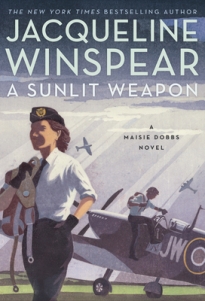
#BookReview A Sunlit Weapon by Jacqueline Winspear @AllisonandBusby

A Sunlit WeaponAbout the Book

October 1942. Jo Hardy, an Air Transport Auxilliary ferry pilot, is delivering a Spitfire to Biggin Hill Aerodrome, when she has the terrifying experience of coming under fire from the ground. In a bid to find out who was trying to take down her aircraft, she returns on foot to the area, and discovers an African American soldier bound and gagged in an old barn. A few days later another ferry pilot crashes and is killed in the same area of Kent.

Although the death has been attributed to ‘pilot error’ Jo believes there is a connection between all three events – and she wants desperately to help the soldier, who is now in the custody of American military police. Jo is advised to take her suspicions to Maisie Dobbs.

As the psychologist-investigator delves into the case, she discovers the attempt to take down ferry pilots and the plight of the black American soldier are inextricably linked with the visit to Britain by the First Lady of the United States, Eleanor Roosevelt. Maisie must work with speed to uncover the depth of connection, to save the life of the President’s wife and a soldier caught in the crosshairs of those who would see them both dead.

Format: Hardback (320 pages)         Publisher: Allison & Busby
Publication date: 22nd March 2022 Genre: Historical Fiction, Crime, Mystery

Find A Sunlit Weapon on Goodreads

Purchase links
Bookshop.org
Disclosure: If you buy a book via the above link, I may earn a commission from Bookshop.org, whose fees support independent bookshops

Hive | Amazon UK
Links provided for convenience only, not as part of an affiliate programme


My Review

A Sunlit Weapon is the seventeenth book in Jacqueline Winspear’s historical crime series featuring psychologist/private investigator Maisie Dobbs. I only discovered the series with the publication of The American Agent (book fifteen) but reading that, and the book that followed it, The Consequences of Fear, was enough to make me a firm fan.

For those new to the series, I believe A Sunlit Weapon can easily be enjoyed as a standalone. And,  although there are references to events in previous books, I don’t think that would preclude going back to read earlier books in the series (as I hope to do one day) in order to learn more about Maisie’s past. However, at this point we find her married to former US Department of Justice agent, Mark Scott, and dividing her time between her London office and the family home in Kent where she lives with her adopted daughter, Anna, her father and stepmother.

Fans of the series will be familiar with Maisie’s methodical approach to investigating the cases that come her way, often recalling the advice of her former mentor, Maurice Blanche, and carefully constructing her elaborate case maps. She possesses a keen eye for detail, has perfected the art of getting information through seemingly casual conversations, is not averse to telling a few white lies to elicit facts and is no stranger to intrepid exploration. Her background as a psychologist gives her an instinct for whether someone is telling the truth and often points her in the direction of a motive that might not be obvious to others.

Her current case sees Maisie searching for a connection between a series of rather disparate events. As she delves further, the picture becomes increasingly complex with new avenues of enquiry opening up all the time. Whenever faced with an obstacle, what motivates Maisie is a sense of responsibility towards her client and her innate sense of justice.

The war is a constant backdrop to events in which few families have been left unaffected whether that’s because of loved ones injured or killed, forced relocation or just the sheer mental strain of not knowing what tomorrow will bring. Will today be the day that dreaded telephone call or telegram arrives? As Maisie observes, ‘We’re all told we can take it, but I’m not sure we can’, wondering if in fact people have become used to death, used to absorbing the shock of loss.

One particularly interesting element of the book for me was the focus on women’s contribution to the war effort, whether as Air Transport Auxilliary ferry pilots or members of the Land Army.  As Maisie discovers not everyone approves of women taking up these roles, believing that it is not ‘women’s work’. Prejudice of another kind also runs through the book, some very close to home for Maisie, and other more institutional in nature.

As you’d expect, Maisie – with the help of her trusty assistant Billy and some string-pulling by her husband – is eventually able to put together the pieces of what turns out to be a very complicated picture. What she discovers is a chain of events which is the product of ‘manipulated minds’. Throw in some dramatic scenes, a portion of woolton pie and lashings of tea and you have another very entertaining addition to the series.

I received an advance review copy courtesy of Allison & Busby via NetGalley.

In three words: Entertaining, clever, fast-moving

Try something similar: Betty Church and the Suffolk Vampire by M.R.C. Kasasian

Follow this blog via Bloglovin


Jacqueline WinspearAbout the Author

Jacqueline Winspear is the author of the New York Times bestsellers The Consequences of Fear, The American Agent and To Die But Once, as well as thirteen other bestselling Maisie Dobbs novels and The Care and Management of Lies, a Dayton Literary Peace Prize finalist. Jacqueline has also published two nonfiction books, What Would Maisie Do?, and a memoir, This Time Next Year We’ll Be Laughing. Originally from the United States, she divides her time between California and the Pacific Northwest.

Connect with Jacqueline
WebsiteFacebook