#BlogTour #BookReview Requiem in La Rossa by Tom Benjamin @RandomTTours

Requiem BT PosterWelcome to today’s stop on the blog tour for Requiem in La Rossa by Tom Benjamin. My thanks to Anne at Random Things Tours for inviting me to take part in the tour and to Little, Brown for my review copy.  Do check out the post by my tour buddy for today, Sandra at BookLoverWorm.
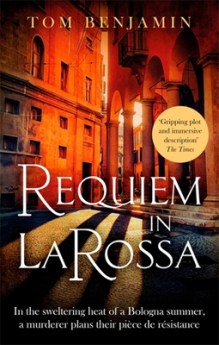

Requiem in La RossaAbout the Book

In the sweltering heat of a Bologna summer, a murderer plans their pièce de résistance…

‘Only in Bologna’ reads the headline in the Carlino after a professor of music is apparently murdered leaving the opera. But what looks like an open-and-shut case begins to fall apart when English detective Daniel Leicester is tasked with getting the accused man off, and a trail that begins among Bologna’s close-knit classical music community leads him to suspect there may be a serial killer at large in the oldest university in the world.

Format: Paperback (352 pages)  Publisher: Constable
Publication date: 5th May 2022 Genre: Crime

Find Requiem in La Rossa on Goodreads

Purchase links
Bookshop.org
Disclosure: If you buy a book via the above link, I may earn a commission from Bookshop.org, whose fees support independent bookshops

Hive | Amazon UK
Links provided for convenience only, not as part of an affiliate programme


My Review

Requiem in La Rossa is the third book in the author’s crime series set in Bologna featuring British private detective Daniel Leicester. I’ve read both the previous books in the series – A Quiet Death in Italy and The Hunting Season – and loved each one. Although I’d obviously recommend reading the series from the beginning, Requiem in La Rossa can definitely be read as a standalone.

It was great to be reunited with characters from the previous books such as trainee investigator Dolores, Daniel’s father-in-law, Giovanni Faidate (known as the ‘Comindante’) and the other employees of Faidate Investigations. Oh, and of course, Daniel’s girlfriend, ‘the svelte and unapologetically visceral’, Stella Amore, who also happens to be his daughter Rose’s art tutor.  Once again there’s some nice verbal sparring between Daniel and Commissario Rita Miranda of the Polizia di Stato.  She dismissively refers to Daniel as ‘the English detective’ and mocks his approach to investigation: ‘It’s all about the clues with you, isn’t it, Sherlock?’

Daniel is a great character. He has a keen sense of justice and is not afraid to push the limits of the law when necessary. Being a qualified locksmith helps, although not when he’s in a police holding cell. He’s fiercely protective of his daughter and I loved seeing his pleasure at his daughter’s burgeoning artistic talent and how she is growing into a young woman his late wife would have been proud of.  Daniel’s Italian is improving as well. In fact, at one point he’s complimented on his English by some tourists who take him for an Italian. Perhaps an experience the author has had?

One of the things that makes the series so enjoyable is the Bologna setting. You really feel as if you are walking the streets alongside Daniel and the other characters and, dear readers, there are maps!  The level of detail could only have come from someone with an intimate knowledge of the city. ‘With the chime of the nine o’clock bell from San Procolo came il vento della sera, the breeze that blew east across the city each evening like a relieved sigh for having made it through another day.’

Amongst other things the labyrinthine plot involves a suicide that may be murder (or perhaps is suicide after all?), a death from natural causes that may be murder (or perhaps is from natural causes after all?), evidence of corruption amongst Bologna’s academic institutions and an outbreak of food poisoning (or is it?). Quite honestly if you managed to work out the identity of the culprit(s) and their motivation before the final chapters, well done you!

Requiem in La Rossa is another wonderful addition to the series. It’s a skilfully-crafted mystery with great characters and lots of local colour. Book that trip to Bologna now!

In three words: Atmospheric, intriguing, immersive

Try something similar: After the Storm by Isabella Muir

Follow this blog via Bloglovin


A Quiet - TomBenjaminAbout the Author

Tom Benjamin grew up in the suburbs of north London and began his working life as a journalist before becoming a spokesman for Scotland Yard. He later moved into public health, where he led drugs awareness programme FRANK. He now lives in Bologna.

Connect with Tom
Website | Twitter | Facebook | Instagram

Requiem Graphic 1

#BookReview The Girl from Lamaha Street by Sharon Maas

The Girl from Lamaha StreetAbout the Book

“One thing stood out in all the books I read. These children were all white. They had blue eyes and soft straight hair. Not a single child in a story was brown like me. How could that be right?”

Growing up in British Guiana in the 1950s, Sharon Maas has everything a shy child with a vivid imagination could wish for. She spends her days studying bugs in the backyard of her family home on Lamaha Street, eating fresh mangoes straight from the tree and losing herself in books tucked up on her granny’s lap, surrounded by her uncles and aunts.

But Sharon feels alone in a house full of adults. Her parents are divorced and her father is busy campaigning for British Guiana’s independence. With her mother often away for work, there’s a void in Sharon’s heart, and she craves rules and structure. The books she devours give her a glimpse of life in a faraway country: England. And although none of the characters in the books she reads look like her, her insatiable curiosity eventually leads Sharon to beg to be sent to boarding school, just like her literary heroes.

Reality comes as a shock. Being the only dark-skinned girl in a sea of posh white girls is a stark contrast to life in her warm homeland, where white people are a small minority. Sharon thrives in her new life. She does well academically, and horse-riding brings her self-discipline and joy in equal measure. But something is not quite right. Writing weekly letters to her mother, she begins to doubt whether this cold country is the right place for her. Is England really her home, and is this where she truly belongs?

Format: Paperback (288 pages)   Publisher: Thread Books
Publication date: 7th April 2022 Genre: Nonfiction, Memoir

Find The Girl from Lamaha Street on Goodreads

Purchase links
Bookshop.org
Disclosure: If you buy a book via the above link, I may earn a commission from Bookshop.org, whose fees support independent bookshops

Hive | Amazon UK
Links provided for convenience only, not as part of an affiliate programme


My Review

I was introduced to the writing of Sharon Maas when I read Those I Have Lost in July 2021. In The Girl from Lamaha Street the author turns her attention to her own life, in particular her childhood experiences. The book is subtitled ‘A Guyanese girl at a 1960’s English boarding school and her search for belonging’ although the author’s experiences at boarding school in England form only the second half of the book.

The first half comprises a fascinating insight into what it was like growing up in 1950s British Guiana (known as Guyana since independence in 1966).  Sharon’s mother and father divorced when she was young and she found herself moving between the houses of her two grandmothers. She writes movingly about how, although she never felt unloved, her family situation made her feel different from other children. How she wanted ‘a mummy and daddy at home, living with me, just like all my cousins and all my friends. A proper family.’  Even had they stayed together, since her mother and father had very different approaches to parenting, one senses that feeling of difference would have remained.  We get a picture of a shy, solitary child, perpetually with her head in a book, but one who seems extraordinarily self-perceptive for her age.  I did question how accurate the characterisation of her younger self was. It was partially answered in the ‘Letter from Sharon’ at the end of the book in which the author explains some events have been ‘reconstructed’ from information passed on to her by relatives and that her younger self’s response to them is viewed to a degree through the perspective of ‘the long lens of time’.  I did marvel at the author’s remarkable memory for even the smallest detail of events and conversations;  my early years are a blur.

I enjoyed the evocative descriptions of British Guiana – the landscape, the sights, smells and especially tastes. ‘We lived in a paradise of mouth-watering fruit. A ripe juicy mango, succulently orange, sliced on a plate and smelling of heaven; slabs of fresh pineapple lightly sprinkled with salt, or a glorious guava, or soursop, or sapodilla’.  It’s a far cry from the grey, tasteless meals she will later endure at boarding school in England.

A section of the book I found particularly interesting was the chapter entitled ‘Land of Six Races’ in which the author explains the ‘racial hierarchy’ evident in 1950s British Guiana, a country made up of people of different colours from ‘the light brown of milky tea’ to deep black. She explains how race was the main marker of an individual’s place in society and the determinant of their ‘value’.  Even as a young child, Sharon recognises that in British Guianan society ‘the best thing was to be born white’.  At the same time she recalls instinctively regarding that as ‘all wrong’, a belief reinforced by her mother and father drumming into her that everyone was of equal value.  That notion is tested when she is enrolled in a school where 99 percent of the children are white and she is ‘a brown speck in a sea of white’.

Influenced by the Enid Blyton books she devours, Sharon persuades her mother to send her to boarding school in England. Contrary to what you might expect, Sharon faces little discrimination because of her race at school – except from the awful two Gwens. If anything, it’s perhaps her family’s class or financial status that makes her feel different from her school mates.  She does well academically; in fact she’s rather boastful about her facility with languages and her brilliance at Latin and geometry.  I confess I found a little puzzling the contradiction between the author’s description of herself as a shy child, often unwilling to speak in public because of her speech impediment, and the girl who laughs and chatters with the other girls after lights out, takes part in dares and midnight feasts.  The later sections of the book in which the author describes her life at Oakdale School and Harrogate Ladies’ College probably mirror those of any girl of her age sent to boarding school in the 1960s and for me lacked the distinctive flavour of the earlier parts of the book.

The cover image gives a taste of the charmingly nostalgic photographs scattered throughout the book. Some of the later chapters commence with examples of letters Sharon (although at the time she preferred to be known as Jo) wrote to her mother from boarding school. It’s not clear if these are the actual letters or just reconstructed from the author’s memory to give a flavour of their content. If the former, I think it was very brave to include these because whilst some are rather amusingly brief others come across as quite cruel and ungrateful given the financial sacrifices her mother has made to fulfil her wishes. Fortunately, the young Sharon does eventually recognise this for herself and is suitably contrite.  The book ends with Sharon’s return to Guyana in 1965.

The Girl from Lamaha Street is a fascinating, skilfully crafted portrait of an unconventional childhood that taught me a lot about the history and culture of Guyana that was completely new to me.

My thanks to Myrto Kalavrezou at Thread Books for my advance review copy.

In three words: Evocative, perceptive, honest

Follow this blog via Bloglovin


Sharon Maas Author PhotoAbout the Author

Sharon Maas was born into a prominent political family in Georgetown, Guyana in 1951. She was educated in England, Guyana and, later, Germany. After leaving school, she worked as a trainee reporter with the Guyana Graphic in Georgetown and later wrote feature articles for the Sunday Chronicle as a staff journalist. In 1971 she set off on a year-long backpacking trip around South America, followed by an overland trek to South India, where she spent two years in an ashram. She is the author of The Violin Maker’s Daughter, The Soldier’s Girl, Her Darkest Hour and many other novels.

Connect with Sharon
Website | Twitter | Facebook