Lionheart by Ben Kane #BookReview #BlogTour @orionbooks

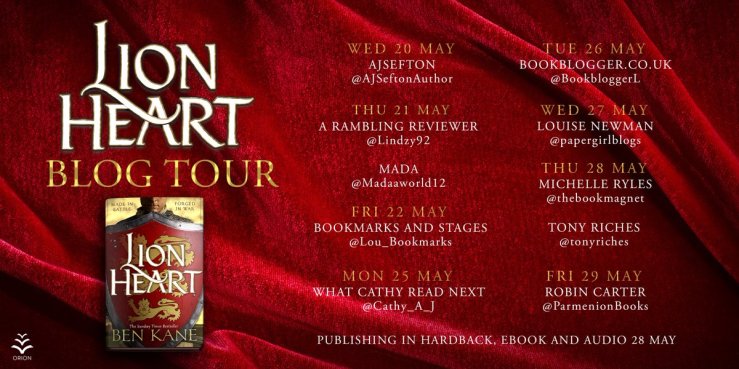
EYXtb37XsAAnCYXWelcome to today’s stop on the blog tour for Lionheart by Ben Kane, which will be published by Orion on 28th May 2020 but is available to pre-order now. My thanks to Virginia at Orion for inviting me to take part in the tour and for my proof copy.


LionheartAbout the Book

1179. Henry II’s Norman conquerors have swept through England, Wales – and now Ireland.

Irish nobleman Ferdia has been imprisoned in Wales to ensure the good behaviour of his rebellious father. But during a skirmish on a neighbouring castle, Ferdia saves the life of the man who would become one of the most legendary warriors to have ever lived: Richard Plantagenet. The Lionheart.

Taken as Richard’s squire, Ferdia crosses the Narrow Sea to resist the rebellious nobles in Aquitaine, besieging castles and fighting bloody battles with brutal frequency.

But treachery and betrayal lurk around every corner. Infuriated by his younger brother Richard’s growing reputation, Henry rebels. And Ferdia learns that the biggest threat to Richard’s life may not be a foreign army – but Richard’s own family . . .

Format: Hardcover (400 pages)    Publisher: Orion
Publication date: 28th May 2020 Genre: Historical Fiction

Find Lionheart on Goodreads

Pre-order/Purchase links*
Amazon UK | Hive (supporting UK bookshops)
*links provided for convenience not as part of an affiliate programme

EYO0ZPoX0AEDRzS


My Review

Lionheart is the first book I’ve read by Ben Kane although I’m aware of his reputation as a bestselling and highly regarded author of historical fiction set in the Roman period. Series such as Spartacus, Hannibal and Eagles of Rome have earned him a devoted following and I can now appreciate why. In Lionheart, the first in a new series, the author turns his attention to 12th century England and France, and in particular to that famous historical figure, Richard the Lionheart.

The narrator of the story is Ferdia, the son of an Irish nobleman defeated by the English. During his time held as a hostage, Ferdia (or Rufus, as he is nicknamed for his red hair) encounters Richard, then Duke of Acquitaine. The manner of their meeting will change the course of both their lives. Rather against his will, Ferdia finds himself drawn to Richard because of the latter’s leadership qualities, military prowess and personal charisma. Whilst held hostage, Ferdia also makes himself a deadly enemy but, luckily, acquires a loyal supporter in the shape of Rhys, a young Welsh urchin.

Over the course of the next few years Ferdia comes to appreciate the camaraderie of his fellow squires and the bonds forged in battle. He also indulges in a young man’s interests: sparring, drinking and trying to attract the attention of young ladies.

As you might expect from a book set in an eventful period of history, Lionheart is full of vivid battle scenes and details of weaponry, armour and military tactics. In the background – an element I particularly enjoyed – is the picture of a family at war between themselves. King Henry’s sons – Henry (known as the Young King), Richard, Geoffrey and John – are distrustful of one another and constantly sparring for favour. As it transpires, some are prepared to go further than others to achieve their ambitions. Poor King Henry’s attempts to create peace between his sons usually come to naught, including during one especially uncomfortable Christmas at Caen.

At this point, I’d like to mention the 1968 film The Lion in Winter, starring Peter O’Toole as Henry, Katharine Hepburn as Eleanor and Sir Anthony Hopkins as Richard. Although historically inaccurate – Eleanor was imprisoned by her husband for rebelling against him from 1173 until his death – it’s still a wonderful depiction of the strife in the family. With a screenplay by James Goldman based on his 1966 play of the same name, the film won three Oscars including one for John Barry’s glorious soundtrack.

Interspersed between Ferdia’s first person narration are occasional sections from the point of view of Sir William Marshal. A real life figure known as ‘the greatest knight in Christendom’ and attached to the household of first the Young King and then King Henry, these sections provide the reader with an up close and personal insight into the turbulent relationships within the Royal family. The book ends at a pivotal moment for the realm, for Richard and for Ferdia. God’s legs, as Richard would say, the author knows how to leave his readers with both a warm feeling and wanting more.

Full of adventure, action and intrigue, Lionheart is a thrilling read. But don’t just take my word for it, read this brilliant review by Kate at For Winter Nights who really knows her stuff when it comes to historical fiction. Or check out some of the other stops on the blog tour.

I’m really looking forward to the next in the series, due in 2021, especially since the author promises us an appearance by Eleanor! Fans of classic films may want to get ready for the next instalment by watching Ivanhoe (1952) and/or The Adventures of Robin Hood (1938).

In three words: Dramatic, immersive, exciting

Try something similar: Lionheart by Sharon Kay Penman

Follow this blog via Bloglovin


contributor-ben-kane-56About the Author

Kenya born, Irish by blood and UK resident, Ben Kane’s passion for history has seen him change career from veterinary medicine to writing, and taken him to more than 60 countries, and all seven continents. During his travels and subsequent research, including walking hundreds of miles in complete Roman military gear, he has learned much about the Romans and the way they lived. Ten of his thirteen novels have been Sunday Times top ten bestsellers, and his books are published in twelve languages; a million copies have sold worldwide. In 2016, his research was recognised by Bristol University with an honorary Doctor of Letters degree. Kane lives in Somerset with his wife and children, where he writes full time. (Photo/bio credit: Publisher author page)

Connect with Ben
Website | Twitter | Facebook


When We Fall by Carolyn Kirby #BookReview #BlogTour @noexitpress

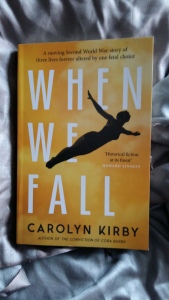
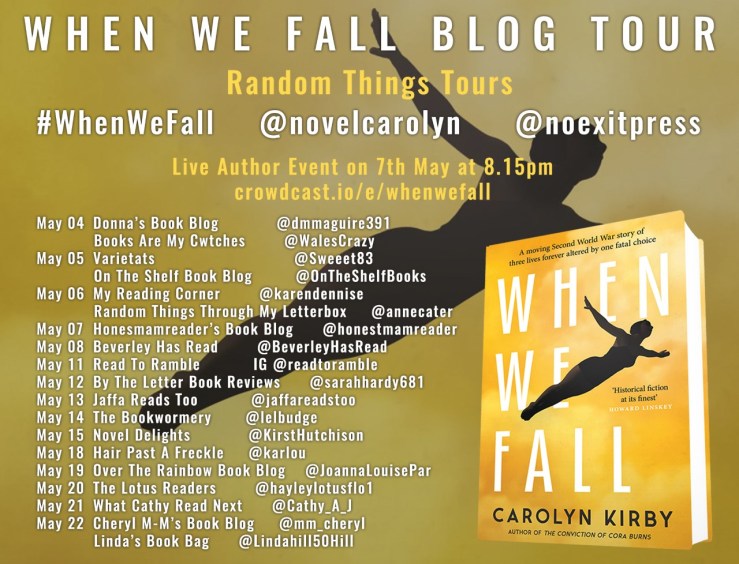
Welcome to today’s stop on the blog tour for When We Fall by Carolyn Kirby which was published on 7th May 2020 to coincide with the 75th anniversary of VE Day. My thanks to Anne at Random Things Tours for inviting me to participate in the tour and to No Exit Press for my advance review copy with its ingenious accompanying material.

You can listen to Carolyn talking to Barry Forshaw about When We Fall and answering reader questions at her virtual book launch on 7th May here (opens in new window/tab). Carolyn has also recorded a video about the true story behind the novel and the only female victim of the massacre – Polish pilot Janina Lewandowska – on whom one of the characters in When We Fall is based.


20191125_100338About the Book

England, 1943. Lost in fog, Air Transport Auxiliary pilot Vee Katchatourian is forced to make an emergency landing where she meets enigmatic RAF airman Stefan Bergel, and then can’t get him out of her mind.

In occupied Poland, Ewa Hartman hosts German officers in her father’s guest house, while secretly gathering intelligence for the Polish resistance. Mourning her lover, Stefan, who was captured by the Soviets at the start of the war, Ewa is shocked to see him on the street one day.

Haunted by a terrible choice he made in captivity, Stefan asks Vee and Ewa to help him expose one of the darkest secrets of the war. But it is not clear where everyone’s loyalties lie until they are tested.

Published to coincide with the 75th anniversary of VE Day and based on the Katyn Massacre of 1940, When We Fall is a moving story of three lives forever altered by one fatal choice.

Format: Paperback (320 pages)   Publisher: No Exit Press
Publication date: 7th May 2020 Genre: Historical Fiction

Find When We Fall on Goodreads

Purchase links*
Publisher | Amazon UK| Hive (supporting UK bookshops)
*links provided for convenience not as part of an affiliate programme


My Review

I really enjoyed Carolyn Kirby’s debut novel, The Conviction of Cora Burns, describing it in my review as “an intensely satisfying read that I can wholeheartedly recommend to readers who like their historical fiction to have real depth”. I’m happy to say those comments equally apply to When We Fall.

When We Fall combines the gradual unfolding of a complex web of relationships with moments of intense darkness and high drama, all set against the backdrop of World War II. I also loved that the book explores other themes, such as questions of identity and the symbolism of how we name things.

For example, Ewa, has German heritage but considers Poland her homeland. Poland’s history is one of occupation and re-occupation by other countries and in 1943, the occupying power is Nazi Germany. They have outlawed the Polish language and are engaged in changing the names of people and places to their German versions. For instance, Poznan to Posen. So Ewa must discipline herself to respond to the name Eva and to suppress her natural inclination to speak Polish. A lapse in the latter could be viewed as a ‘symptom of questionable national loyalty’ and bring unwelcome attention from the authorities on herself, and her father. Leading essentially a double life – as Eva, the attentive, German speaking guest house waitress and Ewa, the Polish speaking Resistance operative – she observes of her two identities that “each one speaks and acts like a different person”. She even dresses to match her role on occasions.

Incidentally, I thought it a clever touch to have the other main female character choose to be known as Vee, although her name is actually Valerie, and have her surname of Katchatourian suggest she is foreign when she was in fact born in England. Interestingly, Vee’s heritage is Armenian, a country that through the centuries was under the sway of both the Russian and Ottoman empires. Sadly, it was also the location of a massacre, now designated a genocide, during and after the First World War.

Talking of Vee, I really enjoyed the scenes in which she takes to the skies. As a reader, you get a sense of the exhilaration of flying in a small aircraft, something I’ve never done and, frankly, am unlikely ever to do.  For example, this description of Vee’s first time flying the iconic Spitfire: ‘Never has an aeroplane felt more at home in its element. Higher, higher. The Spitfire is cushioned by the air. Falling is inconceivable.’ I was brought down to earth (apologies for the pun) by learning that, being a single seater plane, at some point every Spitfire pilot had to get in what was then ‘the fastest machine on earth’ and fly it, for the first time, alone.

In Stefan Bergel, and in the other man who comes to play a pivotal role in Ewa’s life, the author has created two complex characters who possess both attractive and decidedly unattractive sides. I confess I found it difficult to understand Ewa’s devotion to Stefan, even leaving aside what the reader knows but Ewa doesn’t. He shows little awareness of the impact his long, unexplained absence has had on her and, when they are reunited, seems more interested in resuming the physical side of their relationship than anything else. And the other man? On first sight, he appears more of a catch. However, as one character remarks, “It may not be clear where everyone’s loyalties really lie until they are tested”. Or, what form that test will take.

There are many clever touches I could mention such as the atmospheric section titles. [Ed: That’s enough of the puns now.] In addition, the book’s title lends itself to a variety of interpretations: falling in the literal sense, either by accident or design; in a philosophical sense, as when we fail to meet our own or other’s expectations; or in a moral sense when we give in to temptation.

In the final chapters, the revelations come thick and fast; some of these took my breath away. In a sense, When We Fall completes the mission its characters struggle so hard to achieve. The book is a great example of why I love historical fiction. It transported me to a different time and place, drew me into the lives of its characters and taught me things I didn’t know. When We Fall is a wonderful mix of historical fact and fiction, fuelled by a gripping story. Like Vee’s Spitfire, it soars joyfully.

In three words: Compelling, immersive, emotional

Try something similar: People Like Us by Louise Fein or The Secrets We Kept by Lara Prescott

Follow this blog via Bloglovin


Carolyn Kirby Author PicAbout the Author

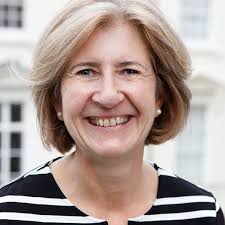
Carolyn Kirby is the author of The Conviction of Cora Burns which was longlisted for the Historical Writers’ Association Debut Crown Award.  Before becoming a full-time writer, Carolyn worked in social housing and as a teacher. She has two grown-up daughters and lives with her husband in Oxfordshire.

Connect with Carolyn
Website | Facebook | Twitter

When We Fall BT Poster