
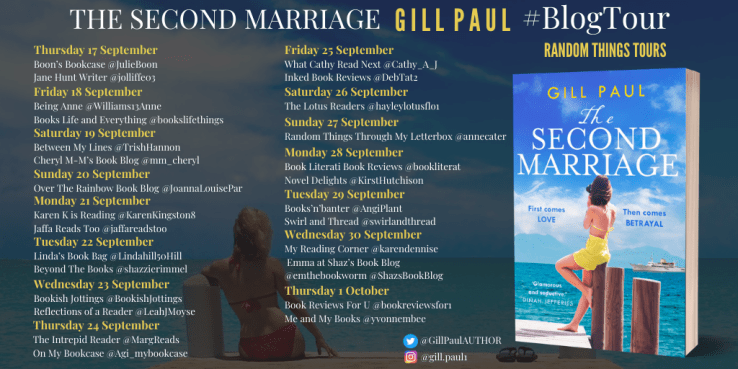
Welcome to today’s stop on the blog tour for The Second Marriage by Gill Paul. My thanks to Anne at Random Things Tours for inviting me to participate in the tour and to Avon for my digital review copy. Do check out the blog post by my tour buddy for today, Debbie at Inked Book Reviews.
 About the Book
Jackie – When her first marriage ends in tragedy, Jackie Kennedy fears she’ll never love again. But all that changes when she encounters…
Ari – Successful and charming, Ari Onassis is a man who promises her the world. Yet soon after they marry, Jackie learns that his heart also belongs to another…
Maria – A beautiful, famed singer, Maria Callas is in love with Jackie’s new husband – and she isn’t going to give up. Little by little, Jackie and Maria’s lives begin to tangle in a dangerous web of secrets, scandal and lies.
But with both women determined to make Ari theirs alone, the stakes are high. How far will they go for true love?
Format: Paperback (464 pages) Publisher: Avon
Publication date: 17th September 2020 Genre: Historical Fiction
Find The Second Marriage on Goodreads
Purchase links*
Amazon UK | Hive (supporting UK bookshops)
*links provided for convenience not as part of an affiliate programme
My Review
From the book’s UK title and blurb, readers could be forgiven for thinking the main focus of the novel is the relationship that develops between the widowed Jackie Kennedy and Aristotle Onassis. In fact, that part of the story takes up only the final section of the book. Instead, Gill Paul commences the story much earlier, giving the reader an insight into the events that shaped the lives of Jackie and Maria. Some of these events, especially those played out in the public eye, may be familiar to many readers. Others less so. And, of course, there are always gaps in historical fact that have to be filled from the author’s imagination or, as Gill Paul freely acknowledges in her afterword, that have to be reshaped to meet the demands of a fictional narrative. Gill has recently written about the delicate balancing act involved in this in an article for Historia magazine.
It’s no coincidence the book is structured in five parts – Acts 1 to 5 – because there is certainly an operatic quality to the story. It’s like watching a performance playing out at length in front of an audience with moments of both high drama and tragedy. Indeed, during one scene in which Maria delivers an ultimatum to Onassis, she reflects, “In an opera, there would have been drumrolls, cymbals clashing.“
Starting in 1957 with the first meeting between Maria Callas and Aristotle Onassis in the Hotel Danieli in Venice, the cast of characters making up the chorus (to continue the opera analogy) is a Who’s Who of the rich and famous: Princess Grace of Monaco, Elizabeth Taylor and Richard Burton, the Duke and Duchess of Windsor, Marilyn Monroe, Winston and Clementine Churchill, to name just a few.
The author vividly and movingly depicts the human stories behind the glamour and luxury. Witnessing through Jackie’s eyes the fateful events of November 1963 is still shocking to read despite knowing what’s going to happen and I found the description of Jackie’s fortitude at her husband’s funeral particularly poignant. Maria’s desperation to have a child was also heartbreaking to witness.
Although from very different backgrounds, I was struck by the similarities between the experiences of the two women. They both had to endure infidelity by the men they became involved with – and, as it turns out, by the same man. They both experienced tragedy in their lives and rifts with family members. And they both had to live under the intense scrutiny of the press and public with every word, every gesture subject to speculation. They were often vilified for what they did, who they met and their lifestyles. Of course, their positions in society meant there was always going to be interest in their lives.
As presented by the author, I felt neither woman deserved the treatment they received from Aristotle Onassis. Though undoubtedly possessing charisma, he seemed to be motivated more by acquisition than genuine love, as if they were rare items to be added to a collection, not fellow human beings – and fragile ones at that. As Maria wisely observes, “He thrived on conquest” and was a man who “collected celebrity notches on his bedpost“. Yet she still ignored his flaws and forgave his betrayals time and time again. For instance, I couldn’t understand how Onassis could have so little interest in opera or music when it was clearly the central passion of Maria’s life and the thing that brought her the most joy and satisfaction. It was Maria I felt most sympathy for and whose story most engaged me. As she observes to her friend Mary, “Some people are born to be happy but I was not one of them. I am destined always to be the tragic heroine”.
The Second Marriage is an absorbing story of love, loss and betrayal.
In three words: Emotional, intimate, dramatic
Try something similar: The Secret Life of Mrs. London by Rebecca Rosenberg
Follow this blog via Bloglovin
 About the Author
Gill Paul’s historical novels have reached the top of the USA Today, Toronto Globe & Mail and Kindle charts, and been translated into twenty languages. They include The Second Marriage (titled Jackie and Maria in the US), two bestselling novels about the Romanovs – The Secret Wife and The Lost Daughter -as well as Women and Children First, which was shortlisted for the 2013 RNA Epic Novel of the Year award, No Place For A Lady, shortlisted for a Love Stories award, and Another Woman’s Husband, about links you might not have suspected between Wallis Simpson and Princess Diana.
Gill also writes historical non-fiction, including A History Of Medicine in 50 Objects, and she speaks at libraries and literary festivals on subjects ranging from the Titanic to the Romanovs. Gill lives in London, where she is working on her tenth novel, and she swims daily in an outdoor pond.
Connect with Gill
Website | Twitter 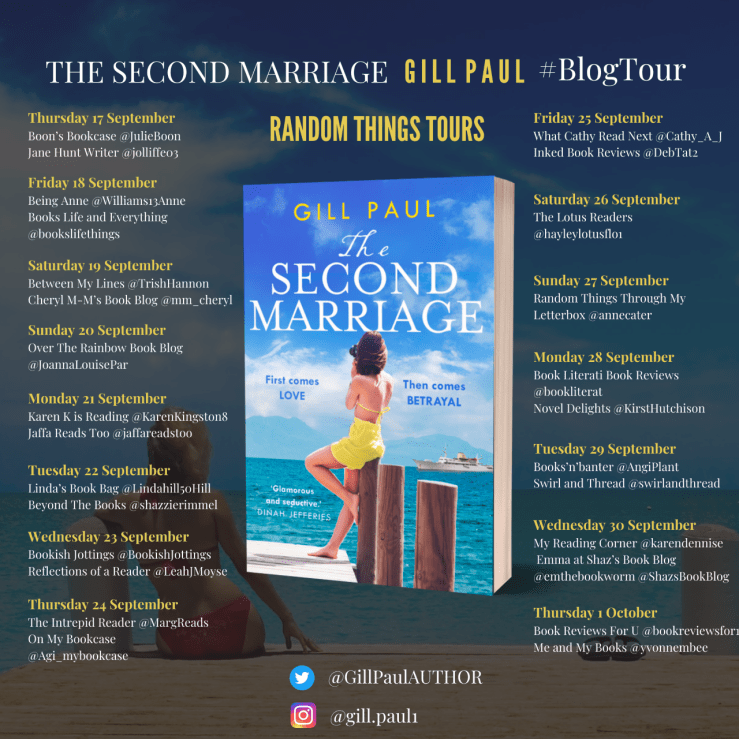

 About the Book
 About the Author
 What Cathy Read Next...