

#6Degrees of Separation: From Postcards to Letters

background book stack books close up
Photo by Sharon McCutcheon on Pexels.com

It’s the first Saturday of the month which means it’s time for 6 Degrees of Separation!

Here’s how it works: a book is chosen as a starting point by Kate at Books Are My Favourite and Best and linked to six other books to form a chain. Readers and bloggers are invited to join in by creating their own ‘chain’ leading from the selected book.

Kate says: Books can be linked in obvious ways – for example, books by the same authors, from the same era or genre, or books with similar themes or settings. Or, you may choose to link them in more personal or esoteric ways: books you read on the same holiday, books given to you by a particular friend, books that remind you of a particular time in your life, or books you read for an online challenge. Join in by posting your own six degrees chain on your blog and adding the link in the comments section of each month’s post.   You can also check out links to posts on Twitter using the hashtag #6Degrees
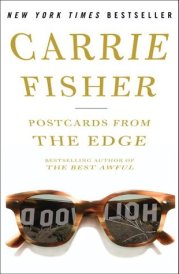

Postcards from the EdgeThis month’s starting book is Postcards From The Edge by Carrie Fisher, the bestselling work of autobiographical fiction.

Postcards From The Edge isn’t a book I’ve read so I’m focusing on the autobiographical element plus a postal theme with the first book in my chain, Please, Mr Postman by Alan Johnson. The second volume in the former Labour Home Secretary’s series of memoirs covers his time as a postman in Slough and describes family and community life on the Britwell Estate in the 1970s and 1980s.

The main character in This Lovely City by Louise Hare, Lawrie Matthews is also a postman, finding employment with the Post Office after arriving in Britain from Jamaica in 1948 aboard the Empire Windrush.

Returning to postcards, an item that Lawrie, or Alan Johnson, might have delivered, my next link is Cartes Postales from Greece by Victoria Hislop. In the book, postcards arrive, week after week, addressed to someone Ellie does not know, each signed with an initial: A.

In Yours, Cheerfully by A J Pearce, Emmy is also in receipt of letters, this time sent by readers to Woman’s Friend magazine seeking advice on their problems.

Staying with the communication theme, Business As Usual by Jane Oliver and Ann Stafford is an epistolary novel in which the story is told by means of telegrams and memoranda, as well as letters.

For my final link in the chain we’re into the world of undelivered mail.  In The Lost Letters of William Woolf by Helen Cullen the ‘letter detectives’ of the Dead Letters Depot work to solve mysteries in order to reunite letters with their intended recipients.

My chain has taken me from postcards to letters. Where did your chain take you?

#6Degrees of Separation: From Eats, Shoots & Leaves to The Wanderers

It’s the first Saturday of the month which means it’s time for 6 Degrees of Separation!

Here’s how it works: a book is chosen as a starting point by Kate at Books Are My Favourite and Best and linked to six other books to form a chain. Readers and bloggers are invited to join in by creating their own ‘chain’ leading from the selected book.

Kate says: Books can be linked in obvious ways – for example, books by the same authors, from the same era or genre, or books with similar themes or settings. Or, you may choose to link them in more personal or esoteric ways: books you read on the same holiday, books given to you by a particular friend, books that remind you of a particular time in your life, or books you read for an online challenge. Join in by posting your own six degrees chain on your blog and adding the link in the comments section of each month’s post.   You can also check out links to posts on Twitter using the hashtag #6Degrees


This month’s starting book is Eats, Shoots & Leaves by Lynne Truss. Subtitled ‘The Zero Tolerance Approach to Punctuation’, in the book the author argues that it is time to look at commas and semicolons and see them for the wonderful and necessary things they are.

Gyles Brandreth takes a similarly non-nonsense attitude in his book Have You Eaten Grandma? which is described as a ‘brilliantly funny tirade on grammar…[and] the linguistic horrors of our times’.

Gyles’ son, Benet Brandreth, as well as being an authority on Shakespeare is also a novelist. His series of historical novels that started with The Spy of Venice and continued with The Assassin of Verona imagine what William Shakespeare might have got up to in his so-called “lost years”.

I’m not going to go for the obvious link to Hamnet as I used that last month. Instead, my next link is to another book set in Venice, Death in Venice by Thomas Mann. The film version starred Dirk Bogarde (as pictured below on the cover of the Penguin edition). Bogarde, as well as being an award-winning actor, was an accomplished author and in his book, Great Meadow, he recalls his idyllic childhood in Sussex in the late 1920s and 1930s.

Also set in the years before the Second World War is All Among the Barley by Melissa Harrison. Set on a farm in Suffolk it features a girl on the cusp of adulthood. It made the ‘Academy Recommends’ list but not the longlist for The Walter Scott Prize for Historical Fiction 2019.

A book that did make the longlist was The Wanderers by Tim Pears, the second book in his West Country trilogy featuring young Leo Sercombe who falls in with a band of gypsies and travels the countryside with them, and then later on his own.

My chain has taken me from proponents of precision in punctuation to a book featuring a much less rules-based way of life. Where did your chain take you?