Book Review – Exit West by Mohsin Hamid #20BooksofSummer2025

About the Book

In a city swollen by refugees but still mostly at peace, or at least not yet openly at war, two young people notice one another.

They share a cup of coffee, a smile, an evening meal. They try not to hear the sound of bombs getting closer every night, the radio announcing new laws, the public executions.

Meanwhile, rumours are spreading of strange black doors in secret places across the city, doors that lead to London or San Francisco, Greece or Dubai. Someday soon, the time will come for this young couple to seek out one such door: joining the multitudes fleeing a collapisng city, hoping against hope, looking for their place in the world.

Format: Hardcover (229 pages) Publisher: Hamish Hamilton
Publication date: 2nd March 2017 Genre: Literary Fiction

Find Exit West on Goodreads

Purchase Exit West from Bookshop.org [Disclosure: If you buy books linked to our site, we may earn a commission from Bookshop.org, whose fees support independent bookshops]

My Review

I approached Exit West with some trepidation having struggled with novels with elements of magical realism in the past. I wasn’t sure I could embrace the concept of doors through which you pass to other parts of the world. As it turned out, I liked how the author concentrated on the motivations for migration, the experience of those who migrate and the response of those on the receiving end of migration rather than details of migrants’ journeys. The doors concept allowed this simplicity and I think also emphasised the suddenness of the transition that migrants experience.

The story begins in an unnamed war-torn city that most readers, given when the book was written, have assumed to be Syria although, sadly, today it could just as easily be many other countries around the world. The conflict makes use of modern technology such as drones giving it a slightly dystopian feel.

Although different in personality and background, Saeed and Nadia meet and fall in love. Soon, however, it becomes clear there is no future for them in the city in which they live and they use an intermediary to exit via one of the doors, ending up first in Greece, later in London.

But wherever they go they often find themselves in a similar situation: living in basic conditions in workers camps or as squatters in sealed off neighbourhoods. As more and more people use the doors, dodging or bribing guards to gain access, there is conflict – sometimes violent conflict – with ‘nativists’ who resent the influx of people from different cultures, who speak different languages and have different religious practices. In some places, the migrants face attack by government forces. It leads Nadia to wonder if they have swapped one bad situation for another. ‘The fury of those nativists advocating wholesale slaughter was what struck Nadia most, and it struck her because it seemed to familiar, so much like the fury of the militants in her own city. She wondered if she and Saeed had done anything by moving, whether the faces and buildings had changed but the basic reality of their predicament had not.’

Their experiences gradually change Saeed and Nadia’s relationship, each responding in different ways to their new situation. Saeed’s instinctive reaction is to seek out people similar to himself and put down roots, Nadia’s impulse is to move on in search of some indefinable ‘something else’.

Interspersed with Saeed and Nadia’s story are brief vignettes describing the experiences of others who travel through the doors. One particularly heart-warming story demonstrates how migration can help forge new connections.

Exit West as well as being beautifully written is definitely a book to get you thinking. For instance I was struck by the notion that we are all migrants of a sort, migrants through time. That even if we stay in the same place, things change around us over time and we must adapt to them.

Exit West is book two of my 20 Books of Summer 2025.

In three words: Thought-provoking, insightful, imaginative

About the Author

Mohsin Hamid is the author of four novels, Moth Smoke The Reluctant Fundamentalist How to Get Filthy Rich in Rising Asia , and Exit West , and a book of essays, Discontent and Its Civilizations. His writing has been featured on bestseller lists, adapted for the cinema, shortlisted for the Man Booker Prize, selected as winner or finalist of twenty awards, and translated into thirty-five languages.

Born in Lahore, he has spent about half his life there and much of the rest in London, New York, and California.

Connect with Mohsin
Website

Book Review – Behind the Scenes at the Museum by Kate Atkinson #20BooksofSummer2025

About the Book

Ruby Lennox was conceived grudgingly by Bunty and born while her father, George, was in the Dog and Hare in Doncaster telling a woman in an emerald dress and a D-cup that he wasn’t married. Bunty had never wanted to marry George, but he was all that was left. She really wanted to be Vivian Leigh or Celia Johnson, swept off to America by a romantic hero. But here she was, stuck in a flat above the pet shop in an ancient street beneath York Minster, with sensible and sardonic Patricia aged five, greedy cross-patch Gillian who refused to be ignored, and Ruby…

Ruby tells the story of The Family, from the day at the end of the nineteenth century when a travelling French photographer catches frail beautiful Alice and her children, like flowers in amber, to the startling, witty, and memorable events of Ruby’s own life.

Format: Hardcover (336 pages) Publisher: Doubleday
Publication date: 1st January 1995 Genre: Historical Fiction

Find Behind the Scenes at the Museum on Goodreads

Purchase Behind the Scenes at the Museum from Bookshop.org [Disclosure: If you buy books linked to our site, we may earn a commission from Bookshop.org, whose fees support independent bookshops]

My Review

Behind the Scenes at the Museum was Kate Atkinson’s debut novel and, having read other books of hers, I can see it contains the keen eye for observational detail, the imagination and sardonic humour of later books.

Ruby goes one better than Charles Dickens’s David Copperfield who proudly announces, ‘I am born’ by telling the story of her life from the moment of her conception. Ruby’s is a rather accident prone family and some of these verge on the farcical whilst others are tragic. Her mother Bunty is a larger-than-life figure, not especially likeable but someone you can’t ignore. The same can’t be said for her approach to motherhood which basically involves ignoring her children for most of the time in order to concentrate on her rigorous regimen of household cleaning. However, even here, something more tragic lies beneath the surface.

Ruby’s memories of her childhood, school days and family holidays are interspersed with vignettes (or ‘footnotes’ as they are called in the book) that describe events in the lives of family members stretching back several generations. These are not arranged chronologically and there are a lot of family members meaning I found it very difficult to remember who was who and how they were related. Some of the ‘footnotes’ are very funny, such as that involving a wedding that takes place on the same day as the 1966 World Cup Final. Others, for example those set in the First and Second World Wars, are very moving.

Although I found the shifting back and forth in time rather confusing, I admired the way the author created a sense of each period and the clever use of objects to create connections down the generations: a silver locket, a rabbit’s foot, a photograph. Those who know York will find themselves easily able to picture Ruby’s travels around the city. I also loved the humorous episodes, the family holiday in Scotland in the company of their neighbours, the Ropers, being a great example.

The latter years of Ruby’s life are wrapped up rather quickly given they involve some quite major events. Perhaps, in a way, that fits the book’s title. Lingering over the first objects in a museum and merely glancing at the final ones in your eagerness to get to the gift shop or tearoom.

Behind the Scenes at the Museum is the first book from my 20 Books of Summer 2025 list. And, yes, I do know it’s already July and I need to get a move on.

In three words: Engaging, witty, episodic
Try something similar: The Heart’s Invisible Furies by John Boyne

About the Author

Kate Atkinson won the Whitbread (now Costa) Book of the Year Award with her first novel, Behind the Scenes at the Museum. Her 2013 novel Life After Life, now a BBC TV series starring Thomasin McKenzie, won the South Bank Sky Arts Literature Prize and the Costa Novel of the Year Award, was shortlisted for the Women’s Prize for Fiction, and was also voted Book of the Year by the independent booksellers associations on both sides of the Atlantic. A God in Ruins, also a winner of the Costa Novel of the Year Award, is a companion to Life After Life, although the two can be read independently.

Her six bestselling novels featuring former detective Jackson Brodie – Case HistoriesOne Good TurnWhen Will There Be Good News?, Started Early, Took My Dog, Big Sky and Death at the Sign of the Rook – became the BBC TV series Case Histories, starring Jason Isaacs.

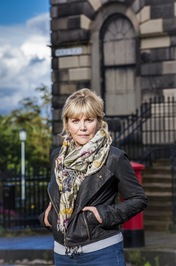
Kate Atkinson was awarded an MBE in the 2011 Queen’s Birthday Honours List, and is a Fellow of the Royal Society of Literature. (Bio: Author website/Photo: Goodreads author page)

Connect with Kate
Website | Facebook