Buchan of the Month: The Half-Hearted by John Buchan

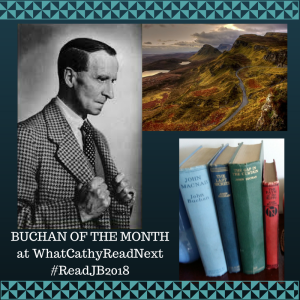
Buchan of the Month

The HalfheartedAbout the Book

The Half-Hearted is a novel in two parts. Part I is a story of manners and romance in upper-class Scotland, while part II is an action tale of adventure and duty in northern India.

The novel is set in the closing years of the 19th century and explores the way in which the social expectations of the main characters shape the paths they must tread. It follows the life of Lewis Haystoun, a young Scottish laird, who finds himself unable to commit wholeheartedly to any course of action.

Format: Paperback (206 pp.)                   Publisher: Tark Classic Fiction
Published: 26th October 2009 [1900]      Genre: Fiction, Adventure

Purchase Links*
Amazon.co.uk ǀ Amazon.com ǀ Hive.co.uk (supporting UK bookshops)
*links provided for convenience, not as part of any affiliate programme

Find The Half-Hearted on Goodreads


My Review

The Half-Hearted is the sixth book in my Buchan of the Month reading project. You can find out more about the project plus my reading list for 2018 here. You can read a spoiler-free introduction to the book here. The Half-Hearted is also one of my 20 Books of Summer and on my Classics Club list.

As I mention in my introduction, David Daniell, author of The Interpreter’s House: A Critical Assessment of the Work of John Buchan, describes The Half-Hearted as ‘an interestingly uneven novel’ but admits that there are some ‘marvellous things’ in the book.  I think this is a fair assessment. One of John Buchan’s early novels, The Half-Hearted provides an indicator of Buchan’s strengths as a writer and the things he would arguably struggle with.

Let’s look at the good things first. In the first part of the book set in the Scottish Highlands, Buchan demonstrates his ability at describing landscape, especially his beloved Scottish countryside. ‘Mists were crowding in the valleys, each bald mountain top shone like a jewel, and far aloft in the heavens were the white streamers of morn. Moorhens were plashing at the loch’s edge, and one tall heron rose from his early meal. The world was astir with life: sounds of the plonk-plonk of rising trout and the endless twitter of woodland birds mingled with the far-away barking of dogs and the lowing of full-uddered cows in the distant meadows.’

The second part of the book, set in Northern India and what is now Afghanistan, is full of ‘derring do’ and the sort of breathless adventure that readers have come to expect from Buchan. Set against the backdrop of the so-called ‘Great Game’ as Britain and Russia vie for territorial advantage in Central Asia and the North-West Frontier of India, Lewis and his friend, George, are sent to the area on an unofficial fact-finding mission and find themselves pitted against the mysterious Marker, thought to be working on behalf of the Russians. Lewis is suspicious of Marker and his motives from the off and suspects his ‘friendly advice’ is deliberate evasion. It’s exciting stuff, very well-described and the story builds to a dramatic conclusion. In the end, Lewis becomes not the ‘half-hearted’ but the ‘stout-hearted’.

Now turning to the less good things… The first part of the book to my mind displays Buchan’s difficulty with depicting romantic relationships that is evident in all his books. The dynamics of the relationship between Lewis and Alice Wishart, the girl to whom he is attracted, never really convince. It’s a story of missed opportunities, true feelings unspoken and misunderstandings that left me rather confused about why it all ends as it does. Lewis has a rival for Alice’s affections and the choice she makes astounds me every time I read the book.  The book also contains some rather scathing remarks about ‘ordinary people’, some rather un-PC generalisations about women and references to Jews that might have been commonplace at the time the book was written but which today we would find distinctly unsavoury, if not bordering on the anti-Semitic.

In The Half-Hearted, Buchan explores themes that he would revisit in other books such as Mr. Standfast and Sick Heart River – honour, self-sacrifice, being prepared to fight for your beliefs, the importance of facing life’s challenges and the value of things hard-won. It’s easy to detect the influence of Buchan’s childhood companion and lifelong vade mecum, John Bunyan’s The Pilgrim’s Progress. Not for the last time, Buchan attributes virtue to physical fitness and the ‘clean, outdoor life’. Lewis is told, ‘Life has been too easy for you, a great deal too easy. You want a little of the salt and iron of the world.’

Having said all this, The Half-Hearted is a book I’ve read a number of times and for me its shortcomings are outweighed by its good points. I wouldn’t necessarily recommend it as a book for readers new to Buchan (he wrote better books) but for aficionados it provides fascinating glimpses of the writer Buchan would become.

Next month’s Buchan of the Month is The Watcher by the Threshold, a collection of short stories.

Follow my blog with Bloglovin

In three words: Uneven, interesting, adventure

Try something similar…Kim by Rudyard Kipling

John BuchanAbout the Author

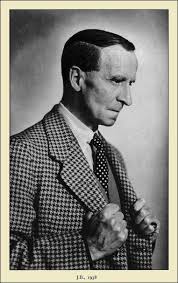
John Buchan (1875 – 1940) was an author, poet, lawyer, publisher, journalist, war correspondent, Member of Parliament, University Chancellor, keen angler and family man. He was ennobled and, as Lord Tweedsmuir, became Governor-General of Canada. In this role, he signed Canada’s entry into the Second World War.   Nowadays he is probably best known – maybe only known – as the author of The Thirty-Nine Steps. However, in his lifetime he published over 100 books: fiction, poetry, short stories, biographies, memoirs and history.

You can find out more about John Buchan, his life and literary output by visiting The John Buchan Society website.

Blog Tour/Book Review: Summer of Love by Caro Fraser

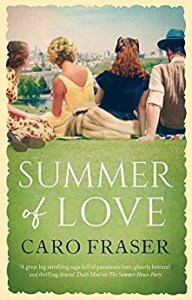
I’m delighted to be hosting today’s stop on the blog tour for historical novel, Summer of Love by Caro Fraser, the sequel to The Summer House Party.  I was lucky enough to interview Caro as part of the blog tour for The Summer House Party and you can find her thoughts on that book here.  I loved her summary of the book as ‘a blend of wartime romance and intrigue, ration books, spam , and a bit of sex!’

Now let’s turn our attention to Summer of Love.  You can read my review below.  Do check out the other book bloggers taking part in the tour.


 Summer of LoveAbout the Book

The dark days of the war are over, but the family secrets they held are only just dawning.

In the hot summer of 1949, a group of family and friends gather at Harry Denholm’s country house in Kent. Meg and Dan Ranscombe, emerging from a scandal of their own making; Dan’s godmother, Sonia; and her two young girls, Laura and Avril, only one of whom is Sonia’s biological daughter. Amongst the heat, memories, and infatuations, a secret is revealed to Meg’s son, Max, and soon a terrible tragedy unfolds that will have consequences for them all.

Afterwards, Avril, Laura and Max must come of age in a society still reeling from the war, haunted by the choices of that fateful summer. Cold, entitled Avril will go to any lengths to take what is hers. Beautiful, naive Laura finds refuge and love in the London jazz clubs, but Max, with wealth and unrequited love, has the capacity to undo it all.

Format:  Hardcover, ebook (512 pp.)      Publisher: Head of Zeus
Published: 31st May 2018 (ebook), 12th July (hardcover) Genre: Historical Fiction

Pre-order/Purchase Links*
Amazon.co.uk ǀ  Amazon.com  ǀ Kobo | Hive.co.uk (supporting UK bookshops)
*links provided for convenience, not as part of any affiliate programme

Find Summer of Love on Goodreads


My Review

Summer of Love is billed as a standalone sequel to Caro Fraser’s earlier book, The Summer House Party.   It definitely can be read as a standalone but if, like me, you still have a lovely copy of The Summer House Party sitting unread on your bookshelf, be aware that the opening pages of Summer of Love reveal a lot of what transpired in the first book.  For this reason I would recommend that, if you intend to read The Summer House Party, you read it before Summer of Love.

The book opens in a country house in Kent in a seemingly idyllic setting.  However, somehow you know that the complicated history of those gathered there and the secrets some of them possess mean all will not end well.    Early on in Summer of Love, one of the characters remarks, ‘The past is the past.’   But how easy is it to consign unpalatable events and actions to the past?  Not easy it turns out because before long a comment made in a moment of cruelty reveals a secret from the past that sets in motion a chain of events that will end in tragedy.  This will open up wounds that seemingly may never be healed, setting a pattern for later events in which actions have unintended consequences creating rifts that will endure for years.

The main focus of the book is the younger members of the family – Max, Avril and Laura – as they navigate life beyond school and family and the transition from childhood to adulthood.    The dynamic between the three of them is complicated and has a bearing on what follows.  In wider society, times are changing although, in certain aspects of life and social attitudes, rather slowly it seems.  Laura is the character most directly affected by this and it is her story that I found the most compelling.

The author skilfully evokes the London of the 1950s and 1960s but focused on a particular section of society.  It’s a world of drink, drugs, increasing sexual freedom, wild parties, avant garde art and basement jazz clubs.   I loved the references to and occasional walk-on parts by now well-known figures in the world of art, poetry, music and film.

I can’t say that I found myself caring about the main characters in Summer of Love, except perhaps Laura who came across as the most likeable.  I was also shocked by some of their attitudes and prejudices and the decisions they make as a result, which reflects perhaps how far we have come as a society since the events depicted.  However, I was certainly gripped by the stories of their lives and eager to learn how events would play out for them.

Summer of Love is a compelling depiction of how secrets, even those hidden for years, will eventually find their way into the light.  As one character in the book perceptively observes, ‘Pretending was the worst part.  A lie happened on its own, but pretending – pretending went on and on.’  It shows how small actions, albeit well-intentioned, can have unintended and long-lasting consequences.  And it asks the question: “Must people go on suffering for their mistakes for ever?”

I received a review copy courtesy of publishers, Head of Zeus, in return for an honest and unbiased review.  Summer of Love is the fourth book in my 20 Books of Summer Reading Challenge.

Follow my blog with Bloglovin

In three words: Compelling, intense, atmospheric

Try something similar…That Summer in Puglia by Valeria Vescina (read my review here)


CaroFraserAbout the Author

Caro Fraser was born in Carlisle and educated at the Glasgow High School For Girls and the Buchan School in the Isle of Man. After attending Watford School of Art she had a brief career as a copywriter, then studied law at King’ College, University of London.  She then read for the Bar and became a barrister specialising in shipping law before retiring from her law practice to concentrate on writing.

She is the author of the bestselling Caper Court novels, based on her own experiences as a lawyer. She is the daughter of Flashman author George MacDonald Fraser and lives in London.

Connect with Caro

Website  ǀ  Facebook ǀ  Goodreads


Summer of Love Blog Tour banner