 The Baillie Gifford Marquee at Phyllis Court was packed to the rafters on Monday 4th October to hear John Simpson talking to Daniel Hahn about his latest novel, Our Friends in Beijing.
Daniel started by asking John if there is any similarity between him and the protagonist of his novels, Jon Swift. John said Swift is “me plus” but perhaps more untidy, more useless and with worse relationships with his bosses. He said his publishers like this rather ‘blowsy’ character who looks like an unmade bed.
Daniel asked whether John had always intended the book to be set in China. John explained his previous book, Midnight, Moscow, was based on an incident that happened to a friend. This latest book is partly based on a real life person, now serving a life sentence, whom John met twenty-five years ago as a junior politician but who subsequently rose through the ranks of the Chinese system before staging a ‘coup’ at a party conference. John said he liked him – although he acknowledged he was ‘a bit of a crook’ – and was sorry when he was toppled from power, not least because he was a great Anglophile.
John recalled his many visits to China over the years, including at the time of the Tiananmen Square massacre in 1989. Daniel observed there has been a major transition in China between then and now. John agreed, saying at the time many young people thought China was going to change, although he thought that many didn’t really understand what ‘democracy’ really meant, they just hoped for more freedom to be speak. John feels there are a large number of people now who no longer want to be told what to do but if there is a hardening of the system something will explode again. “The more you control, the bigger the explosion.”
Daniel asked if John thought China was a threat to other countries. Although China has no history of expansion or attacking others – Tibet being the exception – John feels the ‘new’ China is more about ‘keep your head down and get as rich as you can’ and ‘show what you’ve achieved’. One potential flashpoint is Taiwan – which China claims – where the number of Chinese bombers flying into Taiwanese airspace is increasing. especially now the United States have shown themselves, in John’s words ‘unforgiveably feeble’. Daniel asked how well the story of China is being told at the moment. John thought the BBC coverage of China’s treatment of the Uyghurs has generated a lot of interest but pointed out China is a hard place to get into. For instance, he has been unable to get a visa.
Turning back to Our Friends in Beijing, Daniel mentioned its twisty, exciting plot and asked how much fun that part was. John said it was huge fun. He joked that after 55 years ‘under the BBS cosh’ now it was just him and his laptop, and he can write anything he wants. He can give characters he doesn’t like an awful time and for 276 pages “I am the Almighty”. Daniel observed that, in the book, Jon Swift has a pretty hard time. John said he shouldn’t have too good a time but he should (almost) luck out in the end. Daniel asked about the things you can do in a novel that you can’t do in reporting, the different ways of telling a story. John confessed he wasn’t a huge fan of what he termed ‘personal reporting’ where you’re telling the listener about your emotional response to things. However, in fiction a ‘stiff upper lip’ character wouldn’t do, you need some sense of what a character is feeling.
Daniel wondered if, when writing about the same things he had reported on, he had flashbacks to 1989. John said he’d seen a lot of bad things in his career as a reporter so it didn’t take a lot of imagination to dredge them up. He feels there’s room for ‘faction’ where you take real events but invent other things. It’s a kind of therapy. Writing about it makes it your own, helps you come to terms with it, he said. ‘You’re not its victim but its master.’ In the book his character gets tortured and John said the same had happened to him, in Beirut. He revealed it had such an effect on him that he’s never written about it, never even told his wife the full details. He admitted that during the worst of it, he would have told his torturers everything.
John then read an extract from Our Friends in Beijing before answering questions from the audience. Asked whether foreign reporting had become more dangerous, John said it used to be the case that journalists were regarded as ‘too dangerous to mess with’ but that had changed. John was asked if he thought Xi Jinping was now more dangerous that Vladimir Putin. John’s opinion was it was ‘an unpleasant two horse race’, that although China has killed millions of Uyghurs, whom they regard as their citizens, they don’t send hit squads to other countries like Putin. Asked if he still felt at home in Hong Kong, John said sadly he hadn’t been back there for some time but would love to live there. He felt it was a ‘tragedy and a crime’ what had been done to Hong Kong. John was asked if he saw any future for the people of Afghanistan. He felt we were seeing just another round in the civil war, that the Taliban are doing exactly what they did before and ‘the guys on the ground’ are just as brutal as they always were. Finally, asked if he had always wanted to be a journalist, John said he’s always loved writing and the idea of travel, and revealed that in January he’ll be editing and presenting a programme about foreign affairs for the BBC.
As you might expect, John is a vastly knowledgeable and entertaining speaker and an excellent raconteur. I certainly hope he will make a return visit to Henley Literary Festival. A date for your diary – next year’s Henley Literary Festival will take place between 1st and 9th October 2022.
This review is based on notes I took during the event and my own recollections. Any errors in recording views expressed during the discussion are my own.
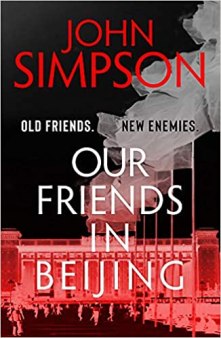 About the Book – Our Friends in Beijing
Jon Swift is in trouble again. His journalism career is in freefall. He is too old to be part of the new world order and he has never learned to suck up to those in charge. But experience has taught him to trust his instincts.
When, for the first time in years, Jon runs into Lin Lifeng in a café in Oxford he wonders if the meeting is a coincidence. When Lin asks him to pass on a coded message, he knows it’s not. Once a radical student who helped Jon broadcast the atrocities of Tiananmen Square, Lin is now a well-dressed party official with his own agenda.
Travelling to Beijing, Jon starts to follow a tangled web in which it is hard to know who are friends and who are enemies. As he ricochets across the country, Jon seeks to make sense of the ways in which China’s past and present are colliding – and what that means for the future of the country and the world. Under the watchful eyes of an international network of spies, double-agents and politicians, all with a ruthless desire for power, Jon is in a high-stakes race to expose the truth, before it’s too late.
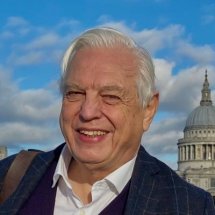 About the Author
BBC World Affairs Editor, John Simpson CBE is a journalist, broadcaster and accomplished author. One of the most respected foreign correspondents in the world, John is an inveterate traveller with an instinct for being at the right place at the right time.
John has reported from 140 countries and interviewed over 200 world leaders, including Barack Obama, Mikhail Gorbachev, Vladimir Putin, Margaret Thatcher and every British prime minister since Harold Wilson. He has spent time with and interviewed many notables over the years, such as Indira Gandhi, the Emperor Bokassa, Colonel Gadaffi, Bashir al-Asad, Nelson Mandela, and Robert Mugabe. He witnessed the execution of Saddam Hussein after the Second Gulf War and reported on Gadaffi’s demise and the aftermath of his death in Libya. He was on the Ayatollah Khomeini’s plane from Paris to Tehran during the Iranian Revolution. He was at the forefront of the BBC’s reporting during the First Gulf War which revolutionised the way in which people watch news to this day.
John is a specialist in many foreign regions, among them China, Russia, the Middle-East and Central Asia, as well as Europe and Africa, Argentina, Peru and Brazil.
John has received many prestigious awards, including the Royal Television Society’s Journalist of the Year (twice), three BAFTAs, an Emmy, Monte-Carlo TV Festival’s Golden Nymph, and the Bayeux award for war reporting. John is a Freeman of the City of London and president of The Chelsea Society. Many universities have awarded him honorary doctorates. He is an Honorary Fellow of Magdalene College, Cambridge, and has written 15 books including his memoir A Mad World, My Masters. His novel Moscow, Midnight was released in 2018. (Bio credit: Author website/Photo credit: Twitter profile)
Connect with John
Website | Twitter | Instagram

 About the Book
 About the Author


