
It’s a pleasure to be joining the publication day celebrations for The Dark Earth by Gordon Doherty, the sixth and epic finale to his ‘Empires of Bronze’ series. Gordon is the author of the ‘Legionary’ and ‘Strategos’ series and, along with Simon Turney, forms the dream team behind the ‘Rise of Emperors’ series. Follow the links from the titles to read my reviews of The Blood Road (Legionary #7) and Masters of Rome (Rise of Emperors #2).
I’m delighted to be able to bring you an excerpt from The Dark Earth which you can read below. The Dark Earth is available to purchase now from Amazon UK and other retailers.
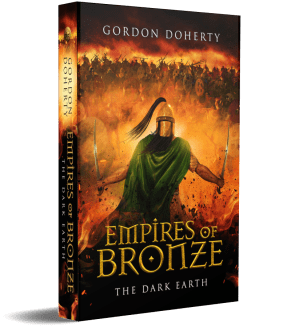 About the Book
The time will come, as all times must, when the world will shake, and fall to dust…
1237 BC: It is an age of panic. The great empires are in disarray – ravaged by endless drought, shaken by ferocious earthquakes and starved of precious tin. Some say the Gods have abandoned mankind.
When Tudha ascends the Hittite throne, the burden of stabilising the realm falls upon his shoulders. Despite his valiant endeavours, things continue to disintegrate; allies become foes, lethal plots arise, and enemy battle horns echo across Hittite lands.
Yet this is nothing compared to the colossal, insidious shadow emerging from the west. Crawling unseen towards Tudha’s collapsing Hittite world comes a force unlike any ever witnessed; an immeasurable swarm of outlanders, driven by the cruel whip of nature, spreading fire and destruction: the Sea Peoples.
Every age must end. The measure of a man is how he chooses to face it.
Format: ebook (478 pages)
Publication date: 26th May 2022 Genre: Historical Fiction
Find The Dark Earth on Goodreads
Extract from The Dark Earth by Gordon Doherty
Darkness fell and the blizzard hissed over the col. The Hittite soldiers hunkered down around a fire, pinching their hands for heat. Prince Tudha moved around the edges of the sheltered camp, thanking each man by name for their swiftness in tracking down the cattle rustlers. It was a technique King Hattu had taught him – to show them that they were more than just soldiers, to forge a bond. He spotted the granite-faced one again – the one who had been acting suspiciously all day. He realised that – to his shame – he didn’t know this man’s name. The mountain of muscle sat in just his leather kilt – no cloak for warmth – re-braiding his three pigtails.
‘What’s your name, soldier?’
The man looked up, sour at the interruption. ‘Skarpi.’
Tudha noticed how he seemed detached from the others. A loner. ‘You did well today. I will not forget your part in things.’
‘Hmm,’ the man said, then turned back to his braiding.
Bemused, Tudha left him to it rather than make an issue of his demeanour. Yet as he strolled away, he was certain – certain – that the man’s eyes were burning into his back.
‘My prince,’ called Heshni from the edge of the camp. He was beckoning Tudha over, shooting concerned looks past him and towards the spot where Skarpi was seated.
‘Who is that man?’ Tudha asked quietly as he neared his half-brother.
‘Skarpi? A nobody – son of a prostitute, some say. Lucky to be part of the Mesedi.’ Heshni eyed the surly soldier again sceptically, then beckoned Tudha towards the edge of the col. ‘Come, I wanted to show you something. Lights.’
‘Lights?’
‘I saw a torch, out there in the night, shining damply in the murk,’ Heshni explained, guiding Tudha forward, round the base of the col and down a loose track. Outside the lee of their camp, the storm roared, casting their long hair and cloaks horizontal. ‘I think the cattle thieves have doubled back,’ Heshni shouted to be heard in the scream of the blizzard. ‘They mean to steal from you again.’
‘Could they be so foolish?’ Tudha said, the snow stinging his bare arms and face. He could see nothing out there. ‘Where are these lights?’
‘There, look,’ Heshni said, pointing into the whiteout. He stepped aside to allow Tudha past to see for himself.
Tudha stared hard, but could see nothing except speeding white snow and darkness beyond. ‘I see no lights, and even if I could, I cannot believe that those men would risk their necks again. They knew how close they came to death today.’
‘If only you were so wise,’ Heshni purred from behind, the words underscored by the zing of a sword being plucked from its sheath.
Tudha swung on his heel, horrified by the sight of his half-brother, rising over him, teeth gritted in a snarl, blade plunging down towards his chest.
Blood erupted, hot and stinking. Tudha fell to his back, coughing, retching. Snow and blood all around…
 About the Author
Gordon writes: “I’m a Scottish writer, addicted to reading and writing historical fiction. My love of history was first kindled by visits to the misty Roman ruins of Britain and the sun-baked antiquities of Turkey and Greece. My expeditions since have taken me all over the world and back and forth through time (metaphorically, at least), allowing me to write tales of the later Roman Empire, Byzantium, Classical Greece and even the distant Bronze Age.”
Connect with Gordon
Website | Twitter | Facebook | Instagram





 What Cathy Read Next...