
My guest today on What Cathy Read Next is Rick Berry whose debut novel Kill All The Dogs was published on 28th January by SpellBound Books and is described as ‘jaw-dropping part psychological drama, part political satire‘. As every author knows, promoting your book to potential readers is a task that never ends. That’s where book bloggers come in, so I’m pleased to be able to bring you an extract from the book that will, I hope, whet your appetite to click on that ‘Buy Now’ button.
Kill All the Dogs is available to purchase from Amazon UK in paperback and as an ebook.
About the Book
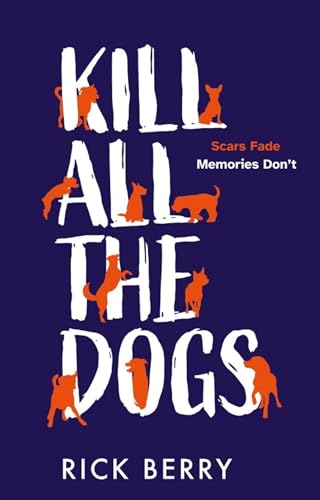
Are we defined by the things that happen to us, or the things we make happen to others?
Ten-year-old Nathan Hyde is playing in a tree house, when he witnesses a vicious attack on his best friend’s younger sisters. Life is never the same again.
Many years later, Nathan finds himself in the lower reaches of a government department, when an opportunity to confront his demons and enact revenge presents itself.
A mystery illness is taking hold in the population, at the very moment a scheming, attention-seeking politician becomes Nathan’s new boss.
It can’t happen, can it? In the farcical world of politics, anything is possible. Nathan Hyde is going to kill all the dogs.
Find Kill All The Dogs on Goodreads
Extract from Kill All The Dogs by Rick Berry
Skye is Nathan’s office friend. She’s been away for six months on secondment to another team, and this is her first day back. He’s been looking forward to her return. That was another reason to hide in the meeting room, to not let her see that.
“You’re back,” Nathan says.
“Before you decide whether to talk to me, let me tell you the most interesting thing I learned during my time in medical regulation. Then you can determine whether I am entertaining enough for you.”
She used to have her hair down, hanging just below her shoulders. Today she has it tied up. Nathan wants to know how it’s fastened but he can’t tell. Two loose strands, faintly brown, almost yellow, are hanging around her neck, the ends touching the skin.
“I’m listening,” Nathan says, smoothing down the corners of his newspaper.
The thing Nathan likes best about Skye is that she always wants to talk about work. Nathan is similar, except that he can only talk about work, but that makes them compatible enough.
“Great,” Skye says. She pulls out the chair next to Nathan’s so it’s diagonal to the table, and sits down. She’s beside him and facing him at the same time. He wants her to cross her legs so her foot dangles near to him, but she doesn’t. She puts both feet down on the floor like she doesn’t care where they go. Nathan likes that even more.
“Before I start, tell me everything you know about the regulation of dandruff shampoo.”
Nathan lets a second pass, then says, “Done.”
Skye laughs. “Well, let me educate you. We were being lobbied quite hard by a start-up pharmaceutical with a new product under development, you know, to help smooth their way to regulatory approval. Same as always, you’ll say. But it threw up some questions that none of us could really answer, so I was asked to write a report on it. I was annoyed at first, but it ended up being a fascinating case study of post-Brexit regulatory mayhem.”
“My favourite words in the English language.”
“It turns out that three distinct legal regimes can apply to dandruff products. Three, Nathan!” Skye holds three fingers up in the air and spins them around, “And the manufacturers essentially get to choose which one they comply with.”
Nathan is interested now.
“Firstly,” she says, “it could be regulated as a medicine.” One finger in the air. “The shampoo is treating a medical condition, so it should be, really. But that’s a very strict set of rules to follow, with years of tests needed to prove efficacy before you can even market the product. So, we looked at option two.”
She forgets to do the fingers, so Nathan holds his own up.
“Exactly,” she says. “They can call it a cosmetic instead, which might make sense, seeing as it’s on the same aisle as all the lime, honey and elderflower shampoos in the supermarket. But if it’s a cosmetic, then they can’t make any medicinal claims on the packaging. Even if it does have a medicinal effect. Isn’t that funny? They have to deliberately downplay the quality of their product.”
Nathan and Skye have had drinks after work a few times. The last time, at the end of the night Skye leaned in close to him. I think something’s happening, she whispered to him, but I want to be sure. The conference room has a frosted glass wall, so no-one would see if Nathan leaned over towards her now and asked quietly in her ear, Are you sure yet? But he doesn’t. He doesn’t want to stop her from talking.
“What’s the third?” he asks. I’ll get another chance, he thinks.
But Skye’s stopped talking anyway. She leans back in her chair and stares at him for a few seconds. “Oh, the dandruff!” she says, finally. She holds three fingers in the air. “The third option is to have it regulated as a biocide. This is more of a catch-all regime, for anything that acts against a biological agent, and isn’t subject to other regulation. Standards are lower. But this is supposed to be for industrial products. Big shampoo doesn’t like the idea of their fancy products being regulated like common bleach, so they volunteer for one of the tougher regimes.”
Nathan laughs. “People can get away with anything in politics, can’t they?” he says. “Just make everyone look where you want them to look.”
“Well, they’re paying my wages and keeping me intellectually stimulated, so I can’t complain,” she says. “Anyway, now I’ve said all this, revealing myself to be the biggest policy nerd in the universe, it’s time you told me your thing.”
“What thing?”
“Your thing, Nathan. The thing that has kept you going recently. The problem you’re trying to figure out or the new idea you’re trying to get implemented.”
“I don’t have a thing,” he says. “There’s no point in anyone as far down the hierarchy as me having a thing.”
Skye tuts and gets up, says she has something to do before the meeting. “You’re wrong,” she adds. “It’s only the people at the bottom who do have things. They make you discard them before they promote you.”
Skye leaves the room and Nathan is alone again. She is the one he likes.
About the Author

Rick Berry is an author from Greater Manchester, now living in London. His debut novel, Kill All The Dogs, was published by SpellBound Books in January 2024. His short fiction has been published by Dream Catcher, The Letters Page, Cafe Irreal, Planet Raconteur and Bandit Fiction. In his day job he works in politics.
Connect with Rick
Website | X | Instagram | Facebook






 What Cathy Read Next...