
About the Book
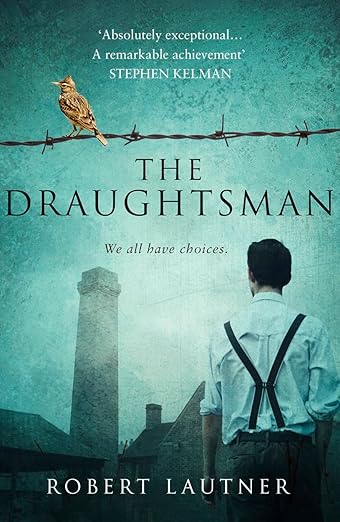
Erfurt, Germany, 1944. Ernst Beck has a new job at prestigious engineering firm, Topf & Sons. Finally he can make a contribution to the war effort, provide for his beautiful wife, Etta, and make his parents proud. But there is a price.
He is assigned to the Special Ovens Department and tasked with annotating plans for new crematoria that are deliberately designed to burn day and night. Their destination: the concentration camps. Topf’s new client: the SS. Ernst must choose between turning a blind eye, or speaking out for the fate of thousands.
Format: Paperback (481 pages) Publisher: The Borough Press
Publication date: 8th February 2018 Genre: Historical Fiction
Find The Draughtsman on Goodreads
Purchase The Draughtsman from Bookshop.org [Disclosure: If you buy books linked to our site, we may earn a commission from Bookshop.org, whose fees support independent bookshops]
My Review
Ernst’s story demonstrates how easily someone can become complicit in evil. The offer of a well-paid job with a highly respected and successful company means the possibility of leaving behind the hand-to-mouth existence of himself and his wife, Etta. There’s even a rent free house that comes with the job, containing more rooms than he has furniture to fill and, wonder of wonders, a telephone. His parents are delighted at his good fortune.
Ernst’s new job involves something he’s good at and has been trained for. He believes he is making a contribution to the war effort. He doesn’t question why the SS might require so many ovens and with such high capacity. But perhaps there really are that many criminals who succumb to typhus in the camps? ‘Prisons need ovens. Cities need sewers. Unpleasant, but the way of things.’
Hannah Arendt’s phrase ‘the banality of evil’ came frequently to mind whilst reading the book and this evil was spread wider than we might imagine and often, as it were, hidden in plain sight. ‘This was how it was done. The tanks and the aircraft were the hammers, but the bureaucracy, the lists and the files by the men in smart shoes and ties were the nails to keep everything in place.’
This is mass murder as a bureaucratic operation with the SS’s prime concern being improving the efficiency of the ovens, ensuring they break down less often and keeping costs to a minimum. Hence the nature of the building Ernst is tasked with working on, something so horrific one cannot imagine it could have been real. (It was, although thankfully it was never built.)
Time and time again I returned to the questions: How did a whole nation allow the ‘normalisation’ of mass murder? How did one individual manage to convince good people to do awful things? (A clever touch is that Hitler is never mentioned by name, but always referred to as ‘He’ or ‘Him’.)
Only Etta has misgivings about Ernst’s work which increase when she learns the nature of the task he is working on.
Eventually Ernst’s eyes are opened to the truth. And when Erfurt, which has been largely immune from the direct impact of the war because of its geographical position, is no longer safe from Allied bombing raids, it becomes clear to him that Germany is not winning the war as the propaganda suggests. Far from it. But what should he do? He’s just one man and he knows the risks involved in speaking out. Not just for himself but for Etta. Even more so for Etta, as it turns out. On the other hand, he fears the information he possesses may be destroyed in the chaos of defeat and the world will never know about it.
Throughout the book there are chilling juxtapositions of the beautiful and the terrible. When Hans Klein, head of the euphemistically named ‘Special Ovens’ Department, shows Ernst to the floor in the factory where he will work, he says, ‘There is a fine view of the hills. All day you can see the smoke from Buchenwald rising to them. It is a pleasant room.’ The book depicts many disturbing scenes but the humanity of the characters of Ernst, Etta and their friend Paul somehow keeps you from feeling completely without hope.
In his Author’s Note, Robert Lautner explains that he started the story wanting to ask the question, ‘What would you do?’ but the question became, ‘What should you do? Now. Today’. It is possible that even today in some small way, and entirely unintentionally, we all may be contributing to a system that profits from the exploitation and misery of others.
The Draughtsman is a chilling reminder of how easy it is not to see what’s going on before your eyes, to question it or to look the other way and thereby be drawn into a state of complicity. And that there is evil in the world that most of us are unable to contemplate but it’s there all the same.
In three words: Chilling, thought-provoking, intense
Try something similar: The Zone of Interest by Martin Amis
About the Author

Robert Lautner was born in Middlesex in 1970. Before becoming a writer he owned his own comic-book store, worked as a wine merchant, photographic consultant and recruitment consultant. He now lives on the Pembrokeshire coast in a wooden cabin with his wife and children. (Robert Lautner is the pen name of the author, Mark Keating.)
Connect with Robert
Website | X/Twitter




 What Cathy Read Next...