Throwback Thursday: Tightrope (Marian Sutro #2) by Simon Mawer

ThrowbackThursday

Throwback Thursday is a weekly meme hosted by Renee at It’s Book Talk.  It’s designed as an opportunity to share old favourites as well as books that we’ve finally got around to reading that were published over a year ago.  If you decide to take part, please link back to It’s Book Talk.

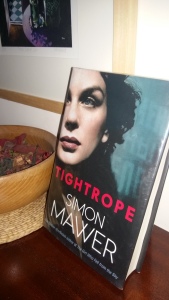
Today I’m reviewing Tightrope (Marian Sutro #2) by Simon Mawer, published in 2015.  It’s my book for the March theme (And The Award Goes To…) of The BookBum Club on Goodreads, run by the lovely Zuky, as it won The Walter Scott Prize for Historical Fiction in 2016.


TightropeAbout the Book

As Allied forces close in on Berlin in spring 1945, a solitary figure emerges from the wreckage that is Germany. It is Marian Sutro, whose existence was last known to her British controllers in autumn 1943 in Paris. One of a handful of surviving agents of the Special Operations Executive, she has withstood arrest, interrogation, incarceration, and the horrors of Ravensbrück concentration camp, but at what cost?

Returned to an England she barely knows and a post-war world she doesn’t understand, Marian searches for something on which to ground the rest of her life. Family and friends surround her, but she is haunted by her experiences and by the guilt of knowing that her contribution to the war effort helped lead to the monstrosities of Hiroshima and Nagasaki.  When the mysterious Major Fawley, the man who hijacked her wartime mission to Paris, emerges from the shadows to draw her into the ambiguities and uncertainties of the Cold War, she sees a way to make amends for the past and at the same time to find the identity that has never been hers.

A novel of divided loyalties and mixed motives, Tightrope is the complex and enigmatic story of a woman whose search for personal identity and fulfillment leads her to shocking choices.

Format: Hardcover (408 pp.)       Publisher: Little, Brown
Published: 4th June 2015              Genre:  Historical Fiction

Purchase Links*
Amazon.co.uk  ǀ  Amazon.com  ǀ Hive.co.uk (supporting UK bookshops)
*links provided for convenience, not as part of any affiliate programme

Find Tightrope on Goodreads


My Review

Based on the book description, I was anticipating an enthralling Cold War spy story in the manner of John Le Carré and I certainly got that in the final third of the book.  What I wasn’t expecting was such a devastating portrait of the lasting impact of their experiences on those who, like Marian, performed undercover roles in the Second World War.

Our narrator is Sam, who first encounters Marian when he is a child (as a friend of his mother), later when he is an impressionable teenager and finally when he is an adult but still slightly in thrall to her.  Marian’s story, as presented to the reader, is part her testimony, part Sam’s first-hand experience, part evidence he has gleaned from official files and part his recreation of how he imagines events may have taken place.  The reader is never entirely sure which. Of course, part of Marian’s undercover role involved presenting herself as someone she wasn’t, living an acquired identity, never really being herself.  ‘That was the problem with words – they nailed the thought down, made it explicit, fixed it, crucified it on the cross of exact meaning.  But life has no exact meanings, only shades of meaning, hints, versions and contradictions, s confusion of loves and hates, of motives and desires.’   What is the true story?

The author convincingly portrays Marian’s difficulty in adjusting to ‘normal’ life and overcoming the psychological, physical and emotional scars she bears as a result of her terrible experiences: arrest, interrogation, torture and, ultimately, confinement in the Ravensbrück concentration camp.  Marian feels a sense of dislocation from other people.  ‘It was just indifference, a sensation of estrangement from the ordinary matters of human contact.  Conversation with anyone felt like trying to talk to people in a foreign language when you only have a fraction of the vocabulary at your disposal and half the grammar.’  It is as if a yawning gulf separates her from the rest of humanity: ‘And she felt something strange, the sensation of uniqueness.  It wasn’t a good feeling, just one of separation’.

It’s not just Marian who has been changed by the war.  The author gives us an evocative and comprehensive picture of the impact of the war on people, places, geopolitics, political and philosophical argument, technology and much else.  Even small things, like the way people interact:
‘“Where are you from, then?” the barman asked.
No stranger ever asked a question like that last time she was in the city.  Questions drew you into other people’s stories, got you involved, got you into trouble.  Now no one cared.’

Marian and her brother, Ned, are appalled by the use of the atomic bomb on Hiroshima and Nagasaki and the prospect of the United States developing the technology still further.  In particular, Marian is plagued by guilt that her actions during the war might unwittingly contribute to a repetition of the horrors she has already witnessed, but multiplied a hundredfold.  This guilt propels Marian down a path of secrets, lies and betrayal that will require the use of all the skills and tradecraft she acquired in preparation for her wartime exploits.   Like how to fashion a weapon out of what’s to hand, how to tell if you’re being followed and how to shake off your followers.  It will put her in danger and make her question who, if anyone, she can trust so that carefully planning each small move, each sentence uttered, becomes critical.

‘She waited a moment, looking at him.  And then she made her move.  It felt like walking a tightrope, feeling the balance, knowing that a slight shift either side might be fatal.  She reached her foot forward and poised to transfer her weight onto it, feeling the rope wobbling.  No safety net.’

I loved Tightrope.  I was completely drawn into Marian’s story although the romantic in me would have liked a slightly different outcome for her and the man who becomes such an important part of her life.  However, the path the author chose for her was admittedly more true to her character. I haven’t read the first book in the series, The Girl Who Fell From The Sky (published under the title Trapeze in the United States), so I don’t have the benefit of knowing how much of this book repeats events from the earlier one. What I do know is that Tightrope works brilliantly as a standalone read and from the very beginning I got that comforting feeling that I was in the hands of a skilled writer and accomplished storyteller.

Follow my blog with Bloglovin

In three words: Insightful, powerful, moving

Try something similar…Nucleus (Tom Wilde #2) by Rory Clements (click here to read my review)


Simon MawerAbout the Author

Simon Mawer is a British author of ten novels and two non-fiction books. The Glass Room, published by Little, Brown in January 2009, was on the Man Booker shortlist. His current novel is entitled Tightrope. The UK paperback and the e-book are out now. The US edition was published in November 2015.

He currently lives in Italy.

Connect with Simon

Website  ǀ  Facebook  ǀ  Twitter ǀ  Goodreads


Book Review: The Gallows Pole by Benjamin Myers

WaltScott_The Gallows PoleAbout the Book

“I saw them. Stag-headed men dancing at on the moor at midnight, nostrils flared and steam rising…”

An England divided. From his remote moorland home, David Hartley assembles a gang of weavers and land-workers to embark upon a criminal enterprise that will capsize the economy and become the biggest fraud in British history.  They are the Cragg Vale Coiners and their business is ‘clipping’ – the forging of coins, a treasonous offence punishable by death.  A charismatic leader, Hartley cares for the poor and uses violence and intimidation against his opponents. He is also prone to self-delusion and strange visions of mythical creatures.

When excise officer William Deighton vows to bring down the Coiners and one of their own becomes turncoat, Hartley’s empire begins to crumble. With the industrial age set to change the face of England forever, the fate of his empire is under threat.

Forensically assembled from historical accounts and legal documents, The Gallows Pole is a true story of resistance that combines poetry, landscape, crime and historical fiction, whose themes continue to resonate. Here is a rarely-told alternative history of the North.

Format: ebook, paperback, hardcover  (360 pp.) Publisher: Bluemoose Books
Published: 17th May 2017                                          Genre: Historical Fiction

Purchase Links (Kindle edition currently 99p on Amazon UK)
Amazon.co.uk  ǀ  Amazon.com  ¦ Publisher ǀ Hive.co.uk (supporting UK bookshops)
*links provided for convenience, not as part of any affiliate programmePublisher

Find The Gallows Pole on Goodreads


My Review

The Gallows Pole is one of the books long-listed for The Walter Scott Prize for Historical Fiction 2018.  Click here for the full long-list and links to information or my reviews of the long-listed books.

The book recounts events that took place in Calderdale, West Yorkshire, over a few years in the 1760s: the exploits of a gang known as the ‘Cragg Vale Coiners’.  ‘Coining’ was the illegal practice of removing shavings of gold from the edges of genuine coins, milling the edges of those coins smooth again and then using the shavings to produce counterfeit coins.

The narrative is interspersed with excerpts from a document written in the first person using vernacular dialogue, eccentric spelling and very little punctuation.  Its author is the so-called ’King’ of the coiners, David Hartley.  It’s his jail cell testimony – not confession, mind you – he’s keen to point that out.  Hartley recounts his first exposure to the coining process in the forges of The Black Country: ‘…What they done is smelt and pour and hammer and mould What they done is hoist and heft and scald and steam And what they done was learn us a new trayde a new way.’

The Gallows Pole transports the reader to a period when the first impact of industrialization and mechanisation was starting to be felt by residents of places like Calderdale.  Power was becoming concentrated in the hands of landowners, of factory and mill owners and employment was taking the place of self-employment or small-scale agriculture.  Old ways were coming into conflict with the forces of progress and modernity.  For many ordinary people, their whole way of life was changing, not necessarily for the better (reminiscent in some ways of the modern day impact of globalisation).   It’s not surprising that desperation and poverty should force some to look outside the law for the means to survive.  Or, that men like Hartley, should reject the notion of change altogether.  [Readers who dislike swearing should skip the next quotation.]

‘An he seys the day of the hand loom is over mass produckshun is cumin wether you lyke it or not aye mass produckshun and organysed laber is what I’m talkin abowt and if youv got any sens about yer yerll embrayce the new ways.  And I says fuck the new ways and fuck the company and fuck your fucken scut with a rusted nyfe if yor still thinken on telling King David of Cragg Vale wer it is he can or cannit wander you soppybolickt daft doylem fiddler of beests.’

I think you may be starting to get a sense that creative use of language is a key element of this book.  [Can I give a shoutout to the copy editors and proof-readers of the book at this point.]  The author evocatively conjures up the atmosphere of the moors; its bleakness but also its harsh beauty.  ‘Then when the downpour eased and the clouds passed over to slowly bank across the open moors in the direction of Haworth, the valley slopes were left with a fresh dusting of white, a patchwork of powdered shapes divided by the black streaks of stone walls that snaked over and around copses, hamlets and the top quarries…’

There is a rhythmic, almost poetic quality to the language with frequent use of alliteration and assonance: ‘In to dell and dingle.  Gulch and gully.’ ‘From the dells and dales and dingles.’ ‘Slipping and sliding.  Gasping and striding.’  Some of the prose is positively audacious – for its use of repetition:

‘Tom Spencer walked to Horsehold and folk there gave up their coin.  Tom Spencer walked to Burnt Stubb and folk there gave up their coin.  Tom Spencer walked to Boulder Clough and folk there gave up their coin.  Tom Spencer walked to Midgley and folk there gave up their coin…’

And for the lists – sometimes long lists – of names and of places giving a sing-song quality to the writing.

‘Up they came and over they came and through they came.  Many men.
Isaac Dewhurst and Absolom Butts.
Thomas Clayton and Benjamin Sutcliffe.
Abraham Lumb and Aloysius Smith and Nathan Horsfall and Matthew Hepworth and Joseph Gelder and Jonathan Bolton.
John Wilcox and Jonas Eastwood.
Fathers and brothers and sons and uncles.  Up they came.  And others too.’

The language at times is earthy and raw with visceral descriptions of bodily sensations and creative evocations of sights, sounds, smells, tastes.  ‘Soot and ash.  Snot and spume. Quag and sump and clotted moss.’ 

The story that unfolds is as compelling as the language. However, despite his criminal activity and the violence perpetrated by those around him, the reader is left with a sense of David Hartley as a tragic figure.  He certainly becomes a folk hero in the eyes of the local community.  That is, to those who don’t attempt to resist him, swindle him, usurp him or bring him to justice.  Retribution is swift and violent for them.

There is a real sense of period atmosphere in The Gallows Pole, of a time when life was hard for many and death was an often close companion.  It was definitely not the time or place to be a woman; relegated to the role of child bearer, provider of sexual pleasure (willingly or not) and household drudge.   The only sign of tenderness is between Hartley and his wife, and even that is relative.

The Gallows Pole made a deep impression on me.  The story was powerfully told and had a marvellous sense of authenticity.  However, it was the imaginative writing that really drew me in.  It may not turn out to be the closest to my heart of the books on the long-list but its author has certainly earned my admiration. I realise it’s early to be making predictions, especially as I haven’t read all the books on the long-list yet.   Nevertheless, I’m going to stick my neck out and say I can see The Gallows Pole being the Days Without End of 2018.  In other words, not only making the shortlist but possibly being the eventual winner.  If I’m wrong, forget you read this.  If it turns out I’m right, remember, you saw it here first.

Follow my blog with Bloglovin

In three words: Gritty, compelling, immersive

Try something similar…Days Without End by Sebastian Barry (click here to read my review)


Benjamin MyersAbout the Author

Benjamin Myers was born in Durham, UK, in 1976.  He is an award-winning author and journalist. As a journalist he has written about the arts and nature for publications including New Statesman, The Guardian, NME, Mojo, Time Out, New Scientist, Caught By The River, The Morning Star, Vice, The Quietus, Melody Maker and numerous others.

Pig Iron (2012) was the winner of the inaugural Gordon Burn Prize and runner-up in The Guardian’s Not The Booker Prize. A controversial combination of biography and novel, Richard (2010), was a bestseller and chosen as a Sunday Times book of the year.  Myers’ short story ‘The Folk Song Singer’ was awarded the Tom-Gallon Prize in 2014 by the Society of Authors and published by Galley Beggar Press. His short stories and poetry have appeared in dozens of anthologies.

His novel Beastings (2014) won the Portico Prize For Literature, was the recipient of the Northern Writers’ Award and longlisted for a Jerwood Fiction Uncovered Award 2015. Widely acclaimed, it featured on several end of year lists, and was chosen by Robert Macfarlane in The Big Issue as one of his books of 2014.  Turning Blue (2016) was described as a “folk crime” novel, and praised by writers including Val McDermid. A sequel These Darkening Days followed in 2017.

Recipient of the Roger Deakin Award, his novel The Gallows Pole was published to acclaim in 2017.  His latest book, Under The Rock, a work of non-fiction, is published May 2018.

He currently lives in the Upper Calder Valley, West Yorkshire, UK.

Connect with Benjamin

Website ǀ  Twitter  ǀ  Goodreads

WaltScott_The Gallows PoleWalterScottPrizeBluemoose_logo_400x400