
 The shortlist for the Walter Scott Prize for Historical Fiction was announced on 2nd April 2020.
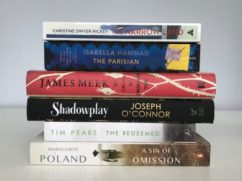
The six books are:
- The Narrow Land by Christine Dwyer Hickey (Atlantic)
- The Parisian by Isabella Hammad (Jonathan Cape)
- To Calais, In Ordinary Time by James Meek (Canongate)
- Shadowplay by Joseph O’Connor (Harvill Secker)
- The Redeemed by Tim Pears (Bloomsbury)
- A Sin Of Omission by Marguerite Poland (Penguin South Africa)
I’m disappointed my own personal favourite from the longlist, Once Upon A River by Diane Setterfield, didn’t make it through but my congratulations to the authors and publishers of those that did. You can find more details about the shortlisted books further on in this post.
In usual times, the winner would be crowned in June at the Borders Book Festival but, since we’re definitely not in ‘usual times’ and the Festival has had to be postponed, news of how and when the winner will be announced is still awaited. Something that is usual is how spectacularly unsuccessful I was once again in forecasting which books would appear on the longlist. To be fair, I actually got three – The Hiding Game, Once Upon A River and The Offing.
As in previous years, I’ll try to read as many of the books on the shortlist as possible before the winner is announced. This year that task is made harder by the fact I haven’t yet read any of them and don’t own copies of them all either.
Once again, I’ll also share my prediction of which book will win. Now there’s something I have been more successful at, having correctly picked last year’s winner, The Long Take by Robin Robertson, and the 2018 winner, The Gallows Pole by Benjamin Myers. (At this stage, just based on the book descriptions and judges’ comments, my money would be on To Calais, In Ordinary Time by James Meek because, if the past couple of years is anything to go by, the judges seem to favour books with an unusual narrative style.)
 About the Shortlisted Books
The Narrow Land by Christine Dwyer Hickey (in my TBR pile)
Described by the judges as ‘a quiet tour-de-force’, the book is a portrait of the marriage of artist Edward Hopper and his wife, Josephine.
The Parisian by Isabella Hammad (in my TBR pile)
Described as ‘a ground-breaking first novel’, it explores the unequal relationship between the Levant and Western Europe before the First World War. It’s a whopper at over 700 pages!
To Calais, In Ordinary Time by James Meek
According to the judges, the book is ‘an extraordinary novel’ but one which they also describe as ‘ambitious and challenging’. Set in the 14th century, it’s about a group of disparate characters en route to Calais. It’s also been nominated for The Orwell Prize for Political Fiction 2020.
Shadowplay by Joseph O’Connor (currently listening to audiobook version)
Described as ‘a deep dive into late Victorian theatreland, the book explores the turbulent relationship between actress Ellen Terry, actor and impresario Sir Henry Irving and Bram Stoker.
The Redeemed by Tim Pears (in my TBR pile)
The final part of the author’s West Country trilogy, is set in 1916 and described as ‘a timeless, stirring and exquisitely wrought story of love, loss and destiny fulfilled, and a bittersweet elegy to a lost world’.
If there’s any justice, Tim Pears should be in with a chance because both the two previous books in the trilogy – The Horseman and The Wanderers – were longlisted in previous years.
A Sin Of Omission by Marguerite Poland
A book I’d never heard of before it appeared on the longlist, it’s the story of a young South African man trained for the Christian ministry in England who faces prejudice and conflicted loyalties when he returns to South Africa.
What do you think of the judges’ selection? If you’ve read any of the shortlisted books, what are your thoughts on them?


