Throwback Thursday: The Last Day by Claire Dyer

ThrowbackThursday

Throwback Thursday is a weekly meme originally created by Renee at It’s Book Talk.  It’s designed as an opportunity to share old favourites as well as books that we’ve finally got around to reading that were published over a year ago.

Today I’m revisiting a book I reviewed last May but that was published almost exactly a year ago – The Last Day by Claire Dyer.  It was a book I loved when I read it which seems a suitable sentiment to mark Valentine’s Day.  In fact, as you will see, I found at least ten reasons to love it….
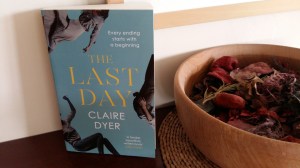

The Last DayAbout the Book

They say three’s a crowd but when Boyd moves back into the family home with his now amicably estranged wife, Vita, accompanied by his impossibly beautiful twenty-seven-year-old girlfriend, Honey, it seems the perfect solution: Boyd can get his finances back on track while he deals with his difficult, ailing mother; Honey can keep herself safe from her secret, troubled past; and Vita can carry on painting portraits of the pets she dislikes and telling herself she no longer minds her marriage is over.

But the house in Albert Terrace is small and full of memories, and living together is unsettling.

For Vita, Boyd and Honey love proves to be a surprising, dangerous thing and, one year on, their lives are changed forever.

Format: Paperback, ebook (370 pp.)    Publisher: The Dome Press
Published: 15th February 2018     Genre: Contemporary Fiction

Purchase Links*
Publisher (buy direct for 30% off) | Amazon.co.uk  ǀ  Amazon.com  ǀ Hive.co.uk (supporting UK bookshops)
*links provided for convenience, not as part of any affiliate programme

Find The Last Day on Goodreads


10 Things I Loved About The Last Day by Claire Dyer

  • The structure of the book – Told from alternating points of view of the main characters, at random intervals the reader gets a chapter about a seemingly unrelated character whose role in the story will only be revealed at the end of the book.
  • The atmosphere in the house – The book creates a powerful sense of claustrophobia.  The house in Albert Terrace is small, smaller than the reader might have imagined, meaning Vita, Boyd and Honey are in close proximity all the time.  The three of them share one bathroom and the rooms are described as ‘crowded with furniture’.  At one point Vita says, ‘I feel cramped by their presence in the house.’
  • The apt names – The character names give an insight into their personalities.  There’s Vita whose name matches her feisty nature, someone who’s full of life and not a little pent-up anger.  There’s Boyd, whose names speaks of solidity and honesty.  There’s Honey who embodies the sweet nature her name suggests.  And there’s Trixie – but I’m going to let you read the book and work that one out.
  • Colin – Oh, poor Colin, Vita’s convenient companion for outings, suppers and – occasionally – something more.   His comment to Vita, “If you’re happy, I’m happy” sums him up.
  • Honey’s superstitions – Bringing bread and salt to a new home (and sprinkling the salt on the doorstep), going in and out by the same entrance, flinging open all the door at midnight on New Year’s Eve to let the old year escape unimpeded.  And I can’t finish without mentioning the precaution against bad luck Honey takes on p.47.  Sorry, you’re going to have to read the book to find out!
  • Vita’s pet portraits – In fact, not so much the pet portraits as Vita’s sheer contempt at what she’s been reduced to – painting pictures of pampered pooches.
  • Shared pleasures – Boyd’s and Vita’s early morning chats over tea or coffee and the crossword.  What could be more civilised?
  • Tension – The presence of secrets and hidden frustration contribute to an air of mounting pressure that the reader feels must eventually find some release.  As Vita observes, ‘…how can this house survive seeing it’s full to bursting with the three of us, our belongings, and so many unsaid things?’
  • That ending – The tension mentioned above builds to a dramatic and heart-breaking conclusion that represents both a last day in one respect and a first day in another.

Elements of the story, for me, were definitely in the realm of fiction but what really stood out about The Last Day was the depth of the characterisation, the intense atmosphere the author created within the house and the compelling nature of the relationship between Vita, Boyd and Honey.

I received a review copy courtesy of publishers, The Dome Press.

Follow my blog with Bloglovin

In three words: Intense, compelling, intimate

Try something similar…That Summer in Puglia by Valeria Vescina (read my review here)

Claire DyerAbout the Author

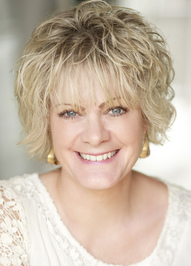
Claire Dyer’s novels The Moment and The Perfect Affair, and her short story, Falling For Gatsby, are published by Quercus. Her poetry collections, Interference Effects and Eleven Rooms are published by Two Rivers Press. She has an MA in Creative Writing from Royal Holloway, University of London and teaches creative writing for Bracknell & Wokingham College.  She also runs Fresh Eyes, an editorial and critiquing service. (Photo credit: Goodreads author page)

Connect with Claire

Website  ǀ  Twitter  ǀ  Facebook | Instagram | Goodreads

Buchan of the Month/Book Review: Memory Hold-the-Door by John Buchan

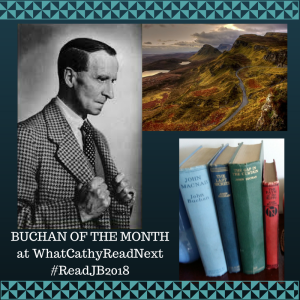
Buchan of the Month

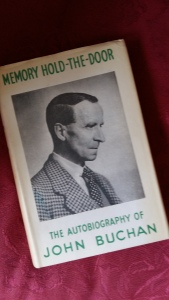
MemoryHoldTheDoorAbout the Book

John Buchan, 1st Baron Tweedsmuir (1875-1940) completed his autobiography not long before his death. A highly accomplished man, his was a life of note. Although now known by many chiefly as an author, he was also an historian, Unionist politician and Governor General of Canada. Although he stated that it was not strictly an autobiography, Memory Hold-the-Door provides a reflective, personal account of his childhood in Scotland, his literary work from his time at Oxford University to the famous Hannay and Leithen stories and his extensive public service in South Africa, Scotland, France in the Great War, and Canada. Known in the United States as Pilgrim’s Way, Memory Hold-the-Door was reportedly one of the favourite books of John F. Kennedy.

Format: Hardcover         Publisher: Hodder & Stoughton
Published: 1964 [1940]  Genre: Nonfiction, Memoir

Purchase Links*
Amazon.co.uk ǀ Amazon.com
*links provided for convenience, not as part of any affiliate programme

Find Memory Hold-the-Door on Goodreads


My Review

Memory Hold-the-Door is the penultimate book in my Buchan of the Month reading project for 2018.  You can find out more about the project plus my reading list for 2018 here and read my introduction to the book here.   Memory Hold-the-Door is also one of the books I read for Nonfiction November.

On 5th February 1940, Buchan wrote to his sister, Anna, ‘I have finished my novel [Sick Heart River] and my autobiography’. The following day, Buchan suffered the cerebral thrombosis that ultimately proved fatal and he died on 12th February.  Some time before Buchan had told a correspondent that Memory Hold-the-Door was ‘not an ordinary autobiography or any attempt to tell the unimportant story of my life; but rather an attempt to pick out certain high lights and expound the impressions made upon me at different stages’.

Buchan made a deliberate choice not to write about anyone still alive, including family members, so there are only a few passing mentions of his wife and children in Memory Hold-the-Door.  There is, however, this lovely sentiment: ‘I have been happy in many things, but all my other good fortune has been as dust  in the balance compared with the blessing of an incomparable wife.’

There are generous and astute pen pictures of contemporary figures of note with whom Buchan came into contact during a life and career that encompassed the law, colonial administration, publishing, journalism, work in military intelligence, service as an MP and as Governor-General of Canada, as well as the writing for which he is now best known.  Such figures include Lord Grey, Arthur Balfour, Lord Haig and King George V.

Of the latter, Buchan writes: ‘He did me the honour to be amused by my romances [by which Buchan means his adventure stories and historical novels], and used to make acute criticisms on questions of fact.  Of one, a poaching story of the Highlands [which I assume to be John Macnab], he gave me a penetrating analysis, but he approved of it sufficiently to present many copies of it to his friends.’

I particularly enjoyed Buchan’s portrait of his friendship with T. E. Lawrence which to me appears insightful despite Buchan’s own remark that ‘there is no brush fine enough to catch the subtleties of his mind, no aerial viewpoint high enough to being into one picture the manifold of his character’.   Buchan recalls, ‘He would turn up without warning at Elsfield [Buchan’s Oxfordshire home] at any time of the day or night on his motor-cycle Boanerges, and depart as swiftly and mysteriously as he came’.  Buchan remembers Lawrence’s ‘delightful impishness’ but also his depression following what he considered his failure on behalf of the Arabs.  Buchan writes: ‘In 1920 his whole being was in grave disequilibrium.  You cannot in any case be nine time wounded, four times in an air crash, have many bouts of fever and dysentery, and finally at the age of twenty-nine take Damascus at the head of an Arab army, without living pretty near the edge of your strength’.  Quite.

Most touching are the portraits of friends, many of whom sadly died in the First World War (as did one of Buchan’s brothers, Alastair) .  Some of these portraits also appear in Buchan’s book These For Remembrance, originally privately printed.

Elsewhere in Memory Hold-the-Door he writes about his student days (including some high jinks) at Oxford University, his admiration for America and its people, his love of fishing and mountaineering, and his experience of the absurdities of the House of Commons (which I suspect may be largely unchanged).  ‘There are seats for only about three-fourths of the members, and these seats are uncomfortable; the ventilation leaves the head hot and the feet cold; half the time is spent dragging wearily in and out of lobbies, voting on matters about which few members know anything; advertising mountebanks can waste a deal of time; debates can be as dull as a social science congress in the provinces…’  However, for balance, he does go on to say that ‘speeches are shorter and of a far higher quality than in any other legislative assembly’.

The book is written in Buchan’s customary effortless prose style and while some of the people he writes about may no longer be familiar to or of interest to the modern reader, it does give a fascinating insight into an admittedly elite stratum of society of that time and Buchan’s personal philosophy and beliefs or his ‘creed’ as he refers to it.  About his own writing, he describes himself as a ‘copious romancer’ and ‘a natural story-teller, the kind of man who for the sake of his yarns would in prehistoric days have been given a seat by the fire and a special chunk of mammoth’.

One of Buchan’s last acts as Governor-General of Canada was to sign that country’s entry into the Second World War.  With remarkable prescience, he writes in the final chapters of Memory Hold-the-Door of his fears for the future.  ‘We have lived by toleration, rational compromise and freely expressed opinion, and we have lived very well.  But we had come to take these blessings for granted, like the air we breathed. […] Today we have seen those principles challenged… We have suddenly discovered that what we took for the enduring presuppositions of our life are in danger of being destroyed.’   Indeed, Buchan had remarked earlier in the book that ‘the study of [history] is the best guarantee against repeating it’.

Next month’s Buchan of the Month is Sick Heart River, Buchan’s last novel which was published posthumously.  Along with Mr. Standfast, it is my favourite of his novels.  Look out for my introduction to the book next week and my review towards the end of the month.

Follow my blog with Bloglovin

In three words: Reflective, friendship, personal

Try something similar…Unforgettable, Unforgotten by Anna Buchan


John BuchanAbout the Author

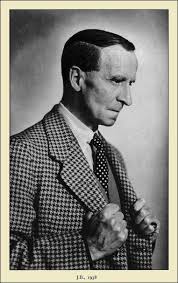
John Buchan (1875 – 1940) was an author, poet, lawyer, publisher, journalist, war correspondent, Member of Parliament, University Chancellor, keen angler and family man.  He was ennobled and, as Lord Tweedsmuir, became Governor-General of Canada.  In this role, he signed Canada’s entry into the Second World War.   Nowadays he is probably best known – maybe only known – as the author of The Thirty-Nine Steps.  However, in his lifetime he published over 100 books: fiction, poetry, short stories, biographies, memoirs and history.

You can find out more about John Buchan, his life and literary output by visiting The John Buchan Society website.