

Throwback Thursday is a weekly meme hosted by Renee at It’s Book Talk. It’s designed as an opportunity to share old favourites as well as books that we’ve finally got around to reading that were published over a year ago. If you decide to take part, please link back to It’s Book Talk.
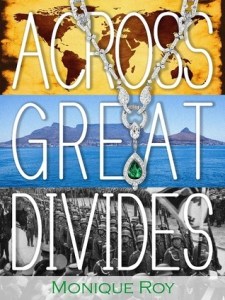
This week I’m sharing my review of Across Great Divides by Monique Roy, published in 2013. It’s the powerful story of a Jewish family’s struggle for a place to call home against the backdrop of war and apartheid.
 About the Book
When Hitler comes to power in 1933, one Jewish family refuses to be destroyed and defies the Nazis only to come up against another struggle – confronting Apartheid in South Africa. As Jews, life becomes increasingly difficult for identical twin sisters Eva and Inge under the oppressive and anti-Semitic laws of Nazi Germany. After witnessing the horrors of Kristallnacht, they flee their beloved homeland, finally finding a new home for themselves in the beautiful country of South Africa; however, just as things begin to feel safe, their new home becomes caught up in its own battles of bigotry and hate under the National Party’s demand for apartheid. Will Eva and Inge ever be allowed to live in peace? Across Great Divides is a tale of one family’s struggle to survive in a world tainted with hate, and the power of love that held them all together.
Format: ebook (223 pp.), paperback (222 pp.)
Published: June 2013 Genre: Historical Fiction
Purchase Links*
Amazon.co.uk ǀ Barnes & Noble
*links provided for convenience, not as part of any affiliate programme
Find Across Great Divides on Goodreads
My Review
As the book opens, the author depicts how life gets increasingly difficult for the family with the rise of Hitler. There are detailed descriptions of events in Berlin such as the book-burning and violence of Kristallnacht. I did feel that one or two sections read more like straight history rather than being illustrated through the experiences of Eva or her family. The author has clearly undertaken extensive research because as well as a wealth of information about events in Germany there are fascinating details about the diamond cutting and trading business.
Eva and her brother, Max, get the most page time with other members of the family, including Eva’s twin, Inge, more in the background. The unique connection between the twins is explored early on and returned to briefly later but it would have been interesting to have more focus on this.
The family’s struggle to escape from Nazi Germany illustrates the bravery and resourcefulness of those in real life who aided Jews to escape death in the concentration camps but also the opportunity for corruption for those prepared to take advantage of the situation. The family have a number of lucky escapes and are fortunate to have a seemingly unlimited stock of diamonds to ease their passage. One wonders how those without such resources would have fared.
Although powerfully told, I found some of the story lines a little convenient and there are a couple of coincidences along the lines of “of all the gin joints in all the towns in all the world, she walks into mine” (Casablanca) or, in this case, tent. However, I really liked the impression the author created of the family’s sense of uprootedness, of feeling no longer welcome somewhere they had considered home and being viewed as a hated “other”.
‘Our home was everything and then we felt like we existed nowhere. The place where I thought I would live all my life was no longer the place where I could exist at all.’
In the latter section of the book, the author juxtaposes the persecution suffered by Jewish families at the hands of the Nazis with the discrimination meted out to black South Africans through the apartheid system. Of the family, only Max and Eva really seem to see the parallels and some of the responses of other family members are surprising given their own experiences. The author’s love of South Africa is clear from the wonderful descriptions of the landscape and scenery of Cape Town. I enjoyed the book and admire the author for attempting to explore some weighty themes.
 About the Author
Monique was born in Cape Town, South Africa, and her grandparents were European Jews who fled their home as Hitler rose to power. It’s their story that inspired her to write Across Great Divides. She is also the author of a middle-grade book, Once Upon a Time in Venice, and Monique is working on her third novel, which also takes place during the World War II.
Connect with Monique
Website ǀ Facebook ǀ Twitter ǀ Goodreads


 About the Book
 About the Author

