
Throwback Thursday: Miss Treadway and the Field of Stars by Miranda Emmerson

ThrowbackThursday

Throwback Thursday is a weekly meme hosted by Renee at It’s Book Talk.  It’s designed as an opportunity to share old favourites as well as books that we’ve finally got around to reading that were published over a year ago.  If you decide to take part, please link back to It’s Book Talk.

Today I’m revisiting a book that I reviewed in the early days of my blog, Miss Treadway and the Field of Stars by Miranda Emmerson (published in January 2017).  I really enjoyed this period mystery set in 1965 in London’s Theatreland and gave it the full five stars.  I heard a rumour that the author is working on a sequel – I do hope so.
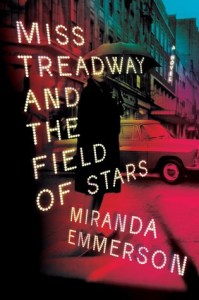

miss-treadwayAbout the Book

Soho, 1965.  In a tiny two-bed flat above a Turkish café on Neal Street lives Anna Treadway, a young dresser at the Galaxy Theatre.  When the American actress Iolanthe Green disappears after an evening’s performance at the Galaxy, the newspapers are wild with speculation about her fate.  But as the news grows old and the case grows colder, it seems Anna is the only person left determined to find out the truth.  Her search for the missing actress will take her into an England she did not know existed: an England of jazz clubs and prison cells, backstreet doctors and seaside ghost towns, where her carefully calibrated existence will be upended by violence but also, perhaps, by love.For in order to uncover Iolanthe’s secrets, Anna is going to have to face up to a few of her own…

Format: Hardcover, ebook (297 pp.)   Publisher: 4th Estate
Published: 12th January 2017                Genre: Historical Fiction, Mystery

Purchase Links*
Amazon.co.uk  ǀ  Amazon.com
*links provided for convenience, not as part of any affiliate programme

Find Miss Treadway and the Field of Stars on Goodreads


My Review

At first, it seems as if Miss Treadway and the Field of Stars is going to be a straightforward period detective mystery but there are a number of elements that, as you read on, raise it to another level.

Firstly, the authentic feel of the period setting.  This is the England of homes without central heating, smoke-filled bars and buses, seedy clubs, drugs, awful coffee, backstreet abortions and, most shockingly, homophobia and overt racism against black people, Irish people and basically anyone who is perceived as an outsider.

Secondly, Miranda Emmerson has created such a great cast of supplementary characters, including Ottmar, the Turkish café owner, and Aloysius, the Jamaican accountant.   It is no accident that the characters who help Anna in her search for Iolanthe are all outsiders and perhaps it’s the fact that Iolanthe is also an outsider that makes them care so much for her fate.

Lastly, this is such a multi-layered novel because underneath the simple mystery narrative are questions of identity and reinvention.   All the characters have either reinvented themselves, wish to reinvent themselves or are struggling to play a part they haven’t quite come to terms with.  There’s Anna, who admits “I tried to be someone and I failed” and is drawn to starting over anew; Sergeant Brennan Hayes, who changes his Christian name and accent to disguise his Irish origins (“His new voice commanded more respect, his new name spoke of privileged beginnings.  He didn’t belong anywhere, he was aware of this, but he looked like he belonged, sounded like he belonged”) ; his wife, Orla, who empathises with Iolanthe’s determination that “one part of your life needs to end and another to begin”  when she realises that Brennan “just wasn’t who I thought he was at all”;  and Aloysius, who has moved to London because he is “in love with the idea of England” but the England of Dickens, which turns out to be a far cry from reality he experiences.

I was really impressed with this book.  At the end, there are questions unanswered but I’d like to think these were not unintended loose ends but deliberate on the part of the author or (even better) threads to be woven into a future book.  This was a great read that would keep you entertained for hours on a train or plane journey.

I received an advance review copy courtesy of NetGalley and HarperCollins UK/4th Estate in return for an honest review.

Follow my blog with Bloglovin

In three words: Authentic, engaging, satisfying

Try something similar… Curtain Call by Anthony Quinn

Miranda EmmersonAbout the Author

Miranda Emmerson is a playwright and author.  She grew up in south-west London before studying English at Oxford and Playwriting Studies at Birmingham. In her twenties she edited and wrote for charity and magazine websites, and scripted audio magazines for people with a learning disability. She has travelled extensively in Europe, North America and Asia. She lives in Wales with her husband and their two daughters.

She’s a regular contributor to BBC Radio 4 and BBC Radio 4 Extra (sometimes as Miranda Davies) where she specialises in adapting books for dramatic serialisation.

She is currently undertaking a PhD at Cardiff University looking at the history of BBC radio adaptation examining the dramatic adaptation of un-English writing for an Anglocentric medium.  She has published one work of non fiction – the travelogue Fragrant Heart – and one work of fiction – the novel Miss Treadway & the Field of Stars.

Connect with Miranda

Website ǀ  Twitter  ǀ  Goodreads


Throwback Thursday: 1066 What Fates Impose by G K Holloway

ThrowbackThursday

Throwback Thursday is a weekly meme hosted by Renee at It’s Book Talk. It’s designed as an opportunity to share old favourites as well as books that we’ve finally got around to reading that were published over a year ago. If you decide to take part, please link back to It’s Book Talk.

Today I’m reviewing a book that was kindly sent to me by the author, Glynn Holloway, quite a few months ago now but which has only just reached the top of my review pile. Published in 2013, it’s his debut historical fiction about the events leading up to the Battle of Hastings in 1066.

1066WhatFatesImposeAbout the Book

England is in crisis. King Edward has no heir and promises never to produce one. There are no obvious successors available to replace him, but quite a few claimants are eager to take the crown. While power struggles break out between the various factions at court, enemies abroad plot to make England their own. There are raids across the borders with Wales and Scotland. Harold Godwinson, Earl of Wessex, is seen by many as the one man who can bring stability to the kingdom. He has powerful friends and two women who love him, but he has enemies who will stop at nothing to gain power. As 1066 begins, England heads for an uncertain future. It seems even the heavens are against Harold. Intelligent and courageous, can Harold forge his own destiny – or does he have to bow to what fates impose?

Format: ebook (456 pp.)                             Publisher: Matador
Published: 4th March 2013                       Genre: Historical Fiction

Purchase Links*
Amazon.co.uk ǀ Amazon.com
*links provided for convenience, not as part of any affiliate programme

Find 1066: What Fates Impose on Goodreads

My Review

The powerful opening chapter of the book places the reader by the bedside of the dying William the Conqueror, in 1087. What follows is a sort of book length flashback setting out the factional and political machinations that would lead inexorably – is the author’s suggestion based on the title – to the events of 1066 and the defeat of Harold at the Battle of Hastings.

Most students of English history will, I suspect, be familiar with the events of 1066 but like me know less about the events of the preceding 20 years. Starting in 1045 in the reign of Edward (the Confessor), the author takes the reader in detail through the rivalries, quarrels, battles for land, influence and power of the nobles close to the throne. There are a lot of characters to keep track of so a dramatis personae would have been a useful addition to the book. It’s probably the nature of the times that the female characters play a pretty shadowy role, their chief value being as diplomatic bargaining chips, marriage material or reproductive machines to provide the all-important male heirs.

I’ll be honest and say that half way through the book I was beginning to feel slightly overwhelmed with all the political machinations. Occasionally, the author’s obviously extensive research seemed a little obtrusive with sections on sword-making, dining customs, etc. feeling a little like they had been inserted from a text book. At times, the dialogue came across as rather stilted or included modern idioms that seemed out of place but you did get a sense of the characters from the way they interacted with each other. There were also a couple of nice succinct lines that drew my eye:

On the death by Count Conan by poison: ‘Brittany now had a new Count, Alan the Red, friend and ally of Duke William. Such is fate.’
On Earls Edwin and Morcar manoeuvring Harold into marrying their sister, Aldytha: ‘Harold had their sister but they had him.’

The pace really picked up for me in the final third of the book as events drew nearer to the decisive Battle of Hastings. The author does a great job of explaining all the factors that played a part in the outcome of that day; some a question of chance, the weather or a seemingly unimportant foolish decision. The battle scenes are absolutely gripping. Harold, although ruthless when needed, definitely comes out as the more likeable character and, although I feel a bit soppy for saying this since everyone knows the outcome of the battle, I couldn’t help wishing events had ended differently and he’d prevailed (if only for poor Edyth waiting under that tree).

This was a violent time in history when life was often short and death did not always come about by natural causes. In keeping with the period, there are some gruesome scenes (especially towards the end of the book where the reader encounters a particularly unpleasant character) although nothing worse I would say than you might find in Game of Thrones.

There was a lot I learnt from reading this book, such as the fact that William was able to use his influence to get the Pope to pronounce his campaign against Harold as a crusade, causing additional troops from across Europe to rally to the Norman standard. For historical fiction fans who like their history detailed and aren’t afraid of a large cast of characters, this would make a rewarding read.

I received a review copy courtesy of the author in return for an honest and unbiased review.

Follow my blog with Bloglovin

In three words: Detailed, well-researched, absorbing

Try something similar…The King’s Jew by Darius Stransky (click here for my review)

Glynn HollowayAbout the Author

Glynn writes: Born in the 1950s in an anonymous northern English town, I left school at sixteen and worked in a series of manual jobs until, at the age of 24, I decided to do something more challenging and rewarding. I chose to combine education and travel, by working over the winter while I studied and touring Europe in the summer after taking exams. I did this for a couple of years until I had the qualifications to get myself on to a degree course. I have been interested in history since I was a boy, which I suppose explains why, when I came across a degree course in History and Politics at Coventry University that looked tailor made for me, I applied right away.

In my first year at Coventry I lived in the halls of residence within a stone’s throw of the Leofric Hotel. Just a short walk from my halls, is the bell tower that houses a clock, which when its bell chimes the hour, produces a half size model of a naked Lady Godiva riding a white horse. Above her, Peeping Tom leans out of a window for a better view. In all of the three years I was there, it never once occurred to me that I would one day write a book featuring Earl Leofric and his famous wife, as key characters.

After graduating, I spent a year in Canada before returning to England to train as a Careers Officer in Bristol. Later, I lived and worked in Gloucestershire as a Careers Officer and then in Adult Education. After I met my wife, I moved back to Bristol to live and I worked at Bath Spa University as a Student Welfare Officer. It was about this time I read a biography about King Harold II which fascinated me so much it inspired me to write my own version of events. Now, after many years of study and time spent over a hot keyboard, I have finally produced that novel.

The decision to write 1066 was one of best I ever made. Research took to places I either had never heard of or I thought I’d never see. In England I visited York, Stamford Bridge, Winchester, Bosham, Battle, Stowe Anglo Saxon village. In Normandy I went to Falaise, Mont St Michael and of course Bayeux, to see the famous tapestry. The more I researched the more amazed I became about how events played out. For Harold, everything that could go wrong did go wrong. It was as though the gods were against him; hence the title, 1066 What Fates Impose.

Connect with Glynn

Website ǀ Facebook ǀ Twitter ǀ Goodreads