My Week in Books – 11th May 2025

Monday – I published my review of Sister Rosa’s Rebellion by Carolyn Hughes.

Tuesday – My take on this week’s Top Ten Tuesday topic was Authors Who’ve Appeared At My Local Literary Festival.

Wednesday – As always WWW Wednesday is a weekly opportunity to share what I’ve just read, what I’m currently reading and what I plan to read next… and to take a peek at what others are reading. 

Thursday – My guest was Susan Ekins, author of Hoodwink!: A ‘true’ medieval whodunnit.

Friday – I shared my book club’s thoughts on The Kellerby Code by Jonny Sweet.

Saturday – I published my sign-up post for the 20 Books of Summer 2025 Reading Challenge.


Our London Lives by Christine Dwyer Hickey (Atlantic Books via NetGalley)

1979. In the vast and often unforgiving city of London, two Irish outsiders seeking refuge find one another: Milly, a teenage runaway, and Pip, a young boxer full of anger and potential who is beginning to drink it all away.

Over the decades their lives follow different paths, interweaving from time to time, often in one another’s sight, always on one another’s mind, yet rarely together.

Forty years on, Milly is clinging onto the only home she’s ever really known while Pip, haunted by T.S. Eliot’s The Waste Land, traipses the streets of London and wrestles with the life of the recovering alcoholic. And between them, perhaps uncrossable, lies the unspoken span of their lives.

Dark and brave, this epic novel offers a rich and moving portrait of an ever-changing city, and a profound inquiry into character, loneliness and the nature of love.

Queen Macbeth by Val McDermid (Polygon)

A thousand years ago in an ancient Scottish landscape, a woman is on the run with her three companions – a healer, a weaver and a seer. The men hunting her will kill her – because she is the only one who stands between them and their violent ambition. She is no lady: she is the first queen of Scotland, married to a king called Macbeth.

As the net closes in, we discover a tale of passion, forced marriage, bloody massacre and the harsh realities of medieval Scotland. At the heart of it is one strong, charismatic woman, who survived loss and jeopardy to outwit the endless plotting of a string of ruthless and power-hungry men. Her struggle won her a country. But now it could cost her life.

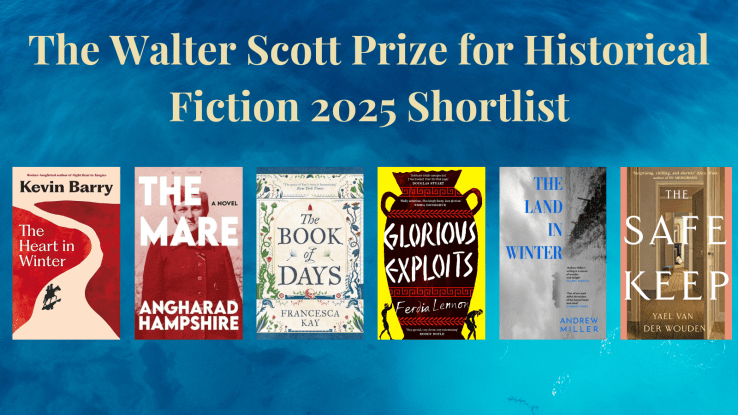
I’m reading Glorious Exploits by Ferdia Lennon, listening to The Book of Days by Francesca Kay – both books on the shortlist for the Walter Scott Prize for Historical Fiction – and reading My Name is Emilia Del Valle by Isabel Allende from my NetGalley shelf.


  • Book Review: Days of Light by Megan Hunter
  • Book Review: My Name is Emilia del Valle by Isabel Allende

The Kellerby Code by Jonny Sweet: A Book Club Discussion

About the Book

In a world he can’t afford, Edward is just about getting by. He spends his days scurrying after his friends, doing everything to prove his value. But not to worry; the attention of his beloved Stanza and the respite he finds in her ancestral home, Kellerby House, provide all the reward he needs.

Until he realises that Stanza is in love with his best friend, Robert, forcing Edward to re-evaluate what those closest to him are actually worth. No price is too high to stop the life he has strived for slipping from his grip. Especially when he won’t be the one paying.

Format: Paperback (384 pages) Publisher: Faber and Faber
Publication date: 27th February 2025 Genre: Contemporary Fiction, Crime

Find The Kellerby Code on Goodreads

Purchase The Kellerby Code from Bookshop.org [Disclosure: If you buy books linked to our site, we may earn a commission from Bookshop.org, whose fees support independent bookshops]

The Discussion

The Kellerby Code was the April pick of the book club run by Waterstones in Reading.

Everyone agreed the book was very funny. As you’d expect from an author who started out as a comedian, there are great one-liners, witty dialogue and acerbic observation. For example, when Edward is introduced to one of Stanza’s schoolfriends, Dinita.

They were told immediately that she was heading up inclusivity, diversity and outreach at Hendepul, a global television firm, and that her employers didn’t at all understand black youth. Dinita had moved to London from Iran, where her father was involved in oil, been educated at public school and now lived in a large house in Notting Hill, but still: ‘These people just do not understand the average immigrant experience.’

There are some very amusing scenes. One I’d pick out is a dinner party hosted by Robert at which, as a parlour game, each guest is handed a folded piece of paper describing a personality trait or conversational tic they must perform. At the end of the evening others must guess what it was. Edward adopts his given persona so enthusiastically it causes alarm to other guests. However, there was a point in the book (involving a horse) where people felt the humour tipped over into absurdity.

Quite a few of us found pretty much all the characters unlikeable. Personally that meant I couldn’t really care what happened to them whilst others absolutely rejoiced in a book with so many unlikeable characters. There were mixed opinions about Edward. Some felt sorry for him. Others (me included) felt his original actions had unintended consequences meaning he increasingly lost control of events. One person, drawing on the comparisons to Patricia Highsmith’s character Ripley, thought Edward was a portrait of a psychopath. And they had a point because events turn increasingly macabre with Edward displaying an unexpected, or perhaps up until now repressed, capacity for violence.

The author is a devotee of P. G. Wodehouse and there are plenty of nods to the Jeeves stories. For example, Edward’s surname is Jevons and he acquires a sort of inner voice he names Plum, which was Wodehouse’s nickname. Edward performs butler-like duties for his friends, Robert and Stanza, such as picking up their dry cleaning, organising birthday presents and preparing meals. Desperate to retain Robert’s friendship, he’s happy to act as ‘fixer’ but the problems he’s asked to tackle for Robert go way beyond anything Jeeves might have had to sort out for Bertie Wooster. And although Bertie may have been hapless at least he was amiably hapless. I felt Robert was completely self-absorbed, sucking up to Edward when he needed something and then ghosting him when it was done, or even denying he’d asked Edward to do it in the first place.

I was surprised, bearing in mind the cover, that Kellerby House doesn’t actually feature much until near the end of the book and that, considering his supposed devotion to the place, Edward’s final act seems rather bizarre. There was a lot of discussion about the ending which I’m not going to detail here but safe to say there are a few ways you could interpret it and the motivations of those involved.

Our discussions often lead to thoughts about similarities to other books. People came up with (obviously) The Talented Mr Ripley by Patricia Highsmith but also The Secret History by Donna Tartt and the film ‘Saltburn’.

Although I was more lukewarm about The Kellerby Code than some other book club members, I still found a lot to enjoy in it. It was definitely a great choice for a book club because it provoked a lot of different views. In fact, the discussion could have gone on for much longer than the allotted hour.

The Kellerby Code is an entertaining mystery/thriller with a generous helping of black comedy. If you’ve seen the film ‘Wicked Little Letters’ (for which the author wrote the screenplay) you’ll have an idea what to expect.

About the Author

Author Jonny Sweet

Jonny Sweet started out winning the Edinburgh Comedy Award for Best Newcomer in 2009, and in the intervening years, his work as a writer and actor has been varied and exceptional. His first feature was Wicked Little Letters, starring Olivia Coleman and Jessie Buckley. Alongside writing and acting, he develops and produces TV and film through his award-winning company People Person Pictures. The Kellerby Code is his debut novel. (Photo: Amazon author page)