#BookReview Youth and the Bright Medusa by Willa Cather #1920Club

510+6-1hr3L._SX398_BO1,204,203,200_About the Book

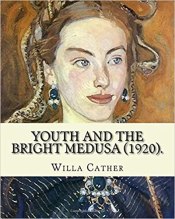
A collection of short stories by Willa Cather, published in 1920, including ‘Coming, Aphrodite!’, an unforgettable novella of a young artist in New York and his relationship with a girl who hopes to become an opera star, and ‘Paul’s Case’ which reveals the frustration and pain of a lonely youth from the provinces who escapes to New York City for a brief, tragic time.

Format: ebook (156 pages)       Publisher: AB Books
Publication date: 11th May 2018 [1920] Genre: Fiction, Short Stories

Purchase links*
Amazon.co.uk | Amazon.com |
*links provided for convenience not as part of an affiliate programme

Find Youth and the Bright Medusa on Goodreads


My Review

The collection, first published in 1920, comprises two novellas – ‘Coming, Aphrodite’ and ‘The Diamond Mine’ – and six short stories. The last four stories had previously appeared in an earlier collection, The Troll Garden, published in 1905.

Having finished the book, I was left puzzled by its title since none of the stories shared it (as if often the case with short story collections) or made direct reference to it. However, I was fortunate to come across an image from the first edition of the book in which its publisher, Alfred A Knopf, helpfully describes its theme as “youth’s adventure with the many-coloured Medusa of art”. (The collection is also praised as ‘a new exhibition of the writer’s power and remarkable artistry’.)

My previous experience of Willa Cather’s writing was through books such as My Antonia, and O Pioneers! meaning I associated her with the setting of those novels not the New York that features so prominently in the stories in Youth and the Bright Medusa. However, as I learned, although she grew up in Virginia and Nebraska, she moved to Pittsburgh and then New York, living in the latter for the remainder of her life.

In fact, many of the stories in Youth and the Bright Medusa present a far from pastoral view of frontier life.   For example, in ‘The Sculptor’s Funeral’, the coffin housing the body of famous sculptor Harvey Merrick is returned to his home town in Kansas but the townspeople who gather to mark his passing are depicted as rather small-minded.  Failing to recognise his achievement in rising from such humble beginnings, they are chided by one of the mourners who reflects, ‘The very name of their town would have remained for ever buried in the postal guide had it not been now and again mentioned in the world in connection with Harvey Merrick’.

The story also contains some striking examples of the author’s closely-observed and often unflinching description of characters.  So the sculptor’s father is ‘tall and frail, odorous of smoke, with shaggy, unkept grey hair and a dingy beard, tobacco stained about the mouth‘. The face of the sculptor’s grieving mother is described thus: ‘The long nose was distended and knobbed at the end and deep lines on either side of it; her heavy black brows almost met across her forehead; her teeth were large and square, and set far apart – teeth that could tear’.   Conversely the opera singers who populate other stories such as ‘A Death in the Desert’ and ‘Coming, Aphrodite!’ are depicted as radiant and uncommonly beautiful.

The power of music or art to move and enrich is a consistent theme of the stories. In ‘A Wagner Matinee’, the narrator takes his aunt, who first influenced his love of music and is visiting from the small Nebraska town where he grew up, to a concert of classical music.  He is amazed by her reaction to it. ‘The deluge of sound poured on and on; I never knew what she found in the shining current of it; I never knew how far it bore her or past what happy islands.’   In ‘Paul’s Case’, a troubled young man who experiences ‘a shuddering repulsion for the flavourless, colourless mass of everyday existence’ finds solace in his work as an usher at Carnegie Hall where the music acts as an ‘orgy of living’.  Determined to live the life he believes he was meant to, he indulges in one glorious period of indulgence, never to be repeated.

Youth and the Bright Medusa was the book I read for The 1920 Club event hosted by Simon at Stuck in a Book and Karen at Kaggsy’s Bookish Ramblings

In three words: Sardonic, acutely-observed, insightful

Try something similar: In A German Pension: 13 Stories by Katherine Mansfield

Follow my blog via Bloglovin


Willa CatherAbout the Author

Wilella Sibert Cather was born in Back Creek Valley (Gore), Virginia, in December 7, 1873. Her novels on frontier life brought her to national recognition. In 1923 she was awarded the Pulitzer Prize for her novel, One of Ours (1922), set during World War I. She grew up in Virginia and Nebraska. She then attended the University of Nebraska, initially planning to become a physician, but after writing an article for the Nebraska State Journal, she became a regular contributor to this journal. Because of this, she changed her major and graduated with a bachelor’s degree in English.

After graduation in 1894, she worked in Pittsburgh as writer for various publications and as a school teacher for approximately 13 years, thereafter moving to New York City for the remainder of her life. She travelled widely and often spent summers in New Brunswick, Canada. In later life, she experienced much negative criticism for her conservative politics and became reclusive, burning some of her letters and personal papers, including her last manuscript.

She was elected a Fellow of the American Academy of Arts and Sciences in 1943. In 1944, Cather received the gold medal for fiction from the National Institute of Arts and Letters, an award given once a decade for an author’s total accomplishments. She died of a cerebral haemorrhage at the age of 73 in New York City.


#WWWWednesday – 15th April 2020

WWWWednesdays

Hosted by Taking on a World of Words, this meme is all about the three Ws:

  • What are you currently reading?
  • What did you recently finish reading?
  • What do you think you’ll read next?

Why not join in too?  Leave a comment with your link at Taking on a World of Words and then go blog hopping!


Currently reading

An ARC, my Buchan of the month, two books from my TBR pile and an audiobook.  Yes, I’m really embracing lockdown multi-tasking!

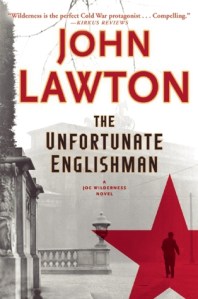
The Unfortunate EnglishmanThe Unfortunate Englishman (Joe Wilderness #2) by John Lawton (hardcover)

Having shot someone in what he believed was self-defence in the chaos of 1963 Berlin, Wilderness finds himself locked up with little chance of escape. But an official pardon through his father-in-law Burne-Jones, a senior agent at MI6, means he is free to go – although forever in Burne-Jones’s service.

His newest operation will take him back to Berlin, which is now the dividing line between the West and the Soviets. A backstory of innocence and intrigue unravels, one in which Wilderness is in and out of Berlin and Vienna like a jack-in-the-box. When the Russians started building the Berlin wall in 1961, two unfortunate Englishmen were trapped on opposite sides. Geoffrey Masefield in the Lubyanka, and Bernard Alleyn (alias KGB Captain Leonid Liubimov) in Wormwood Scrubs.

In 1965 there is a new plan. To exchange the prisoners, a swap upon Berlin’s bridge of spies. But, as ever, Joe has something on the side, just to make it interesting, just to make it profitable. The Unfortunate Englishman is a thrilling tale of Khrushchev, Kennedy, a spy exchange . . . and ten thousand bottles of fine Bordeaux. What can possibly go wrong?

A Life Without EndA Life Without End by Frédéric Beigbeder, trans. by Frank Wynne (advance review copy, courtesy of World Editions)

What does the man who has everything – fame, fortune, a new love, and a new baby – want for his fiftieth birthday? The answer is simple: eternal life.

Determined to shake off the first intimations of his approaching demise, Frédéric tries every possible procedure to ward off death, examining both legal and illegal research into techniques that could lead to the imminent replacement of man with a post-human species. Accompanied by his ten-year-old daughter and her robot friend, Frédéric crisscrosses the globe to meet the world’s foremost researchers on human longevity, who – from cell rejuvenation and telomere lengthening to 3D-printed organs and digitally stored DNA – reveal their latest discoveries.

With his blend of deadpan humor and clear-eyed perception, Beigbeder has penned a brutal and brilliant exposé of the enduring issue of our own mortality.

The Hidden VillageThe Hidden Village by Imogen Matthews (ebook, courtesy of Amsterdam Publishers)

Wartime Holland. Who can you trust?

Deep in the Veluwe woods lies a secret that frustrates the Germans. Convinced that Jews are hiding close by they can find no proof. The secret is Berkenhout, a purpose-built village of huts sheltering dozens of persecuted people.

Young tearaway Jan roams the woods looking for adventure and fallen pilots. His dream comes true when he stumbles across an American airman, Donald C. McDonald. But keeping him hidden sets off a disastrous chain of events.

Sofie, a Jewish Dutch girl, struggles to adapt to living in Berkenhout, away from her family and friends. As weeks turn to months, she’s worried they’ll abandon her altogether. Henk Hauer, head woodman, is in charge of building the underground huts and ensuring the Berkenhout inhabitants stay safe. But many grow suspicious of his liaisons with the Germans. Is he passing on secret information that could endanger lives?

All it takes is one small fatal slip to change the course of all their lives for ever.

Shadowplay AudiobookShadowplay by Joseph O’Connor (audiobook)

1878: The Lyceum Theatre, London. Three extraordinary people begin their life together, a life that will be full of drama, transformation, passionate and painful devotion to art and to one another. Henry Irving, the Chief, is the volcanic leading man and impresario; Ellen Terry is the most lauded and desired actress of her generation, outspoken and generous of heart; and ever following along behind them in the shadows is the unremarkable theatre manager, Bram Stoker.

Fresh from life in Dublin as a clerk, Bram may seem the least colourful of the trio but he is wrestling with dark demons in a new city, in a new marriage, and with his own literary aspirations. As he walks the London streets at night, streets haunted by the Ripper and the gossip which swirls around his friend Oscar Wilde, he finds new inspiration. But the Chief is determined that nothing will get in the way of his manager’s devotion to the Lyceum and to himself. And both men are enchanted by the beauty and boldness of the elusive Ellen.

20200408_133244_kindlephoto-201916321A Book of Escapes and Hurried Journeys by John Buchan (hardcover)

A collection of stories dealing with escapes and adventurous journeys, including the escape of Charles II to France after the Battle of Worcester, Winston Churchill’s escape from South Africa and many more.


Recently finished

Links from the titles will take you to my review or the book description on Goodreads.

A Thousand MoonsA Thousand Moons by Sebastian Barry (eARC, courtesy of Faber & Faber and NetGalley)

Even when you come out of bloodshed and disaster in the end you have got to learn to live.

Narrated by Winona, the young Lakota orphan adopted by soldiers Thomas McNulty and John Cole in Days Without End, A Thousand Moons continues Sebastian Barry’s extraordinary fictional exploration of late nineteenth century America.

Living with Thomas and John on the farm they work in 1870s Tennessee, educated and loved, Winona is employed by the lawyer Briscoe in the nearby town of Paris, as she tries to forge a life for herself beyond the violence and dispossession of her past. But the fragile harmony of this shared world, in the aftermath of the Civil War, is soon threatened by a further traumatic event, one which Winona struggles to confront let alone understand.

Told in Sebastian Barry’s gorgeous, lyrical prose, A Thousand Moons is a powerful, moving study of one woman’s journey, about her determination to write her own future, and about the enduring human capacity for love.

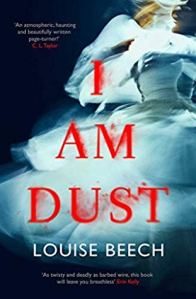
I Am DustI Am Dust by Louise Beech (ebook, courtesy of Orenda Books and Random Things Tours)

When iconic musical Dust is revived twenty years after the leading actress was murdered in her dressing room, a series of eerie events haunts the new cast, in a bewitching, beguiling and terrifyingly dark psychological thriller…

The Dean Wilson Theatre is believed to be haunted by a long-dead actress, singing her last song, waiting for her final cue, looking for her killer… Now Dust, the iconic musical, is returning after twenty years. But who will be brave enough to take on the role of ghostly goddess Esme Black, last played by Morgan Miller, who was murdered in her dressing room?

Theatre usher Chloe Dee is caught up in the spectacle. As the new actors arrive, including an unexpected face from her past, everything changes. Are the eerie sounds and sightings backstage real or just her imagination? Is someone playing games? Is the role of Esme Black cursed? Could witchcraft be at the heart of the tragedy? And are dark deeds from Chloe’s past about to catch up with her?

Not all the drama takes place onstage. Sometimes murder, magic, obsession and the biggest of betrayals are real life. When you’re in the theatre shadows, you see everything. And Chloe has been watching…

510+6-1hr3L._SX398_BO1,204,203,200_Youth and the Bright Medusa by Willa Cather (ebook)

A collection of short stories by Willa Cather, published in 1920, including ‘Coming, Aphrodite!’, an unforgettable novella of a young artist in New York and his relationship with a girl who hopes to become an opera star, and ‘Paul’s Case’ which reveals the frustration and pain of a lonely youth from the provinces who escapes to New York City for a brief, tragic time. (Review to follow)


What Cathy (will) Read Next

The Wheelwright's DaughterThe Wheelwright’s Daughter by Eleanor Porter (ebook, courtesy of Boldwood books and Rachel’s Random Resources)

Can she save herself from a witch’s fate?

Martha is a feisty and articulate young woman, the daughter of a wheelwright, living in a Herefordshire village in Elizabethan England. With no mother Martha’s life is spent running her father’s meagre household and helping out at the local school whilst longing to escape the confines and small-mindedness of a community driven by religious bigotry and poverty.

As she is able to read and is well-versed in herbal remedies she is suspected of being a witch. When a landslip occurs – opening up a huge chasm in the centre of the village – she is blamed for it and pursued remorselessly by the villagers.

But can her own wits and the love of local stable hand Jacob save her from a witch’s persecution and death…