#BookReview A Life Without End by Frédéric Beigbeder @WorldEdBooks

A Life Without EndAbout the Book

What does the man who has everything – fame, fortune, a new love, and a new baby – want for his fiftieth birthday? The answer is simple: eternal life.

Determined to shake off the first intimations of his approaching demise, Frédéric tries every possible procedure to ward off death, examining both legal and illegal research into techniques that could lead to the imminent replacement of man with a post-human species. Accompanied by his ten-year-old daughter and her robot friend, Frédéric criss-crosses the globe to meet the world’s foremost researchers on human longevity, who – from cell rejuvenation and telomere lengthening to 3D-printed organs and digitally stored DNA – reveal their latest discoveries.

With his blend of deadpan humour and clear-eyed perception, Beigbeder has penned a brutal and brilliant exposé of the enduring issue of our own mortality.

Format: Paperback (304 pages)  Publisher: World Editions
Publication date: 16 April 2020 Genre: Contemporary Fiction

Find A Life Without End on Goodreads

Purchase links*
Amazon.co.uk | Amazon.com | Hive (supporting UK bookshops)
*links provided for convenience not as part of an affiliate programme


My Review

For a fair bit of this book I found myself trying to work out whether it was fiction or non-fiction. I came to the conclusion that it’s a mixture of both. Many of the people Frédéric meets do exist in real life (thank you, Google) and hold the positions in the scientific and commercial institutions mentioned. Without a lot of research, I’m unable to say how much of what they tell him about their discoveries and how they might be used is accurate, but I’m betting most of it is. That’s a bit scary in some cases.

This is my first book by the author but, reading up on him, I learned that there is a strong autobiographical element to his work. For instance, in the book, the narrator is married to his second wife and has two daughter, as does the author (although the names of his wife and daughters have been changed). I’m unsure if he shares with the narrator a seeming preoccupation with women’s breasts.

There are some great one-liners such as the author’s observation about the current obsession with selfies that, “Modern man is a collection of 75 trillion cells all striving to become pixels.” In fact, the subject of selfies is a bit of a running joke. There are also quirky touches such as tables entitled Advantages and Disadvantages Of Death, Some Differences Between A Thirtysomething Single Guy And A Fiftysomething Father (‘Goes clubbing in Ibiza vs. Buys a holiday home in the Basque Country’) and Key Differences Between Human And Robot (‘Cogito ergo sum vs. Cogito ergo sum coniuncta ad Wi-Fi’).

Great fun is had with Pepper the Japanese robot who accompanies Frédéric and his daughter, Romy, on their travels to interview scientists and doctors in his quest for the secret of immortality. There are some scenes in a spa resort they visit that are laugh out loud funny.

Encompassing topics as varied as genome sequencing, psychoanalysis, cell renewal, transgenic foods and blood transfusions, the book addresses serious issues as well and contains some sobering statistics, although true to the author’s style these are delivered with humour. ‘Life is a hecatomb. A mass murder that slaughters 59 million people a year. 1.9 deaths per second. 158,857 deaths a day. Twenty people have died around the world since the beginning of this paragraph – more if you’re a slow reader.’ [I had to look up hecatomb as well. It means the sacrifice or slaughter of many victims.]

To begin with, I wasn’t sure I was going to like this book but in fact I found it fascinating, albeit a little chilling at times, especially the chapter in which the author sets out a distinctly dystopian view of the future. Frédéric’s wife, Leonore, a trained scientist, provides a counterbalance to her husband’s belief in the benefits of immortality. She argues, “A life without end would be a life without purpose” and later, tiring (and who can blame her) of his incessant search for the secret of defeating death, describes it as “a fantasy designed to humour infantile, ignorant, narcissistic megalomaniacs who can’t bring themselves to face the inevitable.”

As well as being a very funny book, the narrator’s relationship with his elder daughter is rather touching and the end of the book is surprisingly moving. Does Frédéric find what he’s searching for? As one character tells him, “Perhaps if you publish it the ending will change. You know better than anyone that literature can conquer time.” Do you see what he did there?

I can’t end this review without commending the translator for his skill in reproducing the author’s self-mocking style and communicating with clarity such complex scientific information. If I wasn’t able to grasp quite all of it, that’s definitely my failing not his.

I received an advance review copy courtesy of World Editions.

In three words: Playful, thought-provoking, satirical


CROPPED-Beigbeder-F-c-jf-Paga-GRASSET-500x500About the Author

Frédéric Beigbeder is a French journalist and critic, and is responsible for the literary section of Le Figaro Magazine. Also a bestselling author, his novel 99 Francs both got him fired from his advertising job and established him as a controversial force within French literature. For his other novels, he has been awarded various prizes including the 2003 Prix Interallié and the 2009 Prix Renaudot, and the Independent Foreign Fiction Prize in 2005 for his novel Windows on the World. He is a regular guest on French national morning radio, and a frequent contributor to El País Icon (Spain), Interview (Germany), and Esquire (Russia).

About the Translator

Frank Wynne is a literary translator and writer. Born in Ireland, he moved to France in 1984 where he discovered a passion for language. He began translating literature in the late 1990s, and in 2001 decided to devote himself to this full time. He has translated works by Michel Houellebecq, Frédéric Beigbeder, Ahmadou Kourouma, Boualem Sansal, Claude Lanzmann, Tómas Eloy Martínez, and Almudena Grandes. His work has earned him a number of awards, including the Scott Moncrieff Prize and the Premio Valle Inclán. Most recently, his translation of Vernon Subutex by Virginie Despentes was shortlisted for the Man Booker International 2018.

#WWWWednesday – 22nd April 2020

WWWWednesdays

Hosted by Taking on a World of Words, this meme is all about the three Ws:

  • What are you currently reading?
  • What did you recently finish reading?
  • What do you think you’ll read next?

Why not join in too?  Leave a comment with your link at Taking on a World of Words and then go blog hopping!


Currently reading

An ARC, two books from my TBR pile and an audiobook.  Yes, I’m continuing to embrace lockdown multi-tasking!

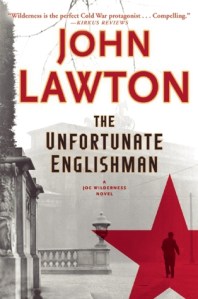
The Unfortunate EnglishmanThe Unfortunate Englishman (Joe Wilderness #2) by John Lawton (hardcover)

Having shot someone in what he believed was self-defence in the chaos of 1963 Berlin, Wilderness finds himself locked up with little chance of escape. But an official pardon through his father-in-law Burne-Jones, a senior agent at MI6, means he is free to go – although forever in Burne-Jones’s service.

His newest operation will take him back to Berlin, which is now the dividing line between the West and the Soviets. A backstory of innocence and intrigue unravels, one in which Wilderness is in and out of Berlin and Vienna like a jack-in-the-box. When the Russians started building the Berlin wall in 1961, two unfortunate Englishmen were trapped on opposite sides. Geoffrey Masefield in the Lubyanka, and Bernard Alleyn (alias KGB Captain Leonid Liubimov) in Wormwood Scrubs.

In 1965 there is a new plan. To exchange the prisoners, a swap upon Berlin’s bridge of spies. But, as ever, Joe has something on the side, just to make it interesting, just to make it profitable. The Unfortunate Englishman is a thrilling tale of Khrushchev, Kennedy, a spy exchange . . . and ten thousand bottles of fine Bordeaux. What can possibly go wrong?

The Hidden VillageThe Hidden Village by Imogen Matthews (ebook, courtesy of Amsterdam Publishers)

Wartime Holland. Who can you trust?

Deep in the Veluwe woods lies a secret that frustrates the Germans. Convinced that Jews are hiding close by they can find no proof. The secret is Berkenhout, a purpose-built village of huts sheltering dozens of persecuted people.

Young tearaway Jan roams the woods looking for adventure and fallen pilots. His dream comes true when he stumbles across an American airman, Donald C. McDonald. But keeping him hidden sets off a disastrous chain of events.

Sofie, a Jewish Dutch girl, struggles to adapt to living in Berkenhout, away from her family and friends. As weeks turn to months, she’s worried they’ll abandon her altogether. Henk Hauer, head woodman, is in charge of building the underground huts and ensuring the Berkenhout inhabitants stay safe. But many grow suspicious of his liaisons with the Germans. Is he passing on secret information that could endanger lives?

All it takes is one small fatal slip to change the course of all their lives for ever.

Shadowplay AudiobookShadowplay by Joseph O’Connor (audiobook)

1878: The Lyceum Theatre, London. Three extraordinary people begin their life together, a life that will be full of drama, transformation, passionate and painful devotion to art and to one another. Henry Irving, the Chief, is the volcanic leading man and impresario; Ellen Terry is the most lauded and desired actress of her generation, outspoken and generous of heart; and ever following along behind them in the shadows is the unremarkable theatre manager, Bram Stoker.

Fresh from life in Dublin as a clerk, Bram may seem the least colourful of the trio but he is wrestling with dark demons in a new city, in a new marriage, and with his own literary aspirations. As he walks the London streets at night, streets haunted by the Ripper and the gossip which swirls around his friend Oscar Wilde, he finds new inspiration. But the Chief is determined that nothing will get in the way of his manager’s devotion to the Lyceum and to himself. And both men are enchanted by the beauty and boldness of the elusive Ellen.

20200224_131215-1The Figure in the Photograph by Kevin Sullivan (advance review copy, courtesy of Allison and Busby)

1898 – When Juan’s father is killed while working as a photographer in Cuba, the young man is left with nothing but his last photos amid the chaos as the war between Spain and America escalates. But the images reveal a sinister truth to his father’s last moments, and Juan soon realises his death was no accident.

The young man travels alone to Scotland to grieve with his surviving family and soon immerses himself in the study of photography and pioneers a new invention, a self-timer. When this technology inadvertently solves a crime, it is not long before the device draws the attention of local law enforcement, and he is invited to Glasgow to assist police hunt down a serial killer. 


Recently finished

Links from the titles will take you to my review or the book description on Goodreads.

20200408_133244_kindlephoto-201916321A Book of Escapes and Hurried Journeys by John Buchan (hardcover)

A collection of stories dealing with escapes and adventurous journeys, including the escape of Charles II to France after the Battle of Worcester, Winston Churchill’s escape from South Africa and many more.

A Life Without EndA Life Without End by Frédéric Beigbeder, trans. by Frank Wynne (advance review copy, courtesy of World Editions)

What does the man who has everything – fame, fortune, a new love, and a new baby – want for his fiftieth birthday? The answer is simple: eternal life.

Determined to shake off the first intimations of his approaching demise, Frédéric tries every possible procedure to ward off death, examining both legal and illegal research into techniques that could lead to the imminent replacement of man with a post-human species. Accompanied by his ten-year-old daughter and her robot friend, Frédéric crisscrosses the globe to meet the world’s foremost researchers on human longevity, who – from cell rejuvenation and telomere lengthening to 3D-printed organs and digitally stored DNA – reveal their latest discoveries.

With his blend of deadpan humor and clear-eyed perception, Beigbeder has penned a brutal and brilliant exposé of the enduring issue of our own mortality. (Review to follow)

The Wheelwright's DaughterThe Wheelwright’s Daughter by Eleanor Porter (ebook, courtesy of Boldwood Books and Rachel’s Random Resources)

Can she save herself from a witch’s fate?

Martha is a feisty and articulate young woman, the daughter of a wheelwright, living in a Herefordshire village in Elizabethan England. With no mother Martha’s life is spent running her father’s meagre household and helping out at the local school whilst longing to escape the confines and small-mindedness of a community driven by religious bigotry and poverty.

As she is able to read and is well-versed in herbal remedies she is suspected of being a witch. When a landslip occurs – opening up a huge chasm in the centre of the village – she is blamed for it and pursued remorselessly by the villagers.

But can her own wits and the love of local stable hand Jacob save her from a witch’s persecution and death…


What Cathy (will) Read Next

Outlook-ecmtvntnLiving Among the Dead: My Grandmother’s Holocaust Survival Story of Love and Strength by Adena Bernstein Astrowsky (ebook, courtesy of Amsterdam Publishers and Random Things Tours)

This is the story of one remarkable young woman’s unimaginable journey through the rise of the Nazi regime, the Second World War, and the aftermath. Mania Lichtenstein’s dramatic story of survival is narrated by her granddaughter and her memories are interwoven with beautiful passages of poetry and personal reflection. Holocaust survivor Mania Lichtenstein used writing as a medium to deal with the traumatic effects of the war.

Many Jews did not die in concentration camps, but were murdered in their lifelong communities, slaughtered by mass killing units, and then buried in pits. As a young girl, Mania witnessed the horrors while doing everything within her power to subsist. She lived in Włodzimierz, north of Lvov (Ukraine), was interned for three years in the labor camp nearby, managed to escape and hid in the forests until the end of the war.

Although she was the sole survivor of her family, Mania went on to rebuild a new life in the United States, with a new language and new customs, always carrying with her the losses of her family and her memories.

Nearly eighty years after liberation, we are still witnessing acts of cruelty born out of hatred and discrimination. Living among the Dead reminds us of the beautiful communities that existed before WWII, the lives lost and those that lived on, and the importance to never forget these stories so that history does not repeat itself.