
About the Book
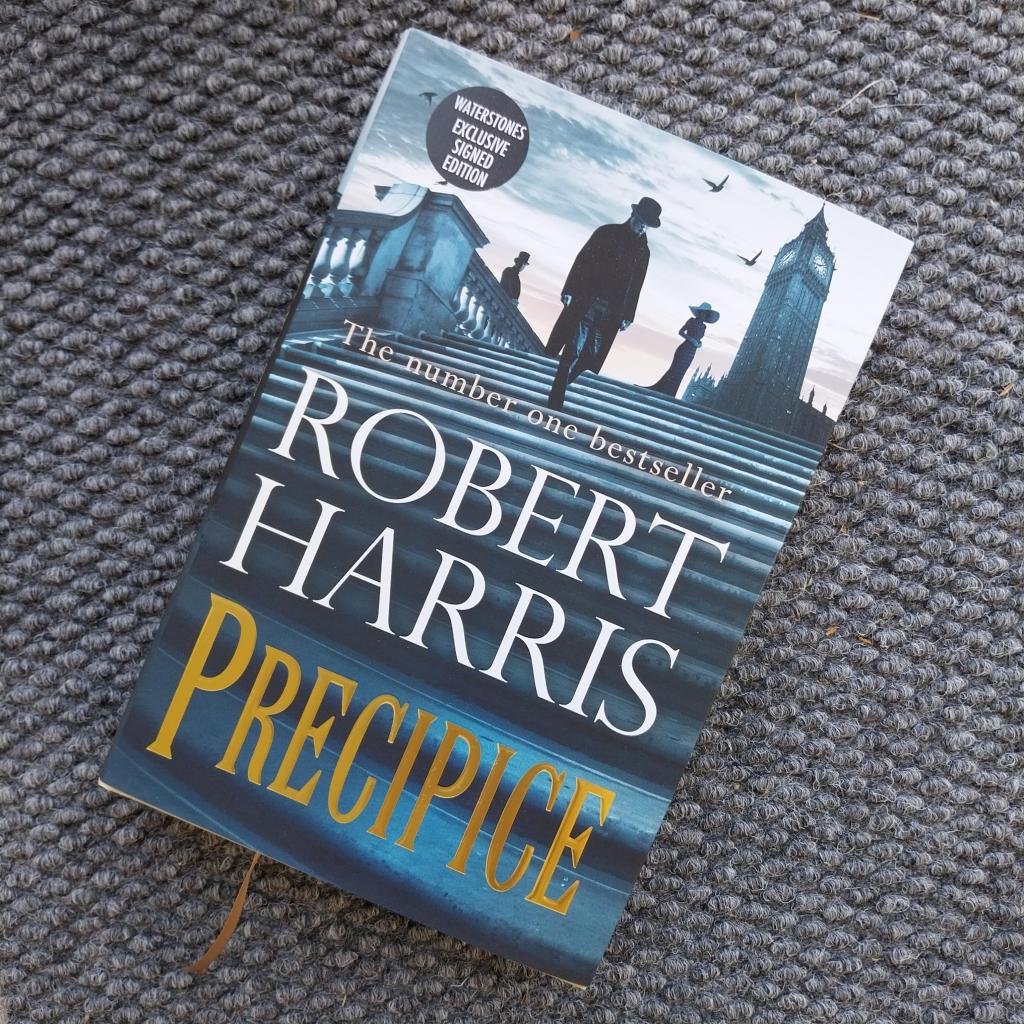
Summer 1914. A world on the brink of catastrophe.
In London, twenty-six-year-old Venetia Stanley—aristocratic, clever, bored, reckless—is part of a fast group of upper-crust bohemians and socialites known as “The Coterie.” She’s also engaged in a clandestine love affair with the Prime Minister, H. H. Asquith, a man more than twice her age. He writes to her obsessively, sharing the most sensitive matters of state.
As Asquith reluctantly leads the country into war with Germany, a young intelligence officer with Scotland Yard is assigned to investigate a leak of top-secret documents. Suddenly, what was a sexual intrigue becomes a matter of national security that could topple the British government—and will alter the course of political history.
Format: Hardcover (464 pages) Publisher: Hutchinson Heinemann
Publication date: 29th August 2024 Genre: Historical Fiction
Find Precipice on Goodreads
Purchase Precipice from Bookshop.org [Disclosure: If you buy books linked to our site, we may earn a commission from Bookshop.org, whose fees support independent bookshops]
My Review
It would take far too long to list all the novels by Robert Harris I’ve read so I’ll just get straight to the point and say Precipice is another brilliant blend of fact and fiction, and that his many fans won’t be disappointed.
What is most remarkable about the book is how much of it is based on fact. Prime Minister Herbert Asquith really did have a liaison with socialite Venetia Stanley, a woman almost half his age. (Whether it was consummated or not is a matter of speculation.) He really did write her multiple letters every day, some composed during Cabinet meetings. (There were twelve postal deliveries a day in London at that time.) His letters still exist, in the British Library, and some are reproduced in the book. He really did go for long car drives with Venetia, often prioritising these over other meetings including audiences with the King. He really did share secret documents with her, including decoded Foreign Office telegrams at a time when the information contained in them would have been incredibly useful to potential enemies. And, most remarkably, from time to time he really did toss documents out of the window of his car, some of which were found by members of the public and handed in to the police. Ironically, it was Asquith who put the Official Secrets Act on the statute book.
You might be asking yourself if so much of the book is based on fact, then where’s the fiction? What actually has the author had to conjure up from his imagination? Well for one, Venetia’s letters to Asquith were all destroyed so the letters that appear in the book are the author’s creations, written in the breezy style of her letters to other correspondents.
Secondly, the author introduces a fictional character, Sergeant Paul Deemer, who is co-opted to Special Branch in order to discover the person responsible for the breach of security. He finds himself becoming an unwitting observer of the relationship between Asquith and Venetia. At one point he muses, ‘It was more than ever like following a romantic novel published in instalments, its story propelled towards its inevitable climax by forces the reader could see more clearly than its characters’.
Despite being married and having several children, Asquith comes across as completely besotted with Venetia to the point of recklessness. He comes to rely on Venetia as someone to unburden himself to, who can act as his sounding board and provide him with encouragement when he struggles with the difficult decisions with which he is faced. This is increasingly the case as a European war becomes inevitable.
It’s less clear what Venetia sees in Asquith. A father figure, perhaps, since her own was so remote? Or was she simply flattered by the attention of someone so important? Did she relish being a participant in events in a way she otherwise would never have been? She certainly finds his devotion flattering, although his need for her and his demands on her time gradually become overwhelming. It’s then that we see that rebellious streak in her become courage.
Another thing I found remarkable about the story is that alongside running the country and, later, fighting a war, Asquith, his fellow Cabinet ministers and other members of their social circle managed to find time to attend lavish dinners most nights and weekend house parties during which huge quantities of alcohol were consumed. Many an important decision was made with a bottle of brandy to hand.
The book is peppered with real historical figures including Secretary of State for War, Lord Kitchener, Foreign Secretary, Sir Edward Grey (he who, on the eve of Britain’s entry in the First World War, famously remarked ‘The lamps are going out all over Europe, we shall not see them lit again in our life-time‘), Chancellor of the Exchequer, David Lloyd George, and most notably Winston Churchill, First Lord of the Admiralty, the driving force behind the disastrous Gallipoli campaign.
Whether the outcome of Asquith’s and Venetia’s affair really did have a bearing on Asquith’s deficiencies in the handling of the war which ultimately forced him to agree to the formation of a coalition government is a matter for speculation. The inclusion of two previously unpublished paragraphs of a letter from Asquith to Venetia on the final page of the book makes it clear what the author thinks.
Although the backdrop to Precipice is the turbulent period in the run-up to the outbreak of the First World War and the growing disaster of its initial phase, it’s the personal story of Herbert Asquith and Venetia Stanley – and the consequences of their relationship – that takes centre stage. Precipice is a thoroughly absorbing, impeccably researched book that fans of 20th century history will love.
In three words: Fascinating, compelling, detailed
Try something similar: Ike and Kay by James MacManus
About the Author

Robert Harris is the author of fifteen bestselling novels: the Cicero Trilogy – Imperium, Lustrum and Dictator – Fatherland, Enigma, Archangel, Pompeii, The Ghost, The Fear Index, An Officer and a Spy, which won four prizes including the Walter Scott Prize for Historical Fiction, Conclave, Munich, The Second Sleep, V2 and Act of Oblivion. His work has been translated into forty languages and nine of his books have been adapted for cinema and television. He lives in West Berkshire with his wife, Gill Hornby.
Connect with Robert
Website | X


 What Cathy Read Next...