
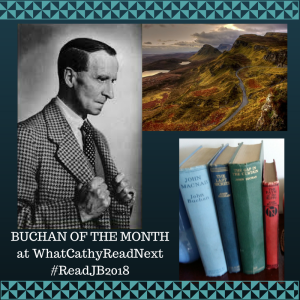
Buchan of the Month: Introducing… The Power-House

Buchan of the Month

The Power-House is the first book in my Buchan of the Month reading project. To find out more about the project and my reading list for 2018, click here. If you would like to read along with me you will be very welcome – leave a comment on this post or on my original challenge post to let me know you’re taking part.

What follows is an introduction to the book (no spoilers!). It is also an excuse to show pictures of my prized first edition of The Power-House (without dust jacket, unfortunately) found in a bookshop on the island of Iona, of all places. As Buchan might have put it, I had ‘tramped’ through the cold, wet rain that day in search of the shop and was rewarded with this treasure.

I will be posting my review of the book later in the month.


“You think that a wall as solid as the earth separates civilisation from barbarism. I tell you the division is a thread, a sheet of glass.”

The Power-House first appeared in Blackwood’s Magazine of December 1913. However, it wasn’t until May 1916, following the success of The Thirty-Nine Steps (published in 1915), that William Blackwood & Sons published The Power-House in novel form. Clearly they were hoping to cash in on the success of The Thirty-Nine Steps and this seems to have been an astute decision because, according to Buchan’s first biographer, Janet Adam Smith, The Power-House (priced at one shilling) had sold 24,000 copies by the end of 1916.

The Power-House DedicationIn the dedication to The Power-House, John Buchan writes, “I have printed this story, written in the smooth days before the war, in the hope that it may enable an honest man here and there to forget for an hour the too urgent realities”. He also wryly observes that the dedicatee, Major-General Sir Francis Lloyd, shares his own “liking for precipitous yarns”.

In describing The Power-House as a ‘yarn’, commonly defined as a long or rambling story, especially one that is implausible (although The Power-House is neither long nor rambling), it seems Buchan intended this first foray into the thriller genre to be a form of escapism from the troubled times the world was living through. In fact, he always used the self-deprecating term ‘shocker’ rather than thriller to describe his adventure stories.

The hero of The Power-House is Edward Leithen, whom Christopher Harvie describes as ‘the first and last of Buchan’s heroes’ and ‘the one closest in character to his author’. In fact, Leithen had earlier appeared briefly in ‘Space’ a short story by Buchan in his collection The Watcher by the Threshold, published in 1902. In The Power-House, Leithen recounts his story to a group of friends during a duck shooting trip, explaining “I once played the chief part in a rather exciting business without ever once budging from London”.

Although an early novel, The Power-House touches on a theme that will recur in later Buchan books, namely the fragility of civilisation. The period during which Buchan was writing The Power-House was a troubled time in his life. In 1910 he had unsuccessfully stood for Parliament and the following year his father died. This was followed by further family tragedy when his younger brother, Willie, died suddenly from an infection contracted while in India. Added to this, Buchan began to suffer from the digestive problems that would plague him for the rest of his life. It was a troubling time in world events as well. As Christopher Harvie notes, “The Power-House announces the terrific anarchy to be loosed upon the world”.

Janet Adam Smith describes Buchan’s recipe for The Power-House (and The Thirty-Nine Steps) as ‘brisk, improbable action played out against a realistic background’. In his autobiography, Memory-Hold-The-Door, Buchan describes himself as ‘a natural storyteller, the kind of man who for the sake of his yarns would in prehistoric days have been given a seat by the fire and a special chunk of mammoth’.

So find yourself a comfy reading spot and turn to the first page of The Power-House…

Sources:
John Buchan, Memory-Hold-The-Door (Hodder & Stoughton, 1964 [1940])
David Daniell, The Interpreter’s House: A Critical Assessment of the Work of John Buchan (Nelson, 1975)
Christopher Harvie, ‘Introduction’ to The Leithen Stories by John Buchan (Canongate Classics, 2000)
Kate Macdonald, John Buchan: A Companion to the Mystery Fiction (McFarland, 2009)
Janet Adam Smith, John Buchan: A Biography (OUP, 1985 [1965])


Throwback Thursday: 1066 What Fates Impose by G K Holloway

ThrowbackThursday

Throwback Thursday is a weekly meme hosted by Renee at It’s Book Talk. It’s designed as an opportunity to share old favourites as well as books that we’ve finally got around to reading that were published over a year ago. If you decide to take part, please link back to It’s Book Talk.

Today I’m reviewing a book that was kindly sent to me by the author, Glynn Holloway, quite a few months ago now but which has only just reached the top of my review pile. Published in 2013, it’s his debut historical fiction about the events leading up to the Battle of Hastings in 1066.

1066WhatFatesImposeAbout the Book

England is in crisis. King Edward has no heir and promises never to produce one. There are no obvious successors available to replace him, but quite a few claimants are eager to take the crown. While power struggles break out between the various factions at court, enemies abroad plot to make England their own. There are raids across the borders with Wales and Scotland. Harold Godwinson, Earl of Wessex, is seen by many as the one man who can bring stability to the kingdom. He has powerful friends and two women who love him, but he has enemies who will stop at nothing to gain power. As 1066 begins, England heads for an uncertain future. It seems even the heavens are against Harold. Intelligent and courageous, can Harold forge his own destiny – or does he have to bow to what fates impose?

Format: ebook (456 pp.)                             Publisher: Matador
Published: 4th March 2013                       Genre: Historical Fiction

Purchase Links*
Amazon.co.uk ǀ Amazon.com
*links provided for convenience, not as part of any affiliate programme

Find 1066: What Fates Impose on Goodreads

My Review

The powerful opening chapter of the book places the reader by the bedside of the dying William the Conqueror, in 1087. What follows is a sort of book length flashback setting out the factional and political machinations that would lead inexorably – is the author’s suggestion based on the title – to the events of 1066 and the defeat of Harold at the Battle of Hastings.

Most students of English history will, I suspect, be familiar with the events of 1066 but like me know less about the events of the preceding 20 years. Starting in 1045 in the reign of Edward (the Confessor), the author takes the reader in detail through the rivalries, quarrels, battles for land, influence and power of the nobles close to the throne. There are a lot of characters to keep track of so a dramatis personae would have been a useful addition to the book. It’s probably the nature of the times that the female characters play a pretty shadowy role, their chief value being as diplomatic bargaining chips, marriage material or reproductive machines to provide the all-important male heirs.

I’ll be honest and say that half way through the book I was beginning to feel slightly overwhelmed with all the political machinations. Occasionally, the author’s obviously extensive research seemed a little obtrusive with sections on sword-making, dining customs, etc. feeling a little like they had been inserted from a text book. At times, the dialogue came across as rather stilted or included modern idioms that seemed out of place but you did get a sense of the characters from the way they interacted with each other. There were also a couple of nice succinct lines that drew my eye:

On the death by Count Conan by poison: ‘Brittany now had a new Count, Alan the Red, friend and ally of Duke William. Such is fate.’
On Earls Edwin and Morcar manoeuvring Harold into marrying their sister, Aldytha: ‘Harold had their sister but they had him.’

The pace really picked up for me in the final third of the book as events drew nearer to the decisive Battle of Hastings. The author does a great job of explaining all the factors that played a part in the outcome of that day; some a question of chance, the weather or a seemingly unimportant foolish decision. The battle scenes are absolutely gripping. Harold, although ruthless when needed, definitely comes out as the more likeable character and, although I feel a bit soppy for saying this since everyone knows the outcome of the battle, I couldn’t help wishing events had ended differently and he’d prevailed (if only for poor Edyth waiting under that tree).

This was a violent time in history when life was often short and death did not always come about by natural causes. In keeping with the period, there are some gruesome scenes (especially towards the end of the book where the reader encounters a particularly unpleasant character) although nothing worse I would say than you might find in Game of Thrones.

There was a lot I learnt from reading this book, such as the fact that William was able to use his influence to get the Pope to pronounce his campaign against Harold as a crusade, causing additional troops from across Europe to rally to the Norman standard. For historical fiction fans who like their history detailed and aren’t afraid of a large cast of characters, this would make a rewarding read.

I received a review copy courtesy of the author in return for an honest and unbiased review.

Follow my blog with Bloglovin

In three words: Detailed, well-researched, absorbing

Try something similar…The King’s Jew by Darius Stransky (click here for my review)

Glynn HollowayAbout the Author

Glynn writes: Born in the 1950s in an anonymous northern English town, I left school at sixteen and worked in a series of manual jobs until, at the age of 24, I decided to do something more challenging and rewarding. I chose to combine education and travel, by working over the winter while I studied and touring Europe in the summer after taking exams. I did this for a couple of years until I had the qualifications to get myself on to a degree course. I have been interested in history since I was a boy, which I suppose explains why, when I came across a degree course in History and Politics at Coventry University that looked tailor made for me, I applied right away.

In my first year at Coventry I lived in the halls of residence within a stone’s throw of the Leofric Hotel. Just a short walk from my halls, is the bell tower that houses a clock, which when its bell chimes the hour, produces a half size model of a naked Lady Godiva riding a white horse. Above her, Peeping Tom leans out of a window for a better view. In all of the three years I was there, it never once occurred to me that I would one day write a book featuring Earl Leofric and his famous wife, as key characters.

After graduating, I spent a year in Canada before returning to England to train as a Careers Officer in Bristol. Later, I lived and worked in Gloucestershire as a Careers Officer and then in Adult Education. After I met my wife, I moved back to Bristol to live and I worked at Bath Spa University as a Student Welfare Officer. It was about this time I read a biography about King Harold II which fascinated me so much it inspired me to write my own version of events. Now, after many years of study and time spent over a hot keyboard, I have finally produced that novel.

The decision to write 1066 was one of best I ever made. Research took to places I either had never heard of or I thought I’d never see. In England I visited York, Stamford Bridge, Winchester, Bosham, Battle, Stowe Anglo Saxon village. In Normandy I went to Falaise, Mont St Michael and of course Bayeux, to see the famous tapestry. The more I researched the more amazed I became about how events played out. For Harold, everything that could go wrong did go wrong. It was as though the gods were against him; hence the title, 1066 What Fates Impose.

Connect with Glynn

Website ǀ Facebook ǀ Twitter ǀ Goodreads