Book Review – Kane by Graham Hurley #Kane @seasidepicture @soph_ransompr

Welcome to today’s stop on the blog tour for Kane by Graham Hurley. To make it even more special, today is publication day! My thanks to Sophie and Ellie at Ransom PR for inviting me to take part in the tour and to Head of Zeus for my review copy via NetGalley

About the Book
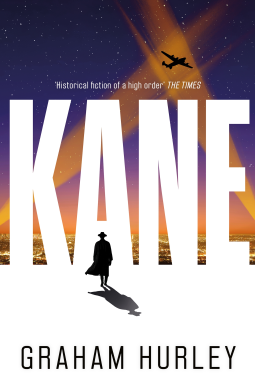
Washington DC, 1941. Quincy Kane, hero of the Boston Police Department and scourge of organised crime, is now a Secret Service agent. His meteoric rise means he’s trusted to guard the most important man in the country: President Roosevelt.

Then Imperial Japan attacks the US naval base at Pearl Harbor.

For Kane, American entry to World War II means the most crucial mission of his career: a complex scheme of bribery and subterfuge that will see him cross the Atlantic. He could change the course of the conflict and save thousands of Allied lives.

First, though, he will have to survive a return to the world of organised crime via the City of Angels itself: Los Angeles, where every gangster has Quincy Kane in their crosshairs.

Format: Hardcover (432 pages) Publisher: Aries Fiction
Publication date: 19th June 2025 Genre: Historical Fiction

Find Kane on Goodreads

Purchase Kane from Bookshop.org [Disclosure: If you buy books linked to our site, we may earn a commission from Bookshop.org, whose fees support independent bookshops]

My Review

I’ve become a great fan of Graham’s books which combine the drama of real historical events – often revolving around key turning points in 20th century history – with the excitement of a thriller. (If you don’t believe me check out my reviews of three of his most recent books: Dead Ground, The Blood of Others and Katastrophe.) Although all the books are part of the ‘Spoils of War’ collection, the great thing is they are non-chronological so can be read in any order or as standalones.

In this case the historical starting point is the Japanese bombing of the US naval base at Pearl Harbour in December 1941, described by US President Franklin D. Roosevelt at the time as “a date which will live in infamy”, and which triggered the US’s entry into WW2.

Quincy Kane’s position in the Secret Service, charged with protecting the President, places him close to the heart of things. He can see the difficult decisions the President must grapple with as well as Roosevelt’s day-to-day struggles with the physical consequences of the polio he contracted as a young man. The author creates a neat personal connection between the two men and, much later, another character.

Kane also witnesses first-hand the difficult relationship between Roosevelt, who favours order and routine, and the mercurial Winston Churchill who seems to thrive on chaos. However, what Roosevelt and Churchill do agree on is the need to stop French ships falling into German hands. A plan is hatched which requires Kane to revisit the organized crime case he solved years before which made him the toast of the Boston Police Department. The only trouble is the people involved are still serving prison time.

From this point on we’re into full-on thriller territory with Kane reunited with a former colleague with a love of reptiles and the music of Wagner. Soon however Kane comes up against a human reptile with an ego the size of a planet, a penchant for violence and a dangerous fascination with the woman in Kane’s life, LA Times journalist Lou Mahoney. Mahoney is surely every red-blooded heterosexual man’s dream: smart, attractive and skilled in the bedroom. It’s a distraction from the mission Kane has been assigned and things become even more difficult when anti-Japanese sentiment scuppers an essential part of the plan.

It’s fair to say Kane doesn’t get through unscathed. Actually, let’s be honest, he’s pretty battered and bruised by the end of the book and makes some death-defying escapes of which James Bond would be proud. The end of the book finds Kane in a different part of the world, possibly leaving things open for a future reunion.

In three words: Compelling, action-packed, dramatic
Try something similar: Betrayal by David Gilman

About the Author

Graham Hurley is a documentary maker and a novelist. For the last two decades he’s written full-time, penning nearly fifty books. Two made the short list for the Theakston’s Old Peculiar Crime Novel of the Year, while Finisterre – the first in the Spoils of War collection – was shortlisted for the Wilbur Smith Adventure Writing Award. Graham lives in East Devon with his lovely wife, Lin.

Connect with Graham
Website | Twitter/X

Book Review – The Book of Days by Francesca Kay

About the Book

Things change; we have to recognise that; the world will not stay still. What we must hope is that the new is better and stronger than the old.

ANNO DOMINI 1546. In a manor house in England a young woman feels the walls are closing around her, while her dying husband is obsessed by his vision of a chapel where prayers will be said for his immortal soul.

As the days go by and the chapel takes shape, the outside world starts to intrude. But as the old ways are replaced by the new, the people of the village sense a dangerous freedom …

Format: audiobook (7 hours 20 mins) Publisher: Swift Press
Publication date: 1st February 2025 Genre: Historical Fiction

Find The Book of Days on Goodreads

Purchase The Book of Days from Bookshop.org [Disclosure: If you buy books linked to our site, we may earn a commission from Bookshop.org, whose fees support independent bookshops]

My Review

The Book of Days is one of the books on the shortlist for the Walter Scott Prize for Historical Fiction 2025. The winner will be announced on Thursday 12th June at the Borders Book Festival (and I will be there!).

There’s a hypnotic quality in the way Alice’s life plays out day by day, governed by the rhythm of the changing seasons and the rituals of religious devotion. ‘All our days are measured in our prayers, our years in the feasts and the seasons.’ 

There’s a claustrophobic feeling to much of the book with the household dominated by the gradual decline of Alice’s husband, the Lord of the Manor, who is suffering from an unknown condition. The prospect of imminent death has caused him to focus on his immortal soul, employing the most highly skilled craftsmen to construct a chapel and create an elaborately carved tomb where he can be laid to rest alongside his first wife (and eventually Alice).

Alice is still grieving the loss of a daughter and is conscious that her position is precarious given her husband has a daughter by his first wife who will inherit the estate. Alice takes things into her own hands in a way that seems impossible to outside observers, opening her up to accusations of adultery and implicating a new arrival in the community. It will provide ammunition for those who support the Reformation.

This is not a book that moves at pace. It’s only in the final chapters when events in the outside world – the death of Henry VII and the accession to the throne by Edward VI – impose themselves on the lives and religious practices of the village that the pace picks up. Suddenly all the familiar things that have been central to their religious beliefs – the Latin Mass, religious images, sacred relics – are prohibited.

There is a brilliant passage in which Alice rails against the impact the changes will have on people who cannot read and who learn the Scriptures from pictures on church walls or in stained glass, and who find hope for worldly troubles in making offerings to images of saints. ‘You who take so much for granted, with your sound walls, rich food and fine jewels – and books, especially books – do you truly begrudge the people of this or any other lowly parish their little scraps of coloured glass, their painted saints, their confidence in prayer? 

The conflicting doctrines divide families and communities, whipped up by the incendiary rhetoric of visiting preachers. For Alice and others, things will never be the same again.

The Book of Days has an authentic sense of time and place, and there are some wonderful descriptions of nature and the changing seasons. However, it was just too unevenly paced for me, with a lot of dramatic events happening in the very final part of the book. Although beautifully written and an admirable work of historical fiction, it’s not my favourite of the books on the shortlist which, on past experience, means it will probably win.

I listened to the audiobook read by Lucy Scott who captured perfectly the contemplative tone of the book.

In three words: Intimate, introspective, meditative
Try something similar: For Thy Great Pain Have Mercy On My Little Pain by Victoria Mackenzie

About the Author

Francesca Kay grew up in Southeast Asia and India, and has subsequently lived in Jamaica, the United States, Germany and now lives in Oxford. Her first novel, An Equal Stillness, won the 2009 Orange Award for New Writers, and her second novel, The Translation of the Bones, was longlisted for the 2012 Women’s Prize for Fiction. Her third novel, The Long Room, was published in 2016; The Book of Days is her fourth. (Photo/bio: Publisher website)