
I’m delighted to be co-hosting today’s stop on the blog tour for The Emperor of Shoes by Spencer Wise alongside my tour buddy, Emma’s Bookish Corner. My thanks to Anne at Random Things Tours for inviting me to take part in the tour and for introducing me to a book I might otherwise not have read. You can read my review below.
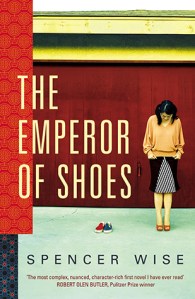 About the Book
Alex Cohen, a twenty-six-year-old Jewish Bostonian, is living in southern China, where his father runs their family-owned shoe factory. Alex reluctantly assumes the helm of the company, but as he explores the plant’s vast floors and assembly lines, he comes to a grim realization: employees are exploited, regulatory systems are corrupt and Alex’s own father is engaging in bribes to protect the bottom line.
When Alex meets a seamstress named Ivy, his sympathies begin to shift. She is an embedded organizer of a pro-democratic Chinese party, secretly sowing dissonance among her fellow labourers. Will Alex remain loyal to his father and his heritage? Or will the sparks of revolution ignite?
Praise for The Emperor of Shoes
‘Spencer Wise’s The Emperor of Shoes is one of the most complex, nuanced, character-rich first novels I have ever read. It is utterly original in portraying a twenty-first century Jewish diaspora, with one foot in homeland America and one foot in Asia creating consumer products, and, for Wise s protagonist, with an accompanying empathy for China s grassroots aspirations. Wise comes to us fully-flighted as a master stylist and a compelling storyteller’ – Robert Olen Butler, Pulitzer Prize winner
‘Fresh and innovative, Spencer Wise’s The Emperor of Shoes is the latest addition to the tradition of young-man fiction that starts with Bellow and Roth… I’ve taught for more than forty years; this is the best first novel I’ve ever read’ – David Kirby, National Book Award Nominee
‘What a haunting and intelligent debut novel. The confident and assured prose evokes easily the beauty of the complex relationships, the ugliness of the situation in the shoe factory, and the difficulty Alex faces when deciding between following his heart and his head. Just stunning’ – Louise Beech, author of How to Be Brave, The Mountain in My Shoe and Maria in the Moon
Format: Hardcover, ebook (320 pp.) Publisher: No Exit Press
Published: 26th July 2018 Genre: Contemporary Fiction
Pre-order/Purchase Links*
Publisher | Amazon.co.uk ǀ Amazon.com ǀ Hive.co.uk (supporting UK bookshops)
*links provided for convenience, not as part of any affiliate programme
Find The Emperor of Shoes on Goodreads
My Review
In his praise for The Emperor of Shoes, Robert Olen Butler describes the book as ‘character-rich’ and I can’t disagree. That doesn’t mean, however, that the characters are necessarily easy to like.
I found myself constantly shifting my view of Alex’s father, Fedor, accorded the accolade the ‘Emperor of Shoes’ (as he proudly reminds people). One minute I felt he was merely an ambitious father trying his best to preserve the family business for his son in the face of changing market forces; the next minute, I was feeling reluctant sympathy for a pathetic, hypochondriac desperate for his son’s attention; the next minute, I was repelled by a monstrous figure up to his eyes in corruption with little or no regard for the lives of his workers.
Similarly, I started out condemning Alex for his naivety about working conditions in the factory. How could he not have known what was going on? Was he stupid, deliberately turning a blind eye because he couldn’t face up to the truth, or fearful of challenging his father? However, the author skilfully takes the reader inside the mind of Alex, sharing his struggles with the difficult moral choices he faces and slowly gaining this reader’s sympathy.
Inspired by Ivy, the Chinese woman and activist with whom he forms a relationship, Alex begins to imagine making a difference to the lives of the workers in his factory. But he faces opposition from the local state institutions built on bribes (euphemistically referred to as ‘gifts’) and corruption, personified by the malign and creepy Gang, described as ‘a Brooklyn mob boss in Mao jacket and togs’ who can make people ‘disappear with a nod of the head.’ A business proposition from Alex’s old friend, Bernie, offers the possibility of a third way but will mean taking a strikingly different path from the way his father has run the business up until now. Does Alex have what it takes to face down ‘The Emperor of Shoes’ and start a quiet revolution? And, if he does, will it take a greater sacrifice than he can bear?
The Emperor of Shoes made me think – and I always like that in a book. For example, it made me question if, with a clear conscience, I could ever buy shoes made in China again without assuring myself of the working conditions in the factory. ‘The elevator opened onto a room the size of an airplane hanger, and the dank warm air from the heat setter boxes slipped over my face like a pillow. A boy with a Mohawk scowled at me: a stump for a right arm, severed at the elbow by the steel embossing plate on the leather grain press. A girl, eyes jaundiced, punch-drunk, the first flush of benzene poisoning from cement glue vapors, scratched at her arm. Everywhere, people and machines.’ A far cry from the conditions in Alex’s upmarket hotel.
The book also explores in an interesting way questions of identity. An American by birth, Alex is nevertheless keenly aware of his Jewish and Russian heritage. At one point, he is asked by Zhang, leader of the activist movement: “Russian, Jewish, American. How can you be all? Or do you pick one?”
There is real energy in the writing, along with acute observation and dark humour – for example, when Alex returns to his luxurious, air-conditioned hotel suite after a day at the factory (while the workers return to their dormitories subject to a curfew). ‘There was a silver tray on my desk with a bottle of wine, a long stem rose in a champagne flute, a box of Godiva chocolates. Even the gifts were a kind of mockery: here, enjoy a long sensual evening by yourself. These came courtesy of the hotel, once a week, for Ambassador level guests. You reached Ambassador when you’d spent a good three quarters of your life on the road sleeping in their hotels. It got passed down too, an inheritance you didn’t earn. Death by luxury.’
The Emperor of Shoes is an impressive debut – compelling, thought-provoking and spirited. I, for one, can’t wait to read what the author creates next.
I received a review copy courtesy of publishers, No Exit Press, and Random Things Tours in return for an honest and unbiased review. The Emperor of Shoes is the eighth of my 20 Books of Summer.
 About the Author
Spencer Wise was born in Boston in 1977. He holds a BA from Tufts University, an MA in fiction from The University of Texas, where he was a James Michener Fellow, and a PhD in Creative Writing from Florida State University. Wise is currently a Visiting Lecturer at Florida State University in Tallahassee, where he is at work on his second novel, Holderness.
Connect with Spencer

 About the Book
 About the Author

