
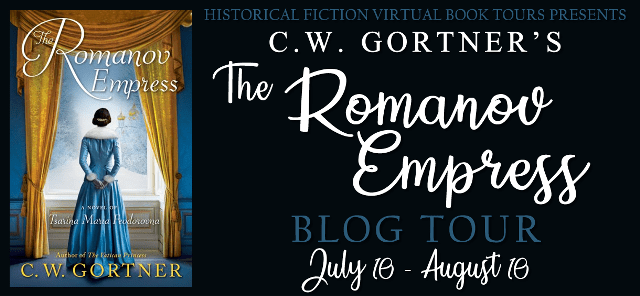
I’m delighted to be hosting today’s stop on the blog tour for The Romanov Empress by C. W. Gortner. It’s been great to see what the other fabulous book bloggers taking part in this tour have had to say about the book. For example, Meg at A Bookish Affair praised the author for doing ‘an amazing job of world building….and weaving in the detail for a fully immersive experience’. Stacie at Pursuing Stacie loved how the author brought Minnie to life ‘giving her personality, quirks, faults, breath, humanity’. Donna at Donna’s Book Blog described The Romanov Empress as ‘a well written, vivid story that completely transports you back to the period’.
 If that’s whetted your appetite to read the book – before you’ve even read my review – I’m thrilled to say there’s a giveaway with a chance for one lucky person (US residents only) to win a copy of The Romanov Empress.
Enter via the Gleam form at the bottom of the tour page. Don’t hang about though, as entries close on 10th August 2018.
 About the Book
Even from behind the throne, a woman can rule.
Narrated by the mother of Russia’s last tsar, this vivid, historically authentic novel brings to life the courageous story of Maria Feodorovna, one of Imperial Russia’s most compelling women, who witnessed the splendour and tragic downfall of the Romanovs as she fought to save her dynasty in the final years of its long reign.
Barely nineteen, Minnie knows that her station in life as a Danish princess is to leave her family and enter into a royal marriage – as her older sister Alix has done, moving to England to wed Queen Victoria’s eldest son. The winds of fortune bring Minnie to Russia, where she marries the Romanov heir and becomes empress once he ascends the throne. When resistance to her husband’s reign strikes at the heart of her family and the tsar sets out to crush all who oppose him, Minnie – now called Maria – must tread a perilous path of compromise in a country she has come to love.
Her husband’s death leaves their son Nicholas II as the inexperienced ruler of a deeply divided and crumbling empire. Determined to guide him to reforms that will bring Russia into the modern age, Maria faces implacable opposition from Nicholas’s strong-willed wife, Alexandra, whose fervour has lead her into a disturbing relationship with a mystic named Rasputin. As the unstoppable wave of revolution rises anew to engulf Russia, Maria will face her most dangerous challenge and her greatest heartache.
From the opulent palaces of St. Petersburg and the intrigue-laced salons of the aristocracy to the World War I battlefields and the bloodied countryside occupied by the Bolsheviks, C. W. Gortner sweeps us into the anarchic fall of an empire and the complex, bold heart of the woman who tried to save it.
Format: ebook (448 pp.) Publisher: Ballantine Books
Published: 10th July 2018 Genre: Historical Fiction
Purchase Links*
Amazon.co.uk ǀ Amazon.com ǀ Hive.co.uk (supporting UK bookshops)
*links provided for convenience, not as part of any affiliate programme
Find The Romanov Empress on Goodreads
My Review
As the book’s subtitle makes clear, A Romanov Empress concentrates on the life and experiences of the woman who would become known as Maria Feodorovna, Tsarina of Russia. From her childhood as a member of the impoverished Danish royal family, through the tragic circumstances of her marriage to Tsar Alexander and finishing with the events of the Russian Revolution, Minnie, as she is called by intimates, acts as the reader’s perceptive observer.
A Romanov Empress covers a turbulent period in Russian history but presents it largely from the perspective of the Imperial family with limited treatment of the lives of the Russian population. Thus the emphasis throughout is on the domestic goings on within the Imperial household, meaning social and political developments in Russia are viewed predominantly for their ability to threaten the future of the Romanov dynasty.
The author gives us an intriguing picture of a woman who wielded what power she could from ‘behind the throne’, in particular the important business of making suitable strategic marriages for her children and relatives with other crowned heads of Europe. Life in the Imperial household is one based on precedence and formality, a life of luxury that contrasts with the poverty experienced by much of the Russian population. However, eventually even the Tsar and his family cannot be entirely cushioned from the impact of growing social and political unrest.
When Minnie’s son, Nicholas, inherits the throne following the death of her husband, he chooses not to heed her advice about how to deal with the increasing unrest resulting in violent scenes that only make matters worse. Not for the first time when reading about the lives of women in history, this reader wondered whether things might have played out quite differently had a woman like Minnie been in charge instead of being relegated to the sidelines.
I found the relationship between Minnie and her sister, Alix, really touching. The way they supported each other through the many and various tragedies in their lives, including the deaths of children and spouses, was heart-warming. I found it interesting that the author presents the relationship between Minnie and her daughter-in-law, Alexandra, as anything but convivial; especially given they seemed to have much in common in terms of their background and lack of preparation for the roles they found themselves in by marriage. So much for female solidarity!
The book has an impressive level of detail and is definitely not a quick read; it’s clear the author must have undertaken an immense amount of research. Personally, I enjoyed the first half of the book where the reader is really immersed in the daily life of the Imperial household more than the second, where external events come more to the fore. Throughout the book, there are a lot of different characters to keep track of and I certainly needed to make frequent use of the helpful family tree to check names and relationships.
The Romanov Empress is a fascinating insight into the life of a woman who lived through a turbulent period in Russian history. I received a review copy courtesy of publishers, Ballantine Books, and Historical Fiction Virtual Book Tours, in return for an honest and unbiased review.
In three words: Detailed, meticulous, fascinating
Try something similar…Dr Zhivago by Boris Pasternak or A Countess in Limbo by Olga Hendrikoff and Sue Carscallen (read my review here)
 About the Author
C. W. Gortner holds an MFA in writing, with an emphasis on historical studies, from the New College of California. He is the internationally acclaimed and bestselling author of Mademoiselle Chanel, The Queen’s Vow, The Confessions of Catherine de Medici, The Last Queen, The Vatican Princess, and Marlene, among other oks.
He divides his time between Northern California and Antigua, Guatemala.
Connect with C. W. Gortner
Website ǀ Facebook ǀ Twitter ǀ Goodreads

 About the Book
 About the Author

