My Week in Books – 15th July ’18


MyWeekinBooks

New arrivals  

The Magick of Mister LillyThe Magick of Mister Lilly by Tobsha Learner (eARC, NetGalley)

In 1641, the country of England stands divided. London has become a wasps’ nest of spies, and under the eyes of the Roundheads those who practice magic are routinely sent to hang. Living in exile in the Surrey countryside is the Master Astrologer and learned magician William Lilly. Since rumours of occult practice lost him the favour of Parliament, he has not returned to the city. But his talents are well-known, and soon he is called up to London once more, to read the fate of His Majesty the King.

What he sees in the stars will change the course of history.   Only Lilly and a circle of learned astrologers – Cunning Folk – know that London is destined to suffer plague and fire before the decade is through, and must summon angel and demon to sway the political powers from the war the country is heading toward. In doing so, Lilly will influence far greater destinies than his own and encounter great danger. But there will be worse to come . . .

An epic telling of the role of magic in the English Civil War, The Magick of Master Lilly is the story of the most influential astrologer in English history.

The Winter SoldierThe Winter Soldier by Daniel Mason (eARC, NetGalley)

Vienna, 1914. Lucius is a twenty-two-year-old medical student when World War I explodes across Europe. Enraptured by romantic tales of battlefield surgery, he enlists, expecting a position at a well-organized field hospital. But when he arrives, at a commandeered church tucked away high in a remote valley of the Carpathian Mountains, he finds a freezing outpost ravaged by typhus. The other doctors have fled, and only a single, mysterious nurse named Sister Margarete remains.

But Lucius has never lifted a surgeon’s scalpel. And as the war rages across the winter landscape, he finds himself falling in love with the woman from whom he must learn a brutal, makeshift medicine. Then one day, an unconscious soldier is brought in from the snow, his uniform stuffed with strange drawings. He seems beyond rescue, until Lucius makes a fateful decision that will change the lives of doctor, patient, and nurse forever.

From the gilded ballrooms of Imperial Vienna to the frozen forests of the Eastern Front; from hardscrabble operating rooms to battlefields thundering with Cossack cavalry, The Winter Soldier is the story of war and medicine, of family, of finding love in the sweeping tides of history, and finally, of the mistakes we make, and the precious opportunities to atone.

Sleeping Through WarSleeping Through War by Jackie Carreira (ebook, review copy courtesy of Rachel’s Random Resources)

Set against the backdrop of real, world-changing events, these are the stories that are forgotten in the history books.

The year is 1968 and the world is changing forever. During the month of May, students are rioting and workers are striking across the globe, civil rights are being fought and died for, nuclear bombs are being tested, there are major conflicts on every continent, and war is raging in Vietnam. Against this volatile background, three women strive to keep everything together.

Rose must keep her dignity and compassion as a West Indian nurse in East London. Amalia must keep hoping that her son can escape their seedy life in Lisbon. And Mrs Johnson in Washington DC must keep writing to her son in Vietnam. She has no-one else to talk to. Three different women, three different countries, but all striving to survive – a courageous attitude that everybody can relate to.

Although Sleeping Through War is a work of fiction, this somewhat hidden history attempts to humanise a few weeks in time that were so stuffed with monumental events that it’s easy to forget the people involved. The author was a child in 1968 and lived in London and Lisbon during the 1960s. She met women like these and didn’t want their voices to go unheard into the future. Readers of both history and literary fiction will enjoy this emotionally-vivid work that weaves fiction into fact

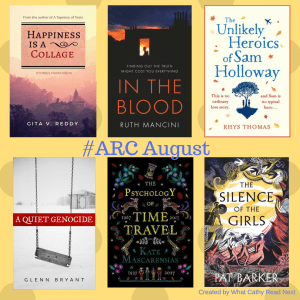
In the BloodIn the Blood by Ruth Mancini (hardcover, review copy courtesy of Head of Zeus)

In southeast London, a young mother has been accused of an unthinkable crime: poisoning her own child – and then leaving him to die.  The mother, Ellie, is secretive and challenging – she’s had a troubled upbringing – but does that mean she’s capable of murder?

Balancing the case with raising her disabled five-year-old son, criminal defence lawyer Sarah Kellerman sets out in desperate pursuit of the truth. But when her own child becomes unwell, Sarah realises she’s been drawn into a dangerous game.

Unsettling and compulsive, In the Blood is a chilling study of class, motherhood and power from a new star in crime fiction.

Happiness is a CollageHappiness is a Collage by Gita V. Reddy (eARC, courtesy of the author)

This collection of fifteen stories leads the reader into a world that is at once Indian and universal. The stories explore love, life, loss, and relationships.

A painter derives inspiration from a long lost love. Every night after going to bed, a woman scours a vast desert for her missing husband. A young woman strides through two worlds. A son experiences the miracle of his father’s immense love. An actor’s wife struggles to keep her husband from slipping into his reel life. And a busy professional tries to factor in pregnancy and motherhood into her hectic life.  Among those traversing this space are a henpecked billionaire, a homeless boy, a middle-aged wife dealing with infidelity, and a seeker finding solace with a lion and a deer.

Happiness is a Collage follows the author’s well-received collection, A Tapestry of Tears.  Published on 4th August 2018, to pre-order from Amazon click here.

IndividutopiaIndividutopia by Joss Sheldon (eARC, courtesy of the author)

THERE IS NO SUCH THING AS SOCIETY

‘Beloved friend,

The year is 2084, and that famous Margaret Thatcher quote has become a reality: There really is no such thing as society. No one speaks to anyone else. No one looks at anyone else. People don’t collaborate, they only compete.

I hate to admit it, but this has had tragic consequences. Unable to satisfy their social urges, the population has fallen into a pit of depression and anxiety. Suicide has become the norm.

It all sounds rather morbid, does it not? But please don’t despair, there is hope, and it comes in the form of our hero: Renee Ann Blanca. Wishing to fill the society-shaped hole in her life, our Renee does the unthinkable: She goes in search of human company! It’s a radical act and an enormous challenge. But that, I suppose, is why her tale’s worth recounting. It’s as gripping as it is touching, and I think you’re going to love it…

Your trusty narrator,

PP
Published on 23rd August 2018, to pre-order from Amazon click here


On What Cathy Read Next last week

Blog posts

Tuesday – I joined the blog tour for The Distance, the latest novel by best-selling author Zoë Folbigg, sharing an extract from the book.   This week’s Top Ten Tuesday topic was by way of a half year round-up as participants shared Best Books I’ve Read in 2018 (So Far).  I also shared my review of the latest action-packed instalment in Gordon Doherty’s Legionary series set in ancient Rome, Legionary: The Blood Road (Legionary #7).

WednesdayWWW Wednesday is the opportunity to share what I’ve just finished reading, what I’m reading now and what I’ll be reading next.

Thursday – For Throwback Thursday I published my review of Grace by Paul Lynch, one of the books shortlisted for The Walter Scott Prize for Historical Fiction 2018.

Friday – I welcomed Nicky Moxey, author of Sheriff and Priest, to What Cathy Read Next. Nicky’s fascinating guest post covered some of the turbulent events of King John’s reign, part of her research for the sequel to Sheriff and Priest.

Saturday – I took part in the blog tour for The Girl in the Pink Raincoat by Alrene Hughes sharing my Q&A with Alrene about, amongst other things, her research for the book and the surprising things that come turn up in the process.

Sunday I published review of The Lost Letters of William Woolf by Helen Cullen.

Challenge updates

  • Goodreads 2018 Reading Challenge – 102 out of 156 books read, 3 more than last week
  • Classics Club Challenge – 16 out of 50 books read, same as last week
  • NetGalley/Edelweiss Reading Challenge 2018 (Gold) – 36 ARCs read and reviewed out of 50, 1 more than last week
  • From Page to Screen– 11 book/film comparisons out of 15 completed, same as last week
  • 2018 TBR Pile Challenge – 5 out of 12 books read, same as last week
  • COMPLETED Historical Fiction Reading Challenge 2018 – 51 books out of 50 read, 3 more than last week
  • When Are You Reading? Challenge 2018 – 7 out of 12 books read, same as last week
  • What’s In A Name Reading Challenge – 1 out of 6 books read, same as last week
  • Buchan of the Month – 6 out of 12 books read, same as last week
  • 20 Books of Summer Challenge – 7 out of 20 books read, same as last week

On What Cathy Read Next this week

Currently reading

Planned posts

  • Book Review: Song by Michelle Jana Chan
  • Book Review: The Road to Newgate by Kate Braithwaite
  • Blog Tour/Book Review: The Emperor of Shoes by Spencer Wise
  • Blog Tour/Book Review: Betty Church and the Suffolk Vampire by M. R. C. Kasasian
  • Book Review: The Secrets of Primrose Square by Claudia Carroll

Book Review: The Lost Letters of William Woolf by Helen Cullen

The Lost Letters of William WoolfAbout the Book

Lost letters have only one hope for survival . . .

Inside the Dead Letters Depot in East London, William Woolf is one of thirty letter detectives who spend their days solving mysteries: Missing postcodes, illegible handwriting, rain-smudged ink, lost address labels, torn packages, forgotten street names – they are all the culprits of missed birthdays, broken hearts, unheard confessions, pointless accusations, unpaid bills and unanswered prayers.

When William discovers letters addressed simply to ‘My Great Love’ his work takes on new meaning. Written by a woman to a soul mate she hasn’t met yet, the missives stir William in ways he didn’t know were possible. Soon he begins to wonder: could William be her great love?

William must follow the clues in Winter’s letters to solve his most important mystery yet: the human heart.

Format: Hardcover, ebook, audiobook (336 pp.)    Publisher: Michael Joseph
Published: 12th July 2018                                              Genre: Contemporary Fiction

Purchase Links*
Amazon.co.uk ǀ  Kobo ǀ Hive.co.uk (supporting UK bookshops)
*links provided for convenience, not as part of any affiliate programme

Find The Lost Letters of William Woolf on Goodreads


My Review

‘More than kisses, letters mingle souls.’ John Donne

From the description, I was expecting this book to concentrate a lot more on the attempts of William and his fellow ‘letter detectives’ to reunite the ‘lost letters’ of the title with their intended recipients.  (The one ‘reunion’ we do get to witness, of an object with someone very significant for its previous owner, I found so touching.) Personally, I would also have liked to learn a bit more about William’s colleagues as we get only teasing insights into their own particular, idiosyncratic interests – Trevor and his philately, Marjorie with her lonely hearts, and so on.   I found myself thinking how much easier it would be today with access to the Internet but, as the book is set in 1989, the letter detectives have to rely on telephone directories, other paper-based research methods and not a little gut instinct.  Incidentally, I loved the description of the Dead Letters Depot as ‘this museum of missed messages’.

What I did enjoy was the reminder of a time when people communicated in writing and, from the evidence of some of the lost letters William deals with, weren’t afraid to express their feelings honestly and eloquently.   William himself wonders, ‘How much would be left unsaid if people were devoid of the opportunity that pen and paper offered to speak from a safe distance?’ Really this epitomises the issue at the heart of the problems William and his wife, Clare, are experiencing in their relationship.  I have to say at this point that I thought the way the author explores the ups and downs of their marriage shows great insight and is the real achievement of this book.

It’s a portrait of a marriage that has gone slightly astray between two people who, when it comes to it, still care for each other.  William and Clare have lost the ability to communicate openly and honestly about their feelings, their hopes and ambitions.   Clare recalls, ‘In the past, theirs had been a gentle love, not prone to arguments, accusations, recriminations.’   But now, ‘Their words rushed at each other like foot soldiers, focused only on their own purpose: not to listen, just to be heard.’  William and Clare have allowed the freedom and joy of their early years together – parties, madcap adventures, laughter and shared interests – to be replaced with the dull, drudgery of domestic life: whose turn is it to put out the bins, who was supposed to buy fresh milk, when is that mirror finally going to get put up on the wall?  Those who have been in a relationship for any length of time will probably recognise this (although will hopefully have found ways to overcome it).

William’s discovery of the letters addressed to ‘My Great Love’ really brings home to him the disappointing change in his relationship with Clare.  After all, wasn’t Clare once his ‘Great Love’?  But is she still?  The reader gets a sense that part of the problem may be William is still surprised even after all these years that the beautiful, talented Clare should have chosen him.  Clare’s frustration with their relationship takes her in a different direction fuelled partly by childhood experiences that haunt her, chiefly a fear (without any real evidence to support it) that she will make the same mistakes as her mother.

I loved the concept of the ‘letter detectives’ and, although I didn’t get as much of their detective work as I’d hoped for, I admired the insightful way the author explored the stresses and strains of the relationship between William and Clare.  Although I enjoyed the book, I confess to being left a little perplexed, and slightly let down, by its open-ended conclusion.   I guess it does allow the reader to write their own ending for William and Clare.  I know the one I wanted.

I received an advance review copy courtesy of publishers, Michael Joseph, and NetGalley in return for an honest and unbiased review.

Follow my blog with Bloglovin

In three words: Tender, insightful, emotional

Try something similar…Entanglement by Katy Mahood (read my review here)


Helen CullenAbout the Author

Helen Cullen is an Irish writer living in London. She worked at RTE (Ireland’s national broadcaster) for seven years before moving to London in 2010. In the UK, Helen established a career as an events and engagement specialist before joining the Google UK marketing team in 2015.

The first draft of her debut novel The Lost Letters of William Woolf was written while completing the Guardian/UEA novel writing programme under the mentorship of Michèle Roberts. Helen holds an M.A. Theatre Studies from UCD and is currently completing an M.A. English Literature at Brunel University.

Helen is now writing full-time and working on her second novel.

Connect with Helen

Website  ǀ  Facebook  ǀ  Twitter  ǀ  Instagram ǀ Goodreads