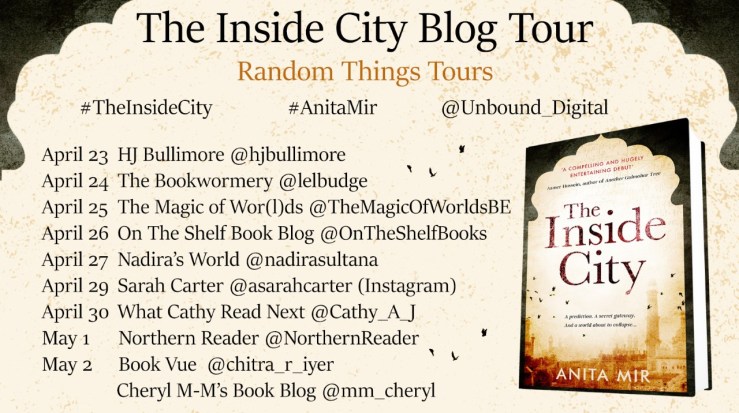
Welcome to today’s stop on the blog tour for The Inside City by Anita Mir. My thanks to Anne at Random Things Tours for inviting me to take part in the tour and to Unbound for my review copy. You can read my review below.
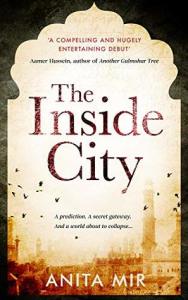 About the Book
There are ancient walled cities all across the world. This story begins in Lahore’s walled, or inside city, as it is called in Urdu, in what was then India.
It’s fear, Khurshid thought, just fear. Unwatched, her face was grim.
Barefoot, she walked to the wall of her rooftop courtyard and looked out at the city she had, in just three months, begun to love: a bulking city ever teetering upwards, with its twelve giant gates which closed each night, keeping them safe, from predators and marauders, and Dar said, bad dreams, but he’d smiled, so she’d known he was joking, only not what he meant.
A pir (seer) predicts great things for a soon to be born born boy, Awais. The year is 1919 – the year of the Jallianwala Bagh (Amritsar) Massacre where anywhere from 379-1,000 unsuspecting peaceful protestors were killed by armed British troops. Politics is everywhere and on every tongue. Will the British go? Will they be booted out? And what will happen to India, then?
But Khurshid, Awais’s mother, cares nothing for all that. Her dreams are not of nationhood; they centre on her boy who will give, she’s sure, her life the meaning and beauty she’s craved for so very long. As they wait for the future to unfold, no-one notices how different Khurshid s youngest daughter, Maryam, is. But then her secret is outed. Maryam has a superb gift for Maths.
Though she doesn’t want to think it, Khurshid begins to wonder if the pir (seer) had been right about the house but wrong about whom the gift of greatness was meant for. She checks herself but the idea grows and grows. She tries to teach Awais her burning overpowering hate. But Maryam is one of Awais’s two great loves. He can’t believe what his mother says. He can’t hate Maryam. Or, he wonders, can he?
Awais’s other great love is the inside city, which through a chance encounter, he has started to explore and to map. When Partition, brutal and horrendous, takes place in 1947, it is Awais knowledge of the inside city that will save lives. But will it be enough to save his family as well?
Format: ebook (368 pp.) Publisher: Unbound Digital
Published: 21st March 2019 Genre: Historical Fiction
Purchase Links*
Amazon.co.uk ǀ Amazon.com ǀ Hive.co.uk (supporting UK bookshops)
*links provided for convenience, not as part of any affiliate programme
Find The Inside City on Goodreads
My Review
In The Inside City, the author creates a colourful collage that is part coming of age story, part family saga, part history of events leading up to partition and the creation of Pakistan. However, political events only ever act as a backdrop to the story of Awais and his extended family. Episodic in nature and with a large cast of characters, scenes are skilfully evoked often drawing the reader’s attention away from the political to the personal and acting as intriguing detours from wider events.
I enjoyed the descriptions of the ‘inside city’ of Lahore – its architecture, people and history – although uncovering its secrets didn’t come to the fore quite as much as I expected. I felt I really got to know Awais and his sister, Maryam. Their mother, Kurshid’s actions and motivations I’ll admit I struggled to understand.
The book explores a number of ideas, including the role of stories in preserving a community’s history and culture and the act of mapping as a form of appropriation. When partition becomes a reality in 1947, the book exposes the realities of displacement and the segregation of communities who once lived side by side.
Covering a time period from 1919 to 1964 but focused especially on the 1930s, The Inside City takes the reader on a vibrant journey encompassing everything from the love of books, the excitement of train journeys and the lure of adventure to celestial numbers.
I received a review copy courtesy of publishers, Unbound, and Random Things Tours.
In three words: Expansive, episodic, colourful
Try something similar…99 Nights in Logar by Jamil Jan Kochai (read my review here)
 About the Author
Anita was born in Lahore, Pakistan and came to England when she was four. She grew up in County Durham and Wales, and it was only when she moved to Lahore with her family in her late teens that it hit her that mornings weren’t supposed to be pitch black. Pakistan was a shock. And she stayed in shock. Is perhaps still in shock. But it was also love at first sight. Lahore Lahore hai/ Lahore is Lahore. Yep. Another thing that doesn’t quite translate.
Straight out of university, she applied for a job at a newspaper and for some strange reason, got it. Most of her work there was on human rights issues, particularly those pertaining to religious minorities and women. Her lighter pieces she wrote under a pseudonym, which, seven years later, her boss told her she’d spelt wrong.
From journalism, she ambled into development work. The best of her development work was when she was privileged to head two emergency programmes.
Anita kept on coming back to England then to Pakistan then…and one day (still plan-less), just stuck it out in London.
She writes fiction and plays, has had two shorts on (The Space and Soho), been longlisted for several prizes (The Bruntwood, the Soho/Verity Bargate, the Old Vic 12), and had a short story published this year in ‘New Welsh Review’. She likes hearing her director friends tell her, ‘Any minute, you’re going to break through’. In her more reflective moments, of which there are now few, she wonders what she’s supposed to break through to. And if, when she does, she’ll like it.
Anita lives in the un-trendy part of East London and when not teaching, can be found playing basketball with her boy, or else, pouring over Lego instructions with the zeal of someone who’s going to grow up to be a YouTube star.
Connect with Anita


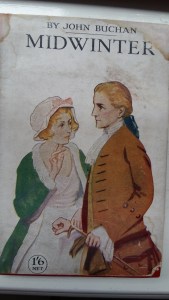 What follows is an introduction to Midwinter. It is also an excuse to show a picture of my Nelson edition of the book with its charming dust jacket. I will be posting my review of the book later in the month.