Buchan of the Month/Book Review: Prester John by John Buchan

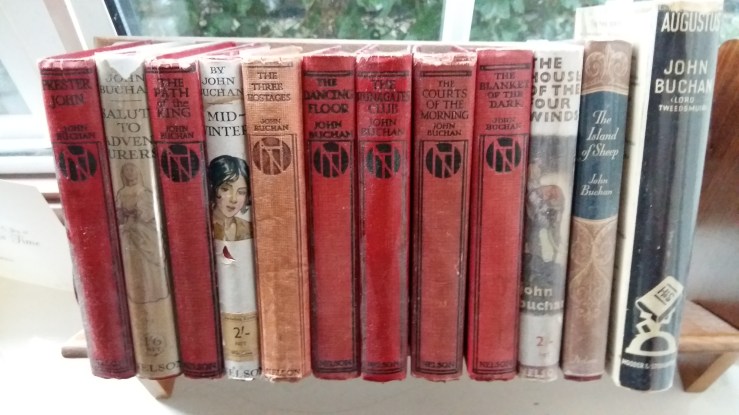
buchan of the month 2019 poster

prester john 1About the Book

Nineteen-year-old David Crawfurd travels from Scotland to South Africa to work as a storekeeper. On the voyage he encounters again John Laputa, the celebrated Zulu minister, of whom he has strange memories. In his remote store David finds himself with the key to a massive uprising led by the minister, who has taken the title of the mythical priest-king, Prester John. David’s courage and his understanding of this man take him to the heart of the uprising, a secret cave in the Rooirand.

Format: Hardcover (245 pp.)    Publisher: Hodder & Stoughton
Published: 1910      Genre: Fiction

Purchase Links*
Amazon.co.uk  ǀ  Amazon.com  ǀ Hive.co.uk (supporting UK bookshops)
*links provided for convenience, not as part of any affiliate programme

Find Prester John on Goodreads


My Review

Prester John is the first book in my Buchan of the Month reading project for 2019.  You can find out more about the project and my reading list for 2019 here.  You can also read my spoiler-free introduction to Prester John.

Prester John was John Buchan’s sixth novel, written seven years after he returned from South Africa where he served as as one of Lord Alfred Milner’s ‘Young Men’.   It’s described as ‘a boys’ story’ and certainly fits the bill as a tale of adventure and daring deeds.  There are narrow escapes, breathless chases, clever disguises, secret allies, a dastardly villain and coded messages.  As the Literary Innkeeper from The Thirty-Nine Steps remarks on hearing of Richard Hannay’s adventures, “By God!…it is all pure Rider Haggard and Conan Doyle.”

John Buchan endows his hero, David Crawfurd, with a young person’s sense of adventure and seemingly tireless energy along with some of his own interests, such as hiking and mountaineering (the latter proving useful for a perilous escape at the end of the book).  They also share an appreciation for the landscape of  Scotland and South Africa and, as you would expect from Buchan, there are some glorious descriptions of the scenery.  ‘As the sun rose above the horizon, the black masses changed to emerald and rich umber, and the fleecy mists of the summits opened and revealed beyond shining spaces of green.’  One of Buchan’s favourite books, The Pilgrim’s Progress by John Bunyan, also makes an appearance, as it would again later in Mr. Standfast and Sick Heart River.

So far, so good.  However, it is difficult for a modern day reader – even a John Buchan admirer like myself – to overlook the racial stereotyping, colonialism and outdated paternalism that pervades Prester John.  This becomes even more problematic when one considers Prester John was a book aimed at young people (more likely than not, boys).

As I noted in my previous introduction piece about the book, Janet Adam Smith, Buchan’s first biographer, attempts to argue that, in Buchan’s portrayal of African leader, John Laputa, he is depicting ‘a battle not so much between black and white but as between civilisation and savagery’. Unfortunately it seems fairly obvious that the book associates the savagery as emanating from the native people and the civilizing influence as the ‘white man’s duty’.  At the end of the book, David Crawfurd reflects: ‘That is the difference between white and black, the gift of responsibility, the power of being a little king; and so long as we know this and practice it, we will rule not in Africa alone but wherever there are dark men who live only for the day and their own bellies.’  I appreciate these words were written in earlier times but still they rather turned my belly.

David Daniell describes Buchan’s representation of John Laputa in Prester John as being like ‘a black Montrose’ with his ‘military skill, high charisma and religious vision’.   It is true that David Crawfurd develops a curious admiration for Laputa as a specimen of a leader, whilst at the same time feeling it his duty to try to prevent what Laputa is seeking to achieve. In fact, David’s admiration seems to stem partly from the fact that a black man could possess such leadership qualities.  As events play out, David remarks, ‘I had no exultation of triumph, still less any fear of my own fate.  I stood silent, the half-remorseful spectator of a fall like the fall of Lucifer.’

Even writing in 1965, Janet Adam Smith concedes that the references to ‘blacks’ and ‘n*****s’ in Prester John will be found offensive today.   I’m not sure that pointing out, as David Daniell does, that the terms are used only twice and three times respectively makes the situation much better.  Therefore, whilst Prester John is, in one respect, an exciting, well-told adventure story, on this rereading I found myself less able to overlook the problematic attitudes in the book.

Sources:

David Daniell, The Interpreter’s House: A Critical Assessment of the Work of John Buchan (Nelson, 1975)
Janet Adam Smith, John Buchan: A Biography (OUP, 1985 [1965])

Follow my blog with Bloglovin


John BuchanAbout the Author

John Buchan (1875 – 1940) was an author, poet, lawyer, publisher, journalist, war correspondent, Member of Parliament, University Chancellor, keen angler and family man.  He was ennobled and, as Lord Tweedsmuir, became Governor-General of Canada.  In this role, he signed Canada’s entry into the Second World War.   Nowadays he is probably best known – maybe only known – as the author of The Thirty-Nine Steps.  However, in his lifetime he published over 100 books: fiction, poetry, short stories, biographies, memoirs and history.

You can find out more about John Buchan, his life and literary output by visiting The John Buchan Society website.

buchan of the month 2019

Book Review: The Edible Woman by Margaret Atwood

The Edible WomanAbout the Book

Marian is a determinedly ordinary girl, fresh out of university, working at her first job but really only waiting to get married. All goes well at first, she likes her work in market research, and her broody flat-mate Ainsley – even an uncharacteristic sexual fling with the divinely mad Duncan cannot lure her away from her sober fiancé, Peter.

But Marion reckons without an inner self that wants something more, which talks to her through the food she eats and calmly sabotages her careful plans.  Marriage a la mode, Marian discovers, is something she literally can’t stomach.

Format: Paperback (281 pp.)    Publisher: Virago
Published: 1986 [1969]  Genre: Literary Fiction

Purchase Links*
Amazon.co.uk  ǀ  Amazon.com  ǀ Hive.co.uk (supporting UK bookshops)
*links provided for convenience, not as part of any affiliate programme

Find The Edible Woman on Goodreads


My Review

In the introduction to my Virago Modern Classics edition, Margaret Atwood (writing in 1979) reports that she had been reflecting for some time about what she refers to as ‘symbolic cannibalism’, exemplified by wedding cakes decorated with sugar brides and grooms.  She notes that The Edible Woman was ‘conceived by a twenty-three-year-old and written by a twenty-four-year old’ and reflects that ‘its more self-indulgent grotesqueries are perhaps attributable to the youth of the author’.  She sees the book as ‘protofeminist’ rather than ‘feminist’, i.e. preceding, anticipating or laying the groundwork for feminism.

The book is structured in three parts – the first and last parts are written in the first person, the second part in the third person.  I think the mention of ‘self-indulgent grotesqueries’ made me expect the concept of the  ‘edible woman’ to form a greater part of the book than it actually does.  (The scene that corresponds most closely to the title takes place only at the very end of the book.)   However, it’s true that Marian’s dilemma about her future prompts some very rebellious behaviour by her stomach, often at the most inopportune moments.  It gets to the point where Marian comes to view her body as having a personality or will of its own that she is powerless to resist. ‘She had tried to reason with it, had accused it having frivolous whims, had coaxed it and tempted it, but it was adamant; and if she used force it rebelled.’

I liked the use of food-related metaphors and similes throughout the book.  For example, Marian describes the structure of the organisation she works for, Seymour Surveys, as ‘layered like an ice-cream sandwich, with three floors: the upper crust, the lower crust, and out department, the gooey layer in the middle’.  At one point she describes her mind feeling as empty as if ‘someone had scooped out the inside of my skull, like a cantaloupe and left me only the rind to think with’.

I enjoyed how the novel pokes fun at the market research and advertising industries. For example, one interviewee when asked, as part of a survey about a new brand of beer, what words he would associate with the phrase ‘Tang of the wilderness’ replies: “It’s one of those Technicolor movies about dogs or horses.  ‘Tang of the Wilderness’ is obviously a dog, part wolf, part husky, who saves his master three times, once from fire, once from flood and once from wicked humans, more likely to be white hunters than Indians these days, and finally gets blasted by a cruel trapper with a .22 and wept over.”   The interviewee in question is the otherwise (to my mind) peculiar and rather unappetising Duncan with whom Marian subsequently becomes involved, although at least the exchange shows he has a sense of humour.    His one saving grace, I’m afraid, as far as I was concerned – oh, apart from his love of ironing.

The notion that marriage and children can imprison or consume an individual is a constant theme of the book.  A good example is Marian’s schoolfriend, Clara, pregrant with her third child, who blithely tolerates the havoc wreaked on her home by the previous two, such as that which results from Arthur’s little ‘accidents’.    Then there’s Marian’s boyfriend, Peter, who gets in a panic whenever any of his friends get married, making his subsequent actions all the more surprising.   Seemingly breaking the mould is Marian’s flatmate, Ainsley, who is intent on having a child but outside the confines of marriage or without any form of ongoing relationship with the biological father.  As she searches for a ‘good specimen’ to father her child, Marian describes Ainsley as bearing ‘a chilling resemblance to a general plotting a major campaign’.

As Marian is propelled, seemingly inexorably, towards marriage, events come to a head after what might be considered the party from Hell.  In her introduction to the book, the author notes (a little ruefully, I’d like to think) that her heroine’s choices ‘remain much the same at the end of the book as they are at the beginning: a career going nowhere, or marriage as an exit from it’.  Atwood’s conclusion seems to be that for women ‘nothing has changed’, to coin a phrase with current resonance here in the UK.  It’s a message that was probably more provocative when  the book was written.  I hope we’ve moved on from facing an either/or choice today.

The Classics ClubThe Edible Woman is the book from my The Classics Club List selected for The Classics Club Spin #19.  The theme of the spin was ‘chunksters’ so, at only 286 pages, it’s fair to say I got away lightly.

Follow my blog with Bloglovin

In three words: Bizarre, thought-provoking, satirical

Try something similar…The Vegetarian by Han Kang


margaret atwoodAbout the Author

Margaret Atwood was born in 1939 in Ottawa and grew up in northern Ontario, Quebec, and Toronto. She received her undergraduate degree from Victoria College at the University of Toronto and her master’s degree from Radcliffe College.

Margaret Atwood is the author of more than forty books of fiction, poetry, and critical essays. Her latest book of short stories is Stone Mattress: Nine Tales (2014).  Her MaddAddam trilogy – the Giller and Booker prize-nominated Oryx and Crake (2003), The Year of the Flood (2009) and MaddAddam (2011) – is currently being adapted for HBO.  The Door is her most recent volume of poetry (2007).  Her most recent non-fiction books are Payback: Debt and the Shadow Side of Wealth (2008) and In Other Worlds: SF and the Human Imagination (2011).  Her novels include The Edible Woman (1970), The Handmaid’s Tale (1983), The Robber Bride (1994), Alias Grace (1996), and The Blind Assassin, which won the prestigious Booker Prize in 2000.

Margaret Atwood lives in Toronto with writer Graeme Gibson.  (Photo credit: Goodreads author page)

Connect with Margaret

Website  ǀ  Facebook  ǀ  Twitter  ǀ  Goodreads