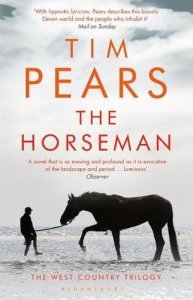
 About the Book
1911. In a forgotten valley on the Devon–Somerset border, the seasons unfold, marked only by the rituals of the farming calendar.
Twelve-year-old Leopold Sercombe skips school to help his father, a carter. Skinny and pale, Leo dreams of a job on the estate’s stud farm. He is breaking a colt for his father when a boy dressed in a Homburg, breeches and riding boots appears. Peering under the stranger’s hat, he discovers Miss Charlotte, the Master’s daughter.
And so begins a friendship between the children, bound by a deep love of horses, but divided by rigid social boundaries – boundaries that become increasingly difficult to navigate as they approach adolescence.
Format: ebook (317 pages) Publisher: Bloomsbury
Publication date: 12th January 2017 Genre: Historical fiction
Find The Horseman (The West Country Trilogy #1) on Goodreads
Purchase links*
Publisher | Hive (supporting UK bookshops)
*links provided for convenience not as part of an affiliate programme
My Review
The Horseman was included in the longlist for The Walter Scott Prize for Historical Fiction 2018. (The next book in the trilogy, The Wanderers, was on the 2019 longlist and the author made it three out of three when the final book in the trilogy, The Redeemed, made the shortlist for the 2020 prize.)
Unfolding month by month from January 1911 to June 1912, The Horseman charts the activities that take place on the farm and surrounding estate: mowing the fields, gathering the hay, harvesting barley, working the threshing machine. All of these are labour intensive relying not just on human effort but horse power as well. The horses are a valued part of the workforce, needing meticulous care and attention. Occasional diversions are choosing a piglet to be fattened, a trip to the annual horse fair or the excitement of a new waggon making its ‘maiden voyage’.
Young Leo has little interest in the academic subjects taught at school. He prefers observing nature: listening to bird song, watching hares play in the field, seeing pigeons roosting or swallows building their nests. He remarks how some creatures take little notice of his presence, as if he is invisible to them. “So each species of animal had its own peculiarities of vision. This world we surveyed was not as it was but as it was seen, in many different guises.”
Leo has a particular affinity with horses and a love of being around them. “There was a smell of leather and saddle soap. Plough strings, cart saddles, cobble trees and swingletrees, each hung on wooden pegs in its allotted place. These were icons of beauty to the boy…” Initially, he has little ambition beyond following in his father’s footsteps and learning everything he can from him about rearing and caring for horses. However, when Leo’s natural riding ability is noticed by the estate’s owner, Lord Prideaux, it seems to open up other possibilities. “He knew that he would work with horses all his life but understood as he had not before that there were different ways and places to do so. He doubted whether one life was long enough to know all there was to know of horses.”
Leo’s unlikely friendship with Charlotte, daughter of Lord Prideaux, is born out of a shared love of horses and the natural world. However, when an afternoon’s innocent pleasure is misinterpreted, it has far-reaching consequences for Leo and his family, setting his life on a completely different path.
There is some wonderful descriptive writing in the book such as this passage in which Leo walks before first light on a January morning. “There was a frost on the ground, the world was silent and new, he perceived it being born out of the darkness around him. The air was cold and clear. There were skeins of most in the low fields that were like the breath of the land made visible, like his own. The last stars of the night sky disappeared above him into the pale blue.” There is a great sense of place which has been likened to Thomas Hardy’s Wessex. (In fact, the description of Bampton horse fair brought to mind The Mayor of Casterbridge.)
The Horseman is a skilful evocation of life in a rural community in the years before the First World War and a homage to a lost way of life, one governed by tradition and measured by the seasons of the year. The fact the reader knows that life will soon be changed irrevocably gives it extra poignancy. For example, when Leo visits the ‘big house’ for the first time he marvels at the number of workers – gardeners, coaches, grooms, stable boys – employed there. Many of these would likely never return from the War.
The Horseman is a book to be savoured slowly, allowing yourself to become immersed in the day-to-day life of a rural community. I’m looking forward to reading the next book in the trilogy, The Wanderers.
In three words: Gentle, lyrical, evocative
Try something similar: All Among the Barley by Melissa Harrison
Follow this blog via Bloglovin
 About the Author
Tim Pears is the author of eight novels: In the Place of Fallen Leaves (winner of the Hawthornden Prize and the Ruth Hadden Memorial Award, In a Land of Plenty (made into a ten-part BBC series), A Revolution of the Sun, Wake Up, Blenheim Orchard, Landed (shortlisted for the IMPAC Dublin Literary Award 2012 and the 2011 Royal Society of Literature Ondaatje Prize, winner of the MJA Open Book Awards 2011), Disputed Land and In the Light of Morning.
He has been Writer in Residence at Cheltenham Festival of Literature and Royal Literary Fund Fellow at Oxford Brookes University, and has taught creative writing at Ruskin College and elsewhere. He lives in Oxford with his wife and children. (Photo credit: Goodreads author page)
Connect with Tim
Website | Goodreads
 My Buchan of the Month for July is The Gap in the Curtain, John Buchan’s only full-length novel with a supernatural element. Written between March 1930 and February 1931, it was published in the UK by Hodder & Stoughton on 7th July 1932 and in the US by The Riverside Press on 27th July 1932. The book is dedicated to his friends, Sybil and Lambert Middleton.


