
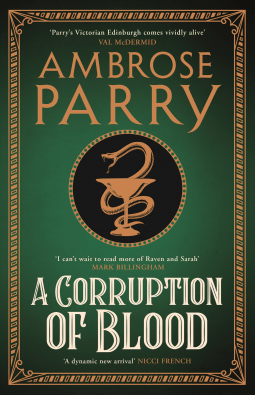
 About the Book
Edinburgh. This city will bleed you dry.
Dr Will Raven is a man seldom shocked by human remains, but even he is disturbed by the contents of a package washed up at the Port of Leith. Stranger still, a man Raven has long detested is pleading for his help to escape the hangman.
Back at 52 Queen Street, Sarah Fisher has set her sights on learning to practise medicine. Almost everyone seems intent on dissuading her from this ambition, but when word reaches her that a woman has recently obtained a medical degree despite her gender, Sarah decides to seek her out.
Raven’s efforts to prove his erstwhile adversary’s innocence are failing and he desperately needs Sarah’s help. Putting their feelings for one another aside, their investigations will take them to both extremes of Edinburgh’s social divide, where they discover that wealth and status cannot alter a fate written in the blood.
Format: eARC (416 pages) Publisher: Canongate
Publication date: 19th August 2021 Genre: Historical Fiction, Crime, Mystery
Find A Corruption of Blood on Goodreads
Pre-order/Purchase links
Bookshop.org
Disclosure: If you buy a book via the above link, I may earn a commission from Bookshop.org, whose fees support independent bookshops
Hive | Amazon UK
Links provided for convenience only, not as part of an affiliate programme
My Review
A Corruption of Blood has all the period atmosphere that was such a feature of its predecessors, The Way of All Flesh and The Art of Dying, transporting the reader to a 19th century Edinburgh in which seedy, crowded tenements inhabited by the poor coexist with the elegant, spacious houses of the wealthy. Although the third in the series, A Corruption of Blood can be read as a standalone although there are references to key events in the earlier books making them best read in order for maximum enjoyment.
Dr. Will Raven is no longer Dr. James Simpson’s apprentice but his assistant. However, he still battles to control what his friend Henry describes as his ‘perverse appetite for mayhem’ and remains plagued by fears he has inherited the violent tendencies of his father. In fact, the debate over whether character traits are inherited is a theme of the book, with some believing that indolence and immorality are destined from birth and others arguing that poverty is the cause of many of society’s ills. It later transpires that the idea of ‘a corruption of blood’ as in the title can have other consequences.
Sarah Fisher has left behind her former life as a servant in the Simpson household. However, even helping Dr. Simpson with the patients who attend his clinic is no longer sufficient for her. She longs to pursue a career in medicine, a profession in which few other women have succeeded, not least because of opposition from men who believe medicine an unsuitable job for a woman. As Sarah observes, the world is controlled by men.
The spark of attraction between Will and Sarah that looked likely to ignite in the first book seems to have become friendship and mutual respect. Will is still aware of the difference in their social status and Sarah has reason to fear her position in Will’s affections has been usurped by someone who offers him greater social advantages, especially for a man who has ambitions to set up his own practice. Despite all this, do they have a future together? This reader certainly hopes so.
Will and Sarah soon find themselves engaged in investigating the death of a wealthy member of Edinburgh society. As they discover, ‘powerful men accumulate powerful enemies’, especially if they are in possession of secrets. Together they make an effective team, possessing complementary skills: Will with his medical knowledge, familiarity with the city’s ‘underbelly’ not to mention being handy with his fists, and Sarah with her ability to elicit information from the lower sections of society. They’re not the only one on the case as there’s an appearance by James McLevy, the famous Edinburgh detective (also brought to life in fictional form in David Ashton’s historical mystery series).
As Will and Sarah press ahead with their enquiries, keen for their investigation to bear fruit, the reader may believe they know exactly who the culprit is but there are times when it’s wise to wait for a second opinion or to revisit your initial diagnosis. And, along the way they uncover a shocking secret that sets the city alight with outrage and a demand for justice.
A Corruption of Blood is another skilful combination of intricately plotted mystery, engaging leading characters and great period atmosphere. The pace is helped by the short chapters, particularly as the book reaches its climax. For me, it’s just what the doctor ordered and I’m hoping for a repeat prescription before too long.
I received an advance review copy from Canongate via NetGalley. A Corruption of Blood is book 17 of my 20 Books of Summer 2021.
In three words: Intricate, atmospheric, assured
Try something similar: The Wages of Sin by Kaite Welsh
Follow this blog via Bloglovin
 About the Authors
Ambrose Parry is a pseudonym for a collaboration between Chris Brookmyre and Marisa Haetzman. The couple are married and live in Scotland. Chris Brookmyre is the international bestselling and multi-award-winning author of over twenty novels. Dr Marisa Haetzman is a consultant anaesthetist of twenty years’ experience, whose research for her Master’s degree in the History of Medicine uncovered the material upon which this series, which began with The Way of All Flesh, is based. The Way of All Flesh was shortlisted for the McIlvanney Prize for Scottish Crime Book of the Year and longlisted for the Theakston Old Peculier Crime Novel of the Year Award. (Photo/bio credit: Publisher author page)
Connect with Ambrose Parry
Twitter

 About the Book
 About the Author

