Welcome to today’s stop on the blog tour for A Monster in the Ash by Susie Gordon which will be published on 15th October 2026. My thanks to Kelly at Folk PR for inviting me to take part in the tour and to Claret Press for my review copy.
About the Book
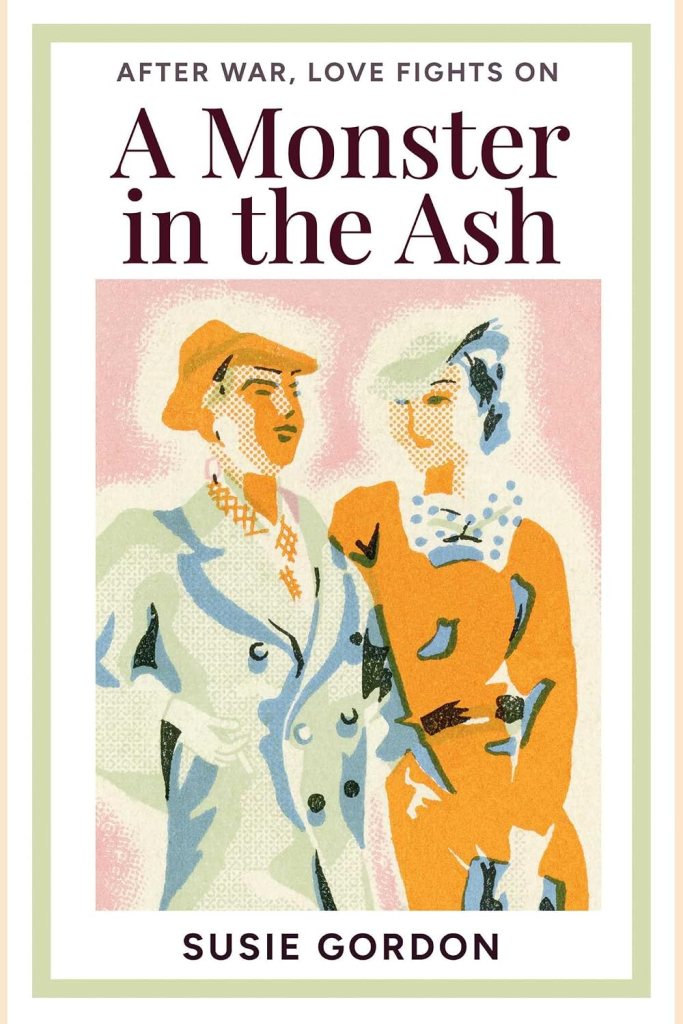
Sadie Shaposnick spent the war running a black-market racket out of her husband Leon’s East End butcher shop. Now Leon has returned from a German POW camp, traumatised and dismayed to find Fascism rising once again, only ten years after Cable Street. With the authorities turning a blind eye, Leon joins a vigilante gang formed by Simka Reubens, a charismatic former street-fighter with ties to Sadie’s late mother Rosy Gold—a local anti-fascist icon who died fighting Franco in Spain. At first, Sadie resists being drawn into the gang, but as the violence escalates she realises that fighting back is the only way to protect her neighbours and hopefully repair her faltering marriage.
Meanwhile, Sadie’s widowed sister Karla has to raise her daughters alone in her grief-stricken in-laws’ mansion. When her late husband’s younger brother Rafi returns from fighting with armed partisans in Mandatory Palestine, Karla must decide how far she’ll go to feel alive again. But when Rafi crosses paths with Sadie, he is drawn into the struggle as well, sending the gang into even greater peril.
With Oswald Mosley gaining power, the only option is resistance, even if it means facing the ghosts of the past while fighting the monsters that are rising from the ashes of the war.
Format: Paperback (235 pages) Publisher: Claret Press
Publication date: 15th October 2026 Genre: Historical Fiction
Find A Monster in the Ash on Goodreads
Purchase A Monster in the Ash from Bookshop.org [Disclosure: If you buy books linked to our site, we may earn a commission from Bookshop.org, whose fees support independent bookshops]
My Review
The Shaposnick family are already bruised and battered by war. They’re mourning the loss of loved ones, coping with the strains that separation can place on a marriage, trying to keep the family business going. Even seemingly miraculous returns don’t come without problems because there are some things that once broken cannot so easily be mended.
What Jewish ex-servicemen like Leon weren’t expecting to be confronted with was a resurgence of fascism directed at the Jewish community. Antisemitic speeches in public places designed to whip up hatred that brand Jews as ‘aliens’ despite the fact many Jews fought and died for Britain, as well as attacks on Jewish businesses and synagogues
The “monster” of the book’s title is Oswald Mosley, interned for much of the Second World War, but now seeking to revive the fascist movement in Britain and still a formidable figure. ‘He had his claws in every corner of society: rich folk to put up the cash for his campaign, the anxious middle classes to listen to his minions, and common thugs to do his dirty work.’ A few contemporary parallels spring to mind…
The novel describes how the Jewish community of London’s East End sought to fight back, mobilising themselves into a group known in the book as the Gold Gang (inspired by the real life 43 Group) to take direct action: disrupting meetings and marches, even eventually infiltrating fascist groups. Some, like Leon, are prepared to use violence, arguing that it is the only way to defeat the fascists, nothing having come of more peaceful methods. Others, like Leon’s brother Raymond, want nothing to do with it, either because they fear the repercussions or simply believe it is futile.
The novel depicts how these differences play out within the Shaposnick family, some of whose relationships are already complicated by their wartime experiences. There is conflict and betrayal, moments of violence and fear. But there are also touching reconciliations. Even when things calm down, not everyone is confident they have a future in Britain. Towards the end of the book we get quick glimpses of what the future holds for some of the characters. Personally I would have liked a little more detail how some of the things mentioned came about.
The book immerses you in the life of London’s East End Jewish community, its customs and religious practices giving a real sense of authenticity. I made frequent use of the Glossary to help with terms I was unfamiliar with.
A Monster in the Ash is a fascinating, emotionally involving insight into an aspect of life in post-WW2 Britain that was completely new to me.
About the Author

Susie Gordon is a Liverpool-based author, poet and journalist. Her first poetry collection, Peckham Blue, was published in London by Penned in the Margins, and her second collection, Harbouring, was published through Math Paper Press. A Monster in the Ash is her first novel. (Photo: Instagram profile)
Connect with Susie
Website | Instagram