
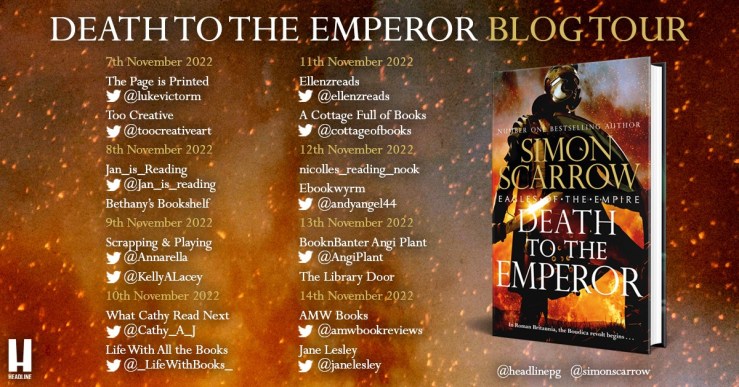
 Welcome to today’s stop on the blog tour for Death to the Emperor by Simon Scarrow which is published today by Headline. My thanks to Jess at Ransom PR for inviting me to take part in the tour and for organising my digital review copy via NetGalley. Do check out the post by my tour buddy for today, Christine at LifeWithAllTheBooks.
 About the Book
AD 60. Britannia. The Roman Empire’s hold on the province of Britannia is fragile. The tribes implacably opposed to Rome have grown cunning in their attacks on the legions. Even amongst those who have sworn loyalty, dissent simmers. In distant Rome, Nero is blind to the danger.
As hostilities create mayhem in the west, Governor Gaius Suetonius Paulinus gathers a vast army, with Prefect Cato in command. A hero of countless battles, Cato wants his loyal comrade Centurion Macro by his side. But the Governor leaves Macro behind, in charge of the veteran reserves in Camulodunum. Suetonius dismisses concerns that the poorly fortified colony will be vulnerable to attack when only a skeleton force remains.
With the military distracted, slow-burning anger amongst the tribespeople bursts into flames. The king of the Iceni is dead and a proud kingdom is set for plundering and annexation. But the widow is Queen Boudica, a woman with a warrior’s heart. If Boudica calls for death to the emperor, a bloodbath will follow.
Macro and Cato each face deadly battles against enemies who would rather die than succumb to Roman rule. The future of Britannia hangs in the balance.
Format: Hardback (480 pages) Publisher: Headline
Publication date: 10th November 2022 Genre: Historical Fiction
Find Death to the Emperor on Goodreads
Purchase links
Bookshop.org
Disclosure: If you buy a book via the above link, I may earn a commission from Bookshop.org, whose fees support independent bookshops
Hive | Amazon UK
Links provided for convenience only, not as part of an affiliate programme
My Review
I wrote in a recent blog post about my tendency to discover series only once they have been going for some time. Could there be a better example than Death to the Emperor which is the 21st (yes, you read that right) in the author’s ‘Eagles of the Empire’ series. And here’s me, a so-called fan of historical fiction set in Roman times, reading a Simon Scarrow book for the first time. However, the good news is he now has a new fan and I shall be scouring bookshops for previous books in the series. In fact, I spotted one – Day of the Caesars – in my local Oxfam bookshop just the other day so only nineteen more to go.
Despite Death to the Emperor being the first book I’ve read in the series, I never felt at a loss. The author provides sufficient detail about previous events to help make sense of things but not too much that you feel you’ve learned everything there is to know. Although this is my first introduction to Centurion Macro and Prefect Cato, I loved their partnership borne of mutual respect and a soldierly comradeship forged in the heat of battle. For much of the book, though, they find themselves apart, each wishing they had the other beside them for support and advice, and because of their complementary skills.
Although now officially an army veteran living in the Roman colony of Camulodunum (Colchester), as Macro remarks to his wife, Petronella, ‘You can take the man out of the army, but never the army out of the man’. That will soon be put the test especially since Camulodunum is ‘a powder keg’, surrounded by tribes chafing under the yoke of Roman rule and people left hungry as a result of poor harvests and high taxes. Poorly defended and with a large civilian population, Camulodunum is vulnerable to attack but only a few, like Macro, can see the potential danger.
Both Cato and Macro find themselves under the command of men whose actions they doubt or whose motives they distrust. For Cato, that man is Gaius Suetonius Paulinus, Governor of Britannia. Suetonius is ambitious for military success. ‘Rulers need victories and heroes keep the mob happy.’ He does not much care how many of his soldiers die in the process so long as he achieves his objective which in this case is to attack and destroy a stronghold of the Druid cult on the island of Mona (Anglesey).
Macro has drawn an even shorter straw in the person of Procurator Decianus, the man tasked with collecting the tribute owed to Rome by the Iceni, ruled by Queen Boudica. Macro has his measure from the start, ‘You seek power and riches and you don’t care who you have to ruin to achieve that… You don’t serve Rome’s interests, only your own, even if that means putting the Empire in danger’. Decianus considers the Iceni savages and demonstrates this in the most ruthless way. Realising Macro’s worst fears, his actions set in motion a series of events that will threaten Rome’s hold on the province of Britannia and the lives of the Romans who have settled there. This includes Cato, Macro and their families.
As you might expect, the book is full of authentic detail about weaponry, military strategy, social and religious customs and much, much more. There are some terrific set pieces such as the assault on the island of Mona which involves not just a battle against a ferocious enemy but against the elements too. Battle scenes are brought thrillingly to life, putting the reader right in the heart of the action. ‘The two sides became a heaving mass of helmets, crests, blades, spears, swords and axes, amid sprays of crimson and a cacophany of weapns clashing and thudding home on shields and limbs’.
Although history tells us how the uprising led by Boudica ended, the book’s stunning but savage conclusion leaves many questions unanswered about the fate of some characters, meaning book twenty-two cannot come too soon.
In three words: Thrilling, action-packed, immersive
Try something similar: The Iron Way by Tim Leach
 About the Author
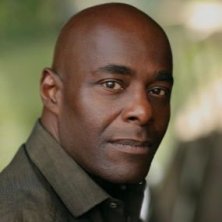
Simon Scarrow is a Sunday Times No. 1 bestselling author with several million copies of his books sold worldwide. After a childhood spent travelling the world, he pursued his great love of history as a teacher, before becoming a full-time writer. His Roman soldier heroes Cato and Macro made their debut in 2000 in Under the Eagle and have subsequently appeared in many bestsellers in the Eagles of the Empire series, including Centurion, Invictus and Day of the Caesars. Many of the series have been Sunday Times bestsellers.
Simon Scarrow is also the author of a quartet of novels about the lives of the Duke of Wellington and Napoleon Bonaparte – Young Bloods, The Generals, Fire and Sword and The Fields of Death; a novel about the 1565 Siege of Malta, Sword & Scimitar; Hearts of Stone, set in Greece during the Second World War; and Playing with Death, a contemporary thriller written with Lee Francis. He also wrote the novels Arena and Invader with T. J. Andrews. His thriller, Blackout, set in WW2 Berlin and first published in 2021 was a Richard and Judy Book Club pick. (Photo: Twitter profile)
Connect with Simon
Website | Twitter | Facebook

 About the Book
 About the Author
 What Cathy Read Next...