
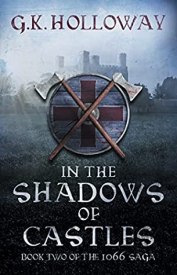
 About the Book
It’s the 1060s, and William of Normandy is establishing a new and brutal regime in England, but there are those who would defy him. As Norman soldiers spread like a plague across the land, resistance builds, but will it be enough to topple William and restore the rightful king to his throne? The English have the courage to fight, but the Normans, already victorious at Hastings, now build castles seeking to secure their tenuous foothold in these lands.
And what of the people caught up in these catastrophic events? Dispossessed but not defeated, their lives ripped apart, the English struggle for freedom from tyranny; amongst them, caught up in the turmoil, are a soldier, a thane and two sisters. As events unfold, their destinies become intertwined, bringing drastic changes that alter their lives forever.
Format: ebook (434 pages) Publisher: Silverwood Books
Publication date: 30th September 2022 Genre: Historical Fiction
Find In the Shadows of Castles on Goodreads
Purchase links
Hive | Amazon UK
Links provided for convenience only, not as part of an affiliate programme
My Review
In the Shadows of Castles is the follow-up to 1066: What Fates Impose which I read back in 2018. We probably all know that King Harold was defeated by Duke William of Normandy (aka William the Conqueror) at the Battle of Hastings, but what happened after that? You might assume that having won that battle and claimed the crown of England (his coronation having taken place in Westminster Abbey where King Charles III will be crowned on 6th May 2023) William was in full control of the country. Think again, because England was far from subdued, as the book demonstrates. Many English nobles were unwilling to accept William as their king and were engaged in trying to form alliances that would enable them to defeat the conquerors or, at the very least, confine them to small areas of the realm. They were also outraged by the Normans’ savagery towards the population: the seizure by force of land, the destruction of property, summary executions, rape and murder.
Alongside detailed accounts of events in the turbulent years following the Battle of Hastings and the actions of key historical figures, the author cleverly introduces a group of fictional characters to personalise what might otherwise have become a litany of military skirmishes and political intrigue. (To help keep track of everyone, the book has a dramatis personae – helpfully divided into English and Norman characters – and a useful map.) Much my favourite part of the book was following the fortunes of four fictional characters: Bondi, a housecarl to King Harold; Whitgar, a thane (minor noble); and sisters, Morwenna and Elfwyn. I liked seeing how their individual stories converged and how, together, they overcome adversity in its many different guises. I must admit to a particular fondness for Bondi (who features in the book’s opening chapter) and for the feisty Morwenna. In fact, there are a surprising number of women in positions of power, such as William’s wife, Matilda who acted as regent of the duchy of Normandy for a time – between bearing him ten children.
The author’s enthusiasm for this period of history is evident and if you like your historical fiction packed with detail you won’t be disappointed. But there are also some exciting scenes, including a perilous journey through the snow and a dramatic escape by ship. And the closing chapter of the book suggests we may not yet have reached the end of the story.
William I left a physical legacy in the form of the many castles he built up and down the country, such as in Durham and York. And of course, we also have the Bayeux Tapestry which depicts the events leading up to the Battle of Hastings. A late 19th century replica of the tapestry is on display in Reading Museum (my home town).
My thanks to the author for my digital review copy. You can read an extract from In the Shadows of Castles as well as a Q&A with Glynn here.
In three words: Detailed, well-researched, dramatic
Try something similar: William the Conqueror by John Wingate (or for a more romatic take, The Conqueror by Georgette Heyer)
 About the Author
G. K. Holloway did several jobs after leaving school before taking A Levels at his local college and later a degree in History and Politics at Coventry University. Once he had graduated, he spent the next twenty years working in education in and around Bristol.
After reading a biography about Harold Godwinson, he studied the late Anglo-Saxon era in detail and discovered a time of papal plots, court intrigues, family feuds, loyalties, betrayals, assassinations and a few battles. When he had enough material to weave together fact and fiction, he produced his award-winning novel, 1066: What Fates Impose, the first in a series about the Norman Conquest.
G. K. Holloway lives in Bristol with his wife and two children. (Photo: Author Website)
Connect with Glynn
Website | Twitter | Facebook

 About the Book
 About the Author
 What Cathy Read Next...