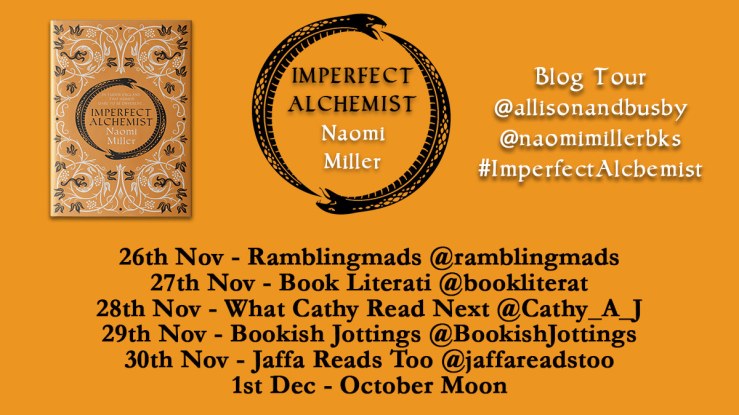
#BookReview Imperfect Alchemist by Naomi Miller @AllisonandBusby

Imperfect Alchemist blog tour Twitter

Welcome to today’s stop on the blog tour for Imperfect Alchemist by Naomi Miller. My thanks to Lesley at Allison & Busby for inviting me to take part in the tour and for my digital review copy via NetGalley.


Imperfect AlchemistAbout the Book

Two women. One bond that will unite them across years and social divides.

England, 1575. Mary Sidney, who will go on to claim a spot at the heart of Elizabethan court life and culture, is a fourteen-year-old navigating grief and her first awareness of love and desire. Her sharp mind is less interested in the dynastic alliances and marriages that concern her father, but will she be able to forge a place for herself and her writing in the years to come?

Rose Commin, a young country girl with a surprising talent for drawing, is desperate to shrug off the slurs of witchcraft which have tarnished life at home. The opportunity to work at Wilton House, the Earl of Pembroke’s Wiltshire residence, is her chance.

Defying the conventions of their time, these two women, mistress and maid, will find themselves facing the triumphs, revelations and struggles that lie ahead together.

Format: Hardback (352 pages)                 Publisher: Allison & Busby
Publication date: 19th November 2020 Genre: Historical fiction

Find Imperfect Alchemist on Goodreads

Purchase links
Bookshop.org
Disclosure: If you buy a book via the above link, I may earn a commission from Bookshop.org, whose fees support independent bookshops

Hive | Amazon UK
Links provided for convenience only, not as part of an affiliate programme


My Review

Subtitled ‘A Novel of Mary Sidney Herbert, Renaissance Pioneer’, in Imperfect Alchemist the author creates a potpourri from elements that will be familiar to readers of historical fiction set in the Tudor period. There’s the risk of accusations of witchcraft against women with midwifery skills or knowledge of herbal remedies, the intrigue and power struggles of the Elizabethan Court, and the social constraints that present women with little option other than marriage, motherhood or a life in service. Throw in the study of alchemy, a little romance as well as famous historical figures such as Walter Raleigh and John Dee, and you have all the ingredients for an engrossing story. Although the book’s structure is clearly designed to replicate the stages of the alchemical process, allusions to alchemy can be found throughout the book.

Mary Sidney emerges as a vibrant character but one, despite her status in life, not immune from an arranged marriage, the tragedy of bereavement and the risks associated with childbirth. What seem like opportunities are often followed by setbacks or unintended consequences.  The equal of her brother Phillip when it comes to literary creativity, I particularly liked Mary’s passion for words. “Honing a phrase to embody a thought was her pleasure. Metaphors were her passion, her liberation from the literal constraints that framed her existence.”   

Mary’s determination to give female characters a more prominent role in works of literature sees her influencing the poetry of her brother, Philip (“her dearest soul and partner of the mind”) and even, the author contends, the work of arguably the most notable playwright of the period.  The Circle, the literary salon Mary establishes, attended by the likes of Edmund Spenser and Ben Jonson, she compares to an alchemical experiment in which materials are “blended and distilled until the union of like and unlike might yield perfect knowledge“.

The inclusion of a first person narrator, Rose Commin, gives the reader another perspective on Mary and provides the opportunity for secondary storylines as well as a touching if unconventional friendship between women from vastly different backgrounds.  Mary’s encouragement of Rose’s artistic talent also allows the author to explore another kind of transformational process.  As Rose observes, “The more I worked with colour the more readily I could understand the layering and mixing of shades in terms of my lady’s alchemy, where painstaking combinations of dissimilar ingredients could produce a harmonious end result”.

In Imperfect Alchemist, Naomi Miller transforms historical fact into the engrossing story of a remarkable woman who was clearly ahead of her time. Like her leading character, the author has “steeped existing material in the tincture of her own imagination” to create a story rich in historical detail.  If the book has made you interested in reading more about Mary Sidney Herbert as a character, do check out the author’s recommendations.

In three words: Immersive, authentic, fascinating

Follow this blog via Bloglovin


Naomi Miller
Photo credit: John Crispin

About the Author

Naomi Miller is a professor of English and the Study of Women and Gender at Smith College, Massachusetts, where she specializes in Shakespeare and his literary “sisters” – women writers of the Renaissance. Imperfect Alchemist is her first novel.

Connect with Naomi
Website | Twitter | Facebook | Instagram

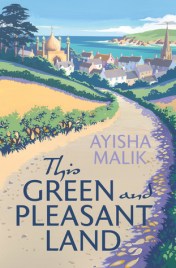
#BookReview This Green and Pleasant Land by Ayisha Malik @ZaffreBooks @ReadersFirst1

This Green and Pleasant Land Ayisha MalikAbout the Book

For years Bilal Hasham and his wife Mariam have lived contented, quiet lives in the sleepy, rural village of Babbel’s End. Now all that is about to change.

On her deathbed, Bilal’s mother reaches for his hand. Instead of whispering her final prayers, she gives him a task: build a mosque in his country village.

Mariam is horrified by Bilal’s plan. His friends and neighbours are unnerved. As outrage sweeps Babbel’s End, battle lines are drawn. His mother’s dying wish reveals deeper divisions in their village than Bilal had ever imagined.

Soon Bilal is forced to choose between community and identity, between faith and friendship, between honouring his beloved mother’s last wish and preserving what is held dear in the place that he calls home.

Format: Hardcover (454 pages)       Publisher: Zaffre
Publication date:  13th June 2019  Genre: Contemporary Fiction

Find This Green and Pleasant Land on Goodreads

Purchase links*
Amazon UK | Hive (supporting UK bookshops)
*links provided for convenience not as part of an affiliate programme


My Review

In Babbel’s End, the author creates a picture of a community which exhibits all the features of small village life: gossip, petty rivalries and disputes between neighbours, the latter exemplified by the hilarious “battle of Tom’s bush”.  However, a recent tragedy has exposed the village to very modern day issues and the response to it (or lack of response to it) has heightened tensions.  As one character observes, “Living in their farmland, thinking nothing’s more important than a fete or a stolen ceramic pot; in the meantime, to hell with what anyone’s going through.” For Richard, the community’s vicar, the tragedy has caused him to doubt his ability to provide comfort where needed, including at a very personal level. “He seemed to have lost the ability to inspire people to faith or find the right words to help people in distress.”

Bilal, his wife Mariam, and son Haaris have embraced village life. In fact, their relocation from Birmingham to Babbel’s End was a deliberate move to escape his family’s expectations that he maintain aspects of his Pakistani heritage despite his having been born in Britain.  His mother’s deathbed wish changes all that, particularly when the strength of opposition becomes clear.  As disapproval bubbles over into overt racism, things get very personal and Bilal is tempted to forget the whole idea. “Change was meant for fascist states and oppressive governments, not serene, bobbing-along, minding-it’s-own-business Babbel’s End.”

As the news of Bilal’s mission goes viral, it becomes a bigger issue than just church versus mosque but raises questions of identity, religious freedom and diversity. As Bilal observes, “What did everyone even mean by English? Bilal was English. Though he could concede that having a mosque in the middle of the village might not be. Surely you could be and want two different things at the same time?”

My favourite character in the book was Bilal’s Aunt (Khala) Rukhsana.  Speaking little English, at first she is something of a fish out of water.  However, she demonstrates the ability to reach out to people in other ways and really does emerge as the heroine of the piece.  For instance, I loved the gradual blossoming of her relationship with Mariam, especially their joint ‘assault’ on the school bake sale substituting the usual cupcakes for something traditionally Indian. “And so they began the process of making the sweet, fragrant, yellow rice, to give everyone in Babbel’s End a taste of what was to come.”

This Green and Pleasant Land teaches us that divisions can be healed if we just take the time to understand the other person’s point of view, that it’s important to seize the day and that, in the words of Rukhsana, “home must be where you feel most alive”.

I received a review copy courtesy of Zaffre and Readers First.

In three words: Warm, engaging, uplifting

Try something similar: The Music Shop by Rachel Joyce

Follow this blog via Bloglovin


Ayisha MalikAbout the Author

Ayisha Malik is a writer and editor, living in South London. She holds a BA in English Literature and a First Class MA in Creative Writing. Her novels Sofia Khan is Not Obliged and The Other Half of Happiness, starring ‘the Muslim Bridget Jones’, were met with great critical acclaim, and Sofia Khan is Not Obliged was chosen as 2019’s Cityread book. Ayisha was a WHSmith Fresh Talent Pick, shortlisted for the Asian Women of Achievement Award and Marie Claire’s Future Shapers Awards. Ayisha is also the ghost writer for The Great British Bake Off winner, Nadiya Hussain.

Connect with Ayisha
Website | Twitter | Instagram