 About the Book
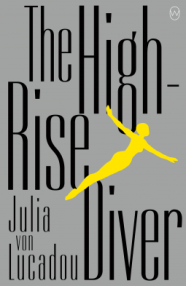
Riva is a “high-rise diver”, a top athlete with millions of fans, and a perfectly functioning human on all levels. Suddenly she rebels, breaking her contract and refusing to train. Cameras are everywhere in her world, but she doesn’t know her every move is being watched by Hitomi, the psychologist tasked with reining Riva back in. Unquestionably loyal to the system, Hitomi’s own life is at stake: should she fail to deliver, she will be banned to the “peripheries”, the filthy outskirts of society.
For readers of The Handmaid’s Tale, The Circle and Brave New World, this chilling dystopia constructs a world uncomfortably close to our own in which performance is everything.
Format: Ebook (288 pages) Publisher: World Editions
Publication date: 2nd March 2021 Genre: Dystopian, Science Fiction, Literature in Translation
Find The High-Rise Diver on Goodreads
Purchase links
Bookshop.org
Disclosure: If you buy a book via the above link, I may earn a commission from Bookshop.org, whose fees support independent bookshops
Hive | Amazon UK
Links provided for convenience only, not as part of an affiliate programme
My Review
In the High-Rise Diver, Julia von Lucadou creates a vivid, if disturbing, picture of a future society in which surveillance is not just widespread but constant and invasive. Think activity trackers that monitor your sleep patterns, nutritional intake and vital signs. Where every action you take online is recorded and scrutinized. Where facial recognition technology is omnipresent and your location is tracked in real time using the tablet device that continuously bombards you with news alerts and advertising messages.
The book introduces the reader to a highly stratified society in which those who have earned the right to dwell in the city enjoy privileges denied to those who live in the ‘peripheries’. The only route out of the latter is via success at “casting sessions” at which future life and career paths are determined based on a candidate’s performance. Naturally, the sessions are live-streamed on social media to millions.
Reminiscent of The Handmaid’s Tale, many children are conceived by ‘breeders’ and even those who aren’t may have little contact with their ‘bioparents’. However, like everything else in this society, the simulated experience of family life can be bought for a price. And if you don’t have the credits for that, there’s always the ‘parentbot’ app.
Readers are likely to have varying responses to certain features of the book, such as the absence of speech marks and the frequent use of ™ appended to certain words. Personally, the former didn’t cause me a problem and, although I found the latter a little annoying, it did underline the sense of a society in which anything can be commercialized, even a celebrity’s favourite cocktail. Pour me another flydrive™ barman. (You may be reassured to know that you can still get a martini even in this imagined future.)
If you thought an annual appraisal with your manager was something to be apprehensive about just imagine a situation in which your performance is continuously monitored, evaluated and rated by your superior, and in which your income, social status, accommodation and other ‘privileges’ are dependent on the outcome. If that doesn’t make you shudder, then how about the thought of having a date reviewed and rated by the other party and having to complete a profile in advance setting out your sexual preferences and expectations.
Although it wasn’t hard for me to imagine why Riva might not want to continue training in order to perform ever more daring dives off high buildings – surely a metaphor for the status conscious society imagined by the author – I’m not sure I really felt much connection with her. I was more drawn to Hitomi’s story, that of the watcher who is constantly watched herself and is gradually overwhelmed by the nature of her assignment.
The High-Rise Diver paints a rather grim vision of a possible future, one I hope will never come to pass. By the end, I definitely found myself hoping that Hugo Masters, Hitomi’s creepy boss, might have an encounter with a defective flysuit™. And if you’ve ever lacked the motivation for a digital detox, The High-Rise Diver will definitely provide the kick you need.
I received an advance review copy courtesy of World Editions via NetGalley.
In three words: Chilling, thought-provoking, imaginative
Try something similar: A Calculated Life by Anne Charnock
Follow this blog via Bloglovin
About the Author
Julia von Lucadou was born in Heidelberg in 1982. She studied film and theater at Johannes Gutenberg University of Mainz and Victoria University of Wellington and earned her PhD in Film Studies in 2015. Lucadou worked as both an assistant director and a television editor prior to writing The High-Rise Diver, her debut novel, which was nominated for the Swiss Book Prize in 2018. She lives between Biel, New York, and Cologne. (Bio credit: Publisher author page)
About the Translator
Sharmila Cohen is an award-winning writer and German-to-English translator who has translated the works of several leading German-language authors. Her work has been featured in publications such as BOMB and Harpers, and her projects span from poetry and literary fiction to crime and children’s stories. Originally from New York, Cohen came to Berlin in 2011 as a Fulbright Scholar to complete an experimental translation project with local poets. She now divides her time between both cities. (Bio credit: Publisher author page)

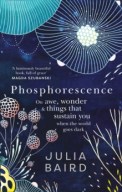 This month’s starting book is Phosphorescence: On Awe, Wonder and Things That Sustain You When the World Goes Dark by Julia Baird. It’s a book I’d not heard of before this, let alone read. Perhaps not surprising because it isn’t published in the UK until May 2021. However, from the blurb, I understand it poses the question: when we’re overwhelmed by illness or heartbreak, loss or pain, how do we survive, stay alive or even bloom?