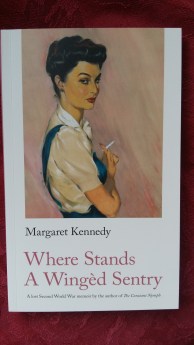
 About the Book
‘Most people knew in their hearts that the lid had been taken off hell, and that what had been done in Guernica would one day be done in London, Paris and Berlin.’
Margaret Kennedy’s prophetic words, written about the pre-war mood in Europe, give the tone of this riveting 1941 wartime memoir: it is Mrs Miniver with the gloves off. Her account, taken from her war diaries, conveys the tension, frustration and bewilderment of the progression of the war, and the terror of knowing that the worst is to come, but not yet knowing what the worst will be.
English bravery, confusion, stubbornness and dark humour provide the positive, more hopeful side of Kennedy’s experiences, in which she and her children move from Surrey to Cornwall, to sit out the war amidst a quietly efficient Home Guard and the most scandalous rumours.
Find Where Stands A Wingèd Sentry on Goodreads
Format: Paperback (280 pages) Publisher: Handheld Press
Publication date: 23rd March 2021 Genre: Memoir, NonFiction
Purchase links
Publisher | Hive
Links provided for convenience only, not as part of an affiliate programme
My Review
In her introduction to the book, Faye Hammill, Professor of English at the University of Glasgow, describes Where Stands A Wingèd Sentry as an extraordinary record of the terrifying months from May to September 1940 when fears of invasion were rife. Originally published in the US in 1941 by Yale University Press, it has never until now been published in the UK.
Where Stands A Wingèd Sentry is Margaret Kennedy’s own day by day account of what she herself describes as her ‘inner battle’, involving everything from resolving everyday domestic challenges to difficult decisions about the safety of her family. Although written with one eye on posterity, Margaret’s journal also seems to have been a sounding board for her concerns and worries. Frequently she lists the pro’s and con’s of things such as asking the doctor for sedatives to help her sleep, or the morality of taking advantage of evacuating her children to Canada. In fact, when she does later go to the doctor about her sleep problems, his advice to her is to stop reading the newspapers but if she has to then only to read The Times, and that listening to the wireless four times a day as she does is ‘three times too often’. I think those of us living through the current pandemic can have some sympathy with that, although at least Margaret didn’t have to cope with 24-hour news and social media.
There are welcome moments of humour, many of them provided by the redoubtable Nanny Ross whose habit of mispronouncing words frequently creates confusion. For example, ‘Nanny says that an Abbess is threatening to swallow the whole of Europe’. I chuckled too at the author’s observation about Cotter, the gardener who presides over their garden with ruthless efficiency, ‘It’s my belief that he was born giving instructions to the midwife’. And Margaret is less than impressed with some of the invasion precautions they are encouraged to take such as, if leaving a car unattended, not just taking out the ignition key but, in her words pretty well disembowelling it, because ‘the Germans know all about hairpins’.
One of the many things I loved about the book is the persistent sense of defiance and fortitude. I found this remarkable given the author did not know at the time whether the war would end in victory or defeat. For example, at one point she writes: ‘But every month, every week, day, hour and minute that we manage to hold on brings it [Hitler’s downfall] that much nearer. Every day will show the world more clearly what Nazism really is, and open the eyes of those still blind, and convince people that any sacrifice is better than submission’.
There is a message of hope for the future as well. Writing in August 1940 in a chapter titled ‘Owed By So Many To So Few’, the author’s fervent wish is: ‘By the grace of God we may emerge from this ordeal a more admirable society than we were when we went in’. But she’s also clear-eyed about the perilous situation the country faces. ‘We are not giving in. We are just going on fighting… Nobody can let us down any more, because we are fighting alone… Hitler may win; I suppose the odds are still heavily on his side. But, please God, we’ll give him such a pounding before he does that he’ll never be the same man after it’. Positively Churchillian, isn’t it? And at the start of the Blitz, despite the fact her husband is working in London, Kennedy observes, ‘Hitler made a mistake when he bombed Buck House [Buckingham Palace] …Buck House and Limehouse are the two places where he won’t find quitters’.
The book contains some wonderful descriptive writing. I was particularly taken with a scene in which Margaret walks to the top of nearby Holmbury Hill. ‘You look south there for miles and miles across Surrey and Sussex, over a patchwork of little fields and smudges of woods and the red roofs of farmhouses. On the horizon is the blue line of the South Downs, and a little knob of one of them which is the clump of huge beeches called Chanctonbury Ring. And beyond them is the sea. And beyond that France. And there, under the same cloudless sky, all this hell of suffering and terror is going on at this very moment. Farms are blazing. Homeless wretches stray along the road. Mothers howl for dead babies, and children for dead mothers. And our men are dying in this sunshine upon a soil they could not defend.’
In her foreword to the book, dated May 1941, the author writes, ‘All my life I have had a great curiosity to know what it felt like to live through history… Lately, I have lived through history myself – quite a bit of history‘. Reading the book, I felt I had joined Margaret on that journey. As she observes, ‘we have certainly taken life to pieces and found out what it is made of‘. Where Margaret is concerned, I think we can safely say it was made of strong stuff.
For anyone interested in women’s writing or the experiences of those on the ‘Home Front’ during the Second World War, Where Stands A Wingèd Sentry is a gem waiting to be discovered amongst the growing list of titles published by Handheld Press. Look out for my review of another of their titles, There’s No Story There: Wartime Writing, 1944 – 1945 by Inez Holden, also published today.
In three words: Powerful, honest, inspiring
Try something similar: Blitz Writing: Night Shift & It Was Different At The Time by Inez Holden
Follow this blog via Bloglovin
 About the Author
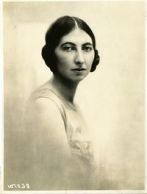
Margaret Kennedy (1896 – 1967) was an English novelist and playwright. Born in April 1896, she attended Cheltenham Ladies’ College, where she began writing, and then went up to Somerville College, Oxford in 1915 to read history. Her first publication was a history book, A Century of Revolution (1922) but her most famous book is the novel, The Constant Nymph, published in 1924. Margaret Kennedy was married to the barrister David Davies. They had a son and two daughters, one of whom was the novelist Julia Birley. (Photo/bio credit: Goodreads author page)


 I’m delighted to say there’s a giveaway with a chance to win one of three paperback copies of You Let Me Go. Enter via Rafflecopter
  About the Book
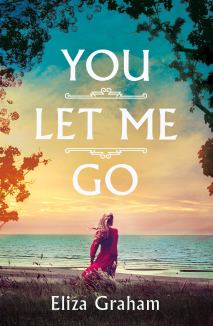
 The story that unfolds in You Let Me Go is told in alternating chapters from the point of view of Rozenn and her granddaughter Morane, transporting the reader between Nazi occupied France in World War Two and present day Cornwall – the Helford River area to be precise. Having been fortunate enough to visit that part of Cornwall in the past, I could easily imagine the creeks described in the book.
 About the Author