My Week in Books – 25th July 2021

MyWeekinBooks

On What Cathy Read Next last week

Blog posts

Monday – I published my review of The Reading List by Sara Nisha Adams.

Tuesday –  This week’s Top Ten Tuesday topic was Books I Read In One Sitting. 

Wednesday – WWW Wednesday is the opportunity to share what I’ve just read, what I’m currently reading and what I plan to read next… and to have a good nose around what others are reading. 

Thursday – I published my review of Vanish in an Instant by Margaret Millar.

Friday – I shared my review of Mrs Palfrey at the Claremont by Elizabeth Taylor.

Saturday – I picked out a few events that have caught my eye in the programme for Henley Literary Festival which takes place in October. 

As always, thanks to everyone who has liked, commented on or shared my blog posts on social media.


New arrivals
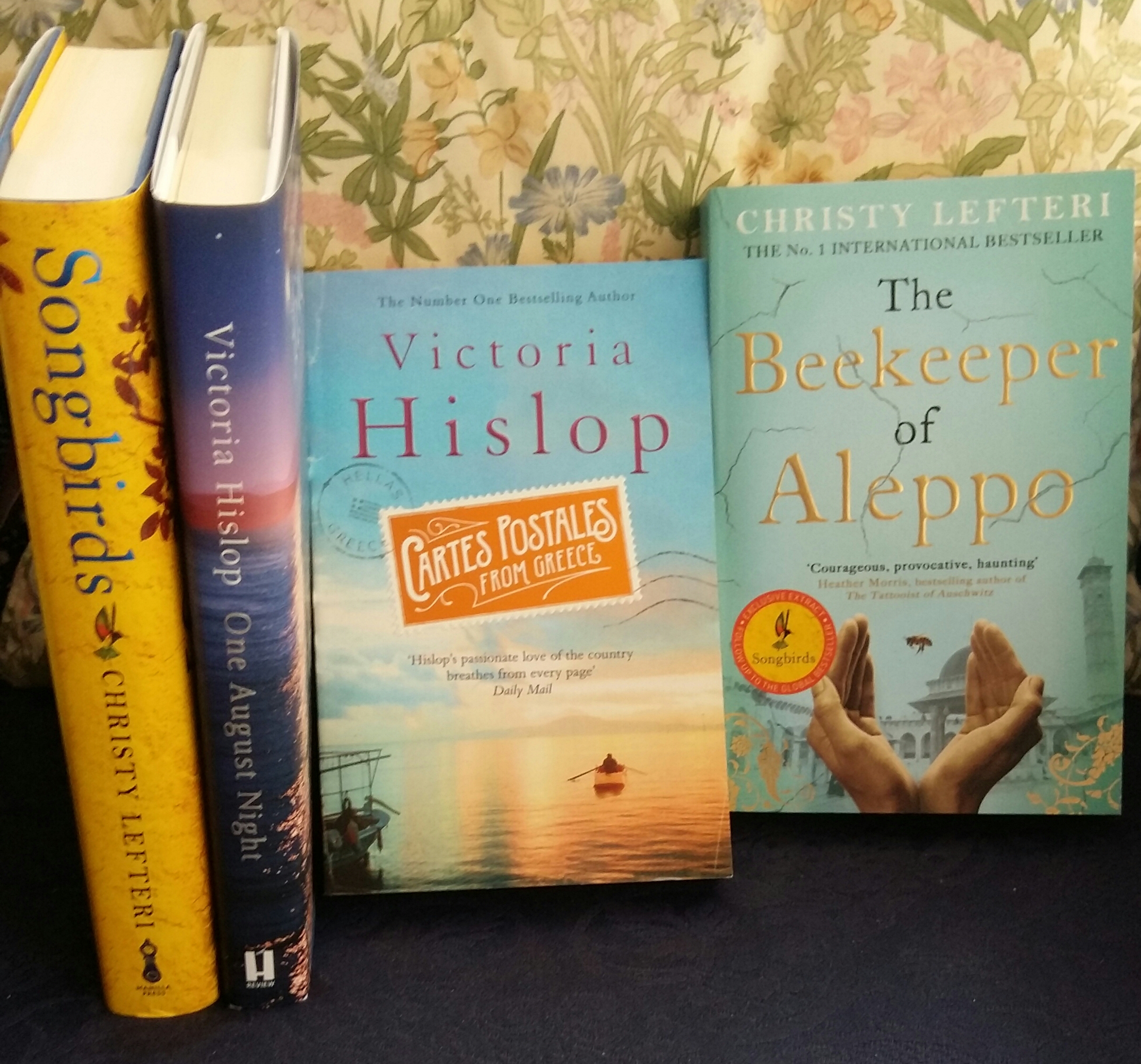
The Beekeeper of Aleppo and Cartes PostalesCartes Postale from Greece by Victoria Hislop

Week after week, the postcards arrive, addressed to someone Ellie does not know, each signed with an initial: A.

These alluring cartes postales of Greece brighten her life and cast a spell on her. She decides she must see this country for herself.

On the morning Ellie leaves for Athens, a notebook arrives. Its pages tell the story of a man’s odyssey through Greece. Moving, surprising and sometimes dark, A‘s tale unfolds with the discovery not only of a culture, but also of a desire to live life to the full once more.

The Beekeeper of Aleppo by Christy Lefteri

Nuri is a beekeeper; his wife, Afra, an artist. They live a simple life, rich in family and friends, in the beautiful Syrian city of Aleppo – until the unthinkable happens. When all they care for is destroyed by war, they are forced to escape. But what Afra has seen is so terrible she has gone blind, and so they must embark on a perilous journey through Turkey and Greece towards an uncertain future in Britain. On the way, Nuri is sustained by the knowledge that waiting for them is Mustafa, his cousin and business partner, who has started an apiary and is teaching fellow refugees in Yorkshire to keep bees.

As Nuri and Afra travel through a broken world, they must confront not only the pain of their own unspeakable loss, but dangers that would overwhelm the bravest of souls. Above all – and perhaps this is the hardest thing they face – they must journey to find each other again.

Planet of ClayPlanet of Clay by Samar Yazbek, translated by Leri Price (ARC, courtesy of World Editions)

Rima is a young girl in war-torn Damascus. Her feet seem to work independently, she says. Is this an affluction? Or is she just an inquisitive, adventurous young child? Her exhausted mother keeps her tied with a rope around her wrist to stop her wandering off.

As a young girl, Rima also loses the ability to speak, although she can recite sutras of Qur’an. And she can use her voice to scream – which, tragically, happens more as the story progresses.

Hidden in the library of the school where her mother works as a cleaner, she finds refuge in a fantasy world full of coloured crayons, secret planets, and The Little Prince, reciting passages of the Qur’an like a mantra as everything and everyone around her is blown to bits.

Since Rima hardly ever speaks, people think she’s crazy, but she is no fool – the madness is in the battered city around her. One day while taking a bus through Damascus, a soldier opens fire and her mother is killed. Rima, wounded, is taken to a military hospital before her brother leads her to the besieged area of Ghouta – where, between bombings, she writes her story.

In Planet of Clay, Samar Yazbek offers a surreal depiction of the horrors taking place in Syria, in vivid and poetic language and with a sharp eye for detail and beauty.


On What Cathy Read Next this week

Currently reading

Planned posts

  • Blog Tour/Book Review: With Face Aflame by A. E. Walnofer
  • Top Ten Tuesday
  • WWW Wednesday
  • Blog Tour/Book Review: One August Night by Victoria Hislop

#BookReview Mrs Palfrey at the Claremont by Elizabeth Taylor @ourclassicsclub

Mrs Palfrey at the ClaremontAbout the Book

On a rainy Sunday in January, the recently widowed Mrs. Palfrey arrives at the Claremont Hotel where she will spend her remaining days. Her fellow residents are magnificently eccentric and endlessly curious, living off crumbs of affection and snippets of gossip. Together, upper lips stiffened, they fight off their twin enemies – boredom and the Grim Reaper.

Then one day Mrs. Palfrey strikes up an unexpected friendship with Ludo, a handsome young writer, and learns that even the old can fall in love.

Format: ebook (209 pages)                     Publisher: Virago
Publication date: 7th July 2011 [1971 ]  Genre: Modern Classics

Find Mrs. Palfrey at the Claremont on Goodreads

Purchase links
Bookshop.org
Disclosure: If you buy a book via the above link, I may earn a commission from Bookshop.org, whose fees support independent bookshops

Hive | Amazon UK
Links provided for convenience only, not as part of an affiliate programme


My Review

Mrs Palfrey at the Claremont might well be subtitled ‘Keeping Up Appearances’ so keen is Mrs Palfrey to hide the fact she’s lonely and feels rather abandoned by her family. However, she’s determined to preserve her independence while she can.

The book provides an insight into a mode of living that is unfamiliar to modern eyes where a hotel is a place to stay on business or for pleasure, not to reside in on a long-term basis – and without the convenience of a bathroom of your own. The presence of so many long-term residents is not quite what Mr Wilkins, the hotel’s manager, wants for his establishment either. ‘His dream was Conference trade, drinking businessmen, a board in the hall saying ‘I.C.I. Pompadour Suite. 11am.’ He aspired to that.’

Alongside the reader, Mrs Palfrey accustoms herself to the routines that punctuate the residents’ days – the posting of the menus for lunch and dinner, gathering in the lounge before dinner, repairing to the television room after dinner to watch the latest serial. The author also gives us insightful, sometimes affectionate, portraits of Mrs Palfrey’s fellow residents, their habits and foibles. There’s Mrs Burton who makes frequent use of the bell to summon the aged waiter, Antonio, to take her drink order in the evening. Or Mrs Arbuthnot who has ‘ears sharpened by malice’ but is crippled by the pain of arthritis so that it would be a hard-hearted reader who did not have some sympathy for her. There’s Mrs Post who delights in feeling useful by running errands for others, Mr Osmond whose favourite occupation is writing angry letters on a variety of subjects to the Daily Telegraph, and Mrs de Salis who has ‘the best hearing at the Claremont’, which occasionally comes in handy.

One of my favourite scenes in the book was the party thrown by Mrs de Salis after she has moved out of the Claremont about which one guest recalls, “I’m glad I went… but I shouldn’t have to go again tomorrow“. (I think many of us may have been to parties like that.) Or the Masonic Ladies’ Night at which an entirely unexpected offer is made.

I found the friendship that develops between aspiring author, Ludovic, and Mrs Palfrey touching even if initially they are using each other: she to hide a deception, and he to provide material for the novel he is writing.  Through Ludovic the reader gets an insight into London life of the period for those with little money to spare: evenings spent at the launderette, careful calculations about how long the gas fire can be lit for, watching the feet of passers-by from a dingy basement flat.  On a lighter note, when Ludovic seeks to augment his income by getting a job as a waiter in a Greek restaurant, there is this wonderful passage. “The Plaka was in a basement throbbing with bouzoukia and smelling of charred lamb. In this deafening noise, Greek refugees became more Greek than ever before in their lives. English Philhellenes Kalisperassed about the place continually.”

Mrs Palfrey at the Claremont is a charming story tinged with humour but also with moments of poignant sadness.

Follow this blog via Bloglovin


elizabeth taylorAbout the Author

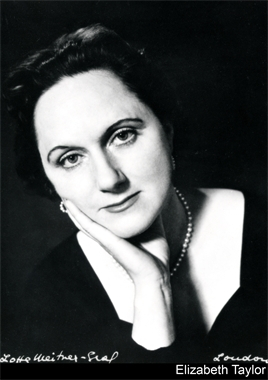
Elizabeth Taylor (1912-1975) is increasingly recognised as one of the best British writers of the twentieth century. She wrote her first book, At Mrs Lippincote’s, during the war while her husband was in the Royal Air Force, and this was followed by eleven further novels and a children’s book, Mossy Trotter. Her acclaimed short stories appeared in publications including Vogue, the New Yorker and Harper’s Bazaar. (Photo/bio credit: Publisher author page)