#NonficNov Nonfiction November: Nonfiction Favourites

nonficnovgraphic-e1569211904841-768x768

This week’s discussion prompt for Nonfiction November is Nonfiction Favorites hosted by Leann of Shelf Aware.

Leann says, ‘We’ve talked about how you pick nonfiction books in previous years, but this week I’m excited to talk about what makes a book you’ve read one of your favourites’.

  • Is the topic pretty much all that matters?
  • Are there particular ways a story can be told or particular writing styles that you love?
  • Do you look for a light, humorous approach or do you prefer a more serious tone?
  • What qualities make you add a nonfiction book to your list of favourites?

I have to admit I found this week’s question a little difficult to answer as I don’t read that much nonfiction… except in November! However, using my list from the first discussion prompt of this year’s Nonfiction November, I think I can draw some conclusions.

Subject matter is the main thing that draws me to a book and it helps if it has some sort of personal connection. For example, I’m a keen gardener so a book like Where The Hornbeam Grows by Beth Lynch was always likely to appeal to me although, unlike the authoruthor, I’ve never had to make a new life in another country. Similarly, my political views incline more to the left than the right so the memoirs of a figure such as Alan Johnson, former Home Secretary in the Labour government, naturally pique my interest. Finally, as regular followers of my blog will know, anything about John Buchan is likely to grab my attention.

When it comes to writing styles, I think my choice shows I like the personal touch. For instance, what particularly appealed to me about reading the latest biography of John Buchan was that it was written by his granddaughter, Ursula Buchan. Even though she never met him, her insight as a member of his family offered an unique element.

I read a lot of historical fiction and the Second World War is a favourite period. This carries over to my choice of nonfiction. Often reading about a particular aspect in a work of fiction makes me want to find out more; the fact behind the fiction, if you like. Occasionally it can happen the other way around as well. An example is one of my book pairings from week two of Nonfiction November. Reading Monopoli Blues about the role of the Special Operations Executive (SOE) in World War 2 meant Eight Hours From England by Anthony Quayle caught my eye. Even more so since it is a fictionalized account of the author’s own wartime service with the SOE.

My final thought is there are often features I particularly like in nonfiction books such as photographs, maps, diagrams and extracts from diaries or letters.

What attracts you to a nonfiction book?

Buchan of the Month: Introducing Augustus by John Buchan #ReadJB2019

buchan of the month 2019 poster

In honour of Nonfiction November, I’ve chosen John Buchan’s biography of the Roman Emperor Augustus as my Buchan of the Month. You can find out more about the project and my reading list for 2019 here. What follows is an introduction to Augustus.   I will be publishing my review of the book later this month.


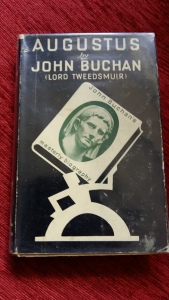
AugustusBuchanAugustus was published by Hodder & Stoughton in the UK and by Houghton Mifflin in the US in October 1937.
Buchan (by this time, Lord Tweedsmuir) started work on the book soon after his arrival in Canada following his appointment as Governor-General. Janet Adam Smith, Buchan’s first biographer, records how when he had completed his official duties and ‘disposed of the day’s chores, he would turn at once to the biography of Augustus’. Buchan received long distance help with research for the book from two friends: Hugh Last, Professor of Ancient History at Oxford (where Buchan had studied) and Roberto Weiss. The latter looked out newly published material, checked references and later oversaw the book’s translation into Italian.

Professor Last was suitably impressed with the finished product, remarking that the book ‘puts us so-called experts as much in your debt for its demonstration of the way in which Augustus should be treated as it does the larger public’, going on to describe it as ‘by far the best general interpretation of its subject’. The book was greeted with approval by many other historians.

David Daniell praises Buchan as a painstaking historian and a ‘modern interpreter who had a powerful sense of the future’. Buchan himself was conscious of the parallels with contemporary events given he was working on the book at the same time as Europe was witnessing the rise of Mussolini and Hitler. In the preface to the book he writes: ‘The convulsions of our time may give an insight into the problems of the early Roman empire which was perhaps unattainable by scholars who lived in easier days‘. Buchan even sent a copy of Augustus to President Roosevelt, saying ‘I hope it may interest you for many of his problems are your own’.

At the end of the book, Buchan points out similarities between the two ages: Once again the crust of civilization has grown thin, and beneath can be heard the muttering of primeval fires. Once again many accepted principles of government have been overthrown, and the world has become a laboratory where immature and feverish minds experiment with unknown forces.‘ (The concept of the thin crust of civilization was one Buchan had previously explored in his adventure novels, notably The Power-House.)

Despite its positive reception by historians, Augustus sold only 5,000 copies in the UK in the first year of its publication. By 1960, that figure had reached 36,000 boosted by the release of a cheap edition in 1942.

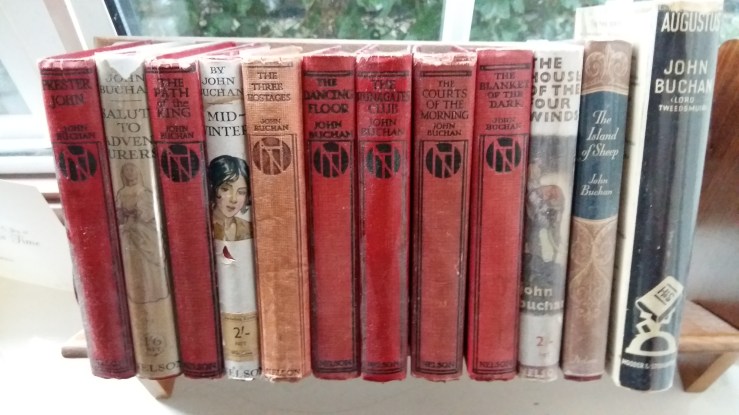
My Buchan of the Month for December will be the final Richard Hannay adventure, The Island of Sheep.

Sources:

Janet Adam Smith, John Buchan: A Biography (OUP, 1985 [1965])
David Daniell, The Interpreter’s House: A Critical Assessment of John Buchan (Nelson, 1975)
Kenneth Hillier and Michael Ross, The First Editions of John Buchan: A Collector’s Illustrated Biography (Avonworld, 2008)

buchan of the month 2019