Nonfiction November 2020: My Year in Nonfiction #NonficNov

nonficnov1_smallNonfiction November 2020 runs from 2nd to 30th November 2020.  This year it’s hosted by Katie at DoingDewey, Rennie at What’s Nonfiction, Julz of JulzReads and Leann at Shelf Aware.

As in previous years, they’ll be posting a discussion question and link-up on the Monday of each week.  Check out this post for the full schedule and proposed prompts. You can read my response to the first week’s prompt below.


My Year in Nonfiction

Leann asks: Take a look back at your year of nonfiction and reflect on the following questions – What was your favorite nonfiction read of the year? Do you have a particular topic you’ve been attracted to more this year? What nonfiction book have you recommended the most? What are you hoping to get out of participating in Nonfiction November?

Here are the nonfiction books I’ve read since last year’s Nonfiction November, grouped roughly by subject matter. Links from the titles will take you to my reviews. I would say my favourite was The Salt Path, Raynor Winn’s account of her journey along the South West Coast Path with her husband, Moth. I have also read a number of Holocaust memoirs. They never make easy reading but are invariably incredibly inspiring.

Memoir
The Salt Path by Raynor Winn
The Wild Silence by Raynor Winn
One Hundred Miracles: A Memoir of Music and Survival by Zuzana Ruzickova & Wendy Holden
Living Among the Dead: My Grandmother’s Holocaust Survival Story of Love and Strength by Adena Bernstein Astrowsky

History
Adrift: How Our World Lost Its Way by Amin Maalouf
A Book of Escapes and Hurried Journeys by John Buchan
Homilies and Recreations by John Buchan
The Last Secrets: The Final Mysteries of Exploration by John Buchan


Here are the nonfiction books I hope to read in November. It will be good to get them off my TBR pile and Nonfiction November gives me the perfect push to do that!  Click on the title to view the full book description on Goodreads.

In A Time of Monsters: Travels Through A Middle East in Revolt by Emma Sky – won in a Readers First giveaway, this has been on my shelf for way too long.  It promises to make ‘a complex region more comprehensible’.  I shall look forward to that.

The King’s Grace by John Buchan – his portrait of Britain during the reign of George V published in 1935 to mark the 25th anniversary of the King’s accession.

It Was Different At The Time by Inez Holden – published by Handheld Press alongside the author’s novella Night Shift (so perfect for next week’s book pairing prompt), It Was Different At The Time is Holden’s account of wartime life from April 1938 to August 1941, drawn from her own diary.

Are you taking part in Nonfiction November?

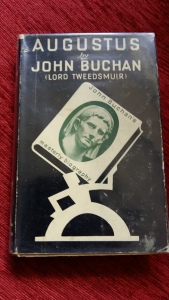
#BookReview Augustus by John Buchan #nonfic

AugustusBuchanAbout the Book

In 27 BC, out of the carnage of two civil wars, one man emerged to rule absolutely the Roman world. This man was Octavian, the adopted son of Julius Caesar, and he was perhaps the least likely candidate to return stability to the Republic. But by AD 14 Octavian had established peace over an empire that stretched from the shores of Britain to Anatolia. Power, prosperity and propaganda had seen him renamed as Augustus, ‘The Divinely Favoured One.’ He had become a God, and had changed the face of the Republic forever.

Format: Hardcover (349 pages)            Publisher: Hodder & Stoughton
Publication date: August 1941 [1937] Genre: Biography, History

Find Augustus on Goodreads


My Review

In Augustus, John Buchan combines his flair for storytelling and skill at crafting clear, precise prose with his love of history and knowledge of the Greek and Roman Classics, which he studied at Oxford University. Whilst Augustus may not have the pace of The Thirty-Nine Steps it is very readable and the book is clearly the product of extensive research, witnessed by the extensive footnotes and references to a range of sources. On publication it was greeted with approval by many eminent historians.

Buchan admires Augustus for his pragmatism, administrative skills and diplomacy whilst acknowledging that at times he could be ruthless in dealing with enemies and perceived threats. As someone who suffered poor health for much of his adult life, I wonder too if Buchan empathised with Augustus who also endured bouts of ill health as a young man.

Conversely, Buchan makes clear his disapproval of Mark Antony, writing that ‘each of his virtues – and they were many – was nullified by some rampant vice’ and summing him up as ‘the classic instance of the second-rate man who is offered a first-rate destiny, and who, in stumbling after it, loses his way in the world’.

I particularly enjoyed the sections where Buchan takes the reader inside the Imperial household, acknowledging the influential role played by Augustus’ wife, Livia. (When I think of Livia it always conjures up a picture of the actress, Sian Phillips, who played her in the TV series I Claudius, opposite Brian Blessed as Augustus.)

Buchan points out interesting parallels between the challenges faced by Augustus and contemporary events (he was working on the book at the same time as Europe was witnessing the rise of Mussolini and Hitler). In the preface to the book he writes ‘The convulsions of our time may give an insight into the problems of the early Roman empire which was perhaps unattainable by scholars who lived in easier days’.

And, at the end of the book, Buchan points out similarities between the two ages: ‘Once again the crust of civilization has grown thin, and beneath can be heard the muttering of primeval fires. Once again many accepted principles of government have been overthrown, and the world has become a laboratory where immature and feverish minds experiment with unknown forces.’ The concept of the thin crust of civilization was one Buchan frequently explored in his adventure novels, notably The Power House.

In three words: Lucid, detailed, well-researched

Try something similar: Julius Caesar by John Buchan

Follow my blog via Bloglovin


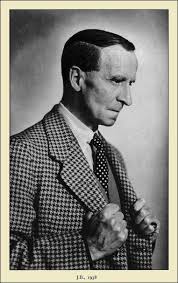
John BuchanAbout the Author

John Buchan (1875 – 1940) was an author, poet, lawyer, publisher, journalist, war correspondent, Member of Parliament, University Chancellor, keen angler and family man.  He was ennobled and, as Lord Tweedsmuir, became Governor-General of Canada.  In this role, he signed Canada’s entry into the Second World War.   Nowadays he is probably best known – maybe only known – as the author of The Thirty-Nine Steps.  However, in his lifetime he published over 100 books: fiction, poetry, short stories, biographies, memoirs and history.

You can find out more about John Buchan, his life and literary output by visiting The John Buchan Society website.