Book Review – The Zone of Interest by Martin Amis

About the Book

Book cover of The Zone of Interest by Martin Amis

Amidst the horrors of Auschwitz, German officer, Angelus Thomsen, has found love. But unfortunately for Thomsen, the object of his affection is already married to his camp commandant, Paul Doll.

As Thomsen and Doll’s wife pursue their passion – the gears of Nazi Germany’s Final Solution grinding around them – Doll is riven by suspicion. With his dignity in disrepute and his reputation on the line, Doll must take matters into his own hands and bring order back to the chaos that reigns around him.

Format: ebook (322 pages) Publisher: Vintage
Publication date: 30th September 2014 Genre: Historical Fiction

Find The Zone of Interest on Goodreads

Purchase The Zone of Interest from Bookshop.org


My Review

This was a book club pick prompted by the recent release of the film adaptation. I haven’t seem the film but I’m reliably informed it is quite different from the book in that, although it focuses on the family of the camp commander of the Auschwitz concentration camp, the camp is very much in the background – quite literally – whereas Amis takes us right inside it.

This is a very dark place to be and it’s fair to say many of the book club members found it a place they did not want to inhabit and either didn’t finish the book or, knowing the subject matter, decided not to read it at all. I can definitely understand this as there are some extremely disturbing scenes although of course these probably pale into insignificance compared to the reality. There are phrases in German scattered throughout the book without any accompanying translations which some readers also found a barrier. Personally, I didn’t bother looking up what they meant.

Each chapter of the book features three narrators: German officer Golo Thomsen, the nephew of Martin Bormann, who is in charge of the construction, using camp labour, of a factory to produce synthetic rubber; Paul Doll, the camp commandant (based on the real-life commandant of Auschwitz, Rudolf Höss); and Szmul, a member of a group of Jewish prisoners tasked with escorting fellow Jews to the gas chamber and disposing of their remains.

Initially Thomsen, something of a playboy, views his position and his Aryan good looks as an opportunity to bed any female he sets his eyes on but he soon becomes besotted by Hannah, the wife of the camp commandant. His feelings for her seem to awaken a sense of humanity in him and they share a growing awareness that Germany is going to lose the war.

Doll is obsessed with numbers, treating his role as something like the overseer of a production line, bewailing the unceasing demands from his superiors and the complaints of local inhabitants about the smells emanating from the camp and the state of the local drinking water. Often drinking himself into a stupor, Doll bemoans his wife’s unwillingness to sleep with him, observing her in the bathroom through a two-way mirror he has had installed. The sections written from his point of view are shot through with black humour as he becomes an increasingly ridiculous figure albeit a remarkably dangerous one.

Szmul knows his survival rests on his usefulness to the Germans but that this will end at some point. The only kindness he can bestow on those heading for the gas chamber is to tell them ways to shorten their suffering.

As I was reading the book, Hannah Arendt’s phrase ‘the banality of evil’ came to mind. This is mass murder as a bureaucratic operation with every detail recorded, prisoners’ worth calculated in terms of the work they can do versus the calories they consume, the arrival of trains carrying new prisoners meticulously scheduled and the most cost effective way of disposing of bodies argued over. At the same time, there is the nauseating artificiality of new arrivals being welcomed by the camp commandant whilst an orchestra plays in the background.

Many questions arise from the book: How did such an atrocity happen? How did a whole nation allow the ‘normalisation’ of mass murder? How did one individual manage to convince good people to do awful things? I don’t know the answers to those questions but books like this, even as disturbing to read as this one, should make us keep asking them, especially as we look around the world today.

The Zone of Interest is not an easy read but I think it’s an important one.

In three words: Hard-hitting, dark, thought-provoking
Try something similar: All the Broken Places by John Boyne


About the Author

Author Martin Amis

Martin Amis was an English novelist, essayist, and short story writer. His works included the novels MoneyLondon Fields and The Information.

He passed away on Friday 19 May, 2023, aged 73.

Book Review – The Small Museum by Jody Cooksley @AllisonandBusby

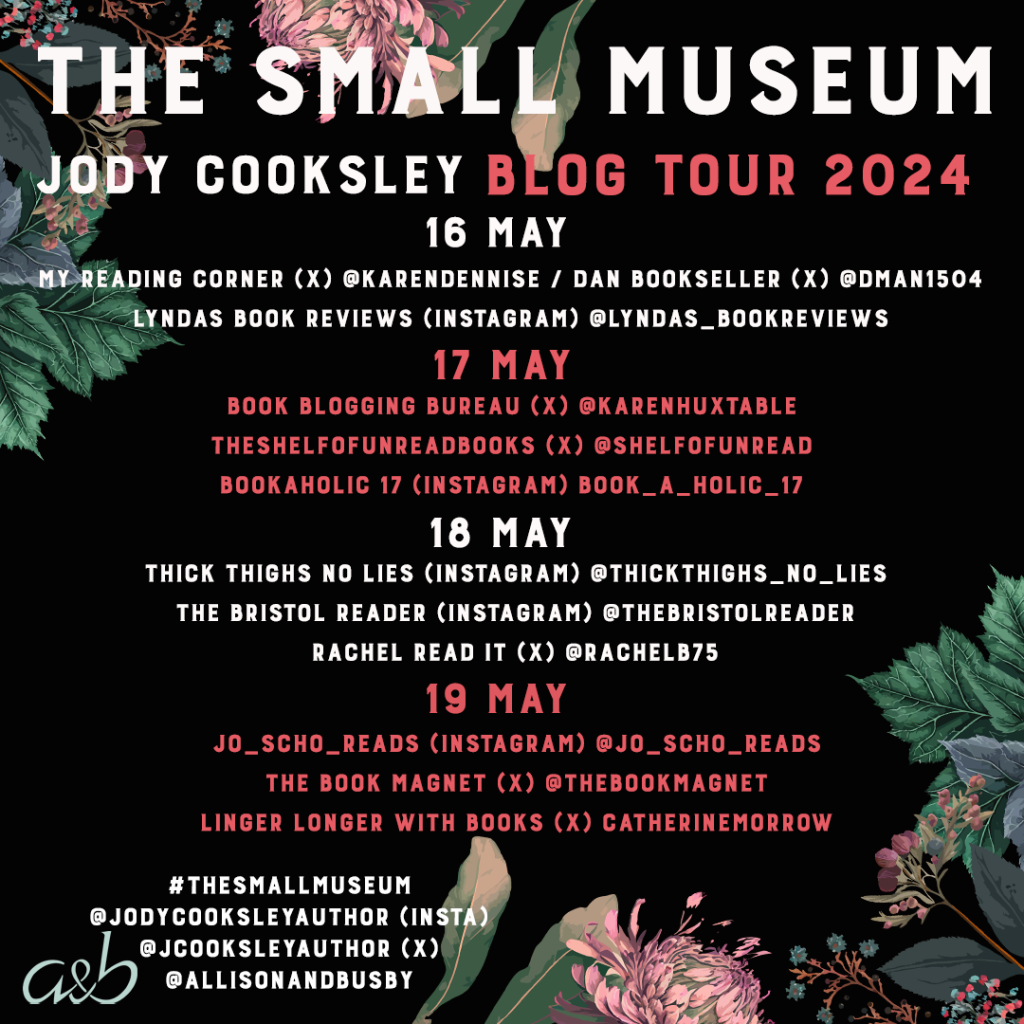
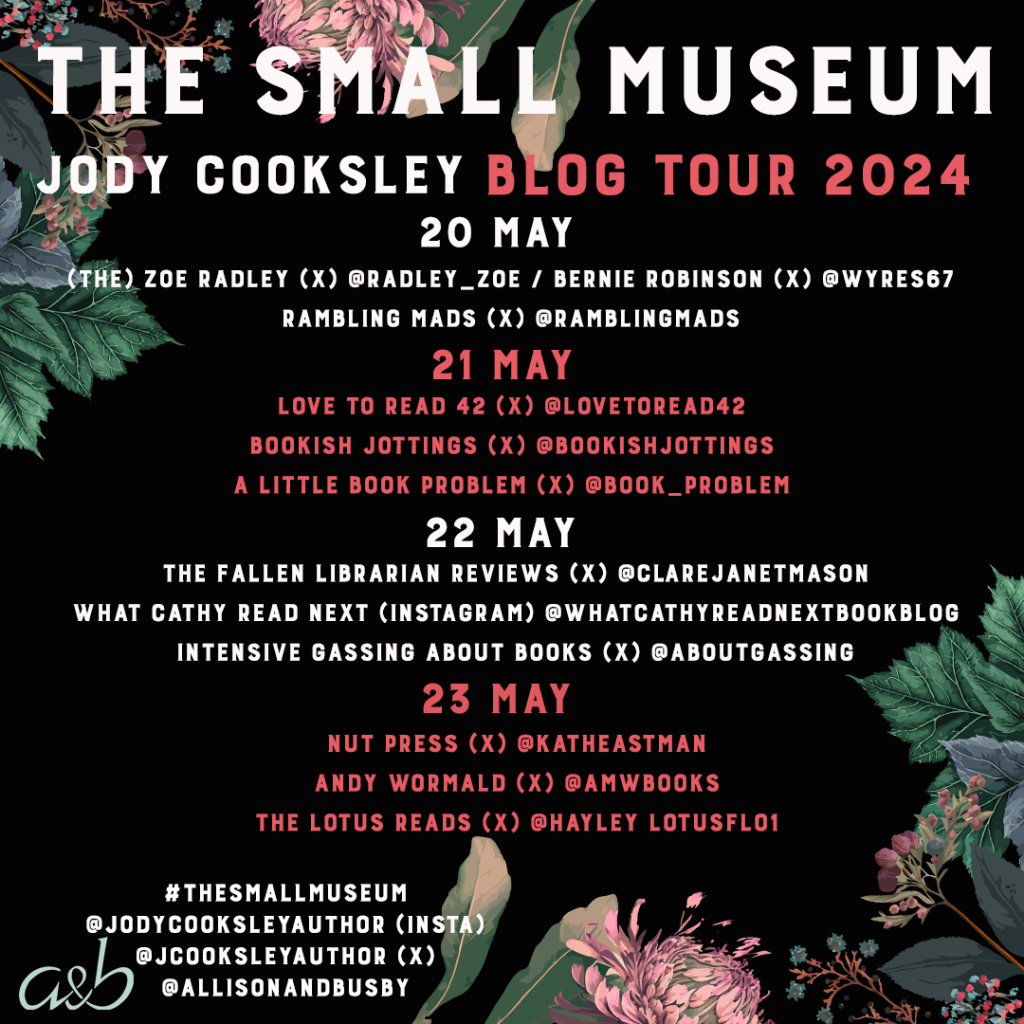
Welcome to today’s stop on the blog tour for The Small Museum by Jody Cooksley. My thanks to Helen at Helen Richardson PR for inviting me to take part in the tour and to Allison & Busby for my review copy via NetGalley. Do check out the posts by my tour buddies today, Clare at The Fallen Librarian, and Sara at Intensive Gassing About Books.


About the Book

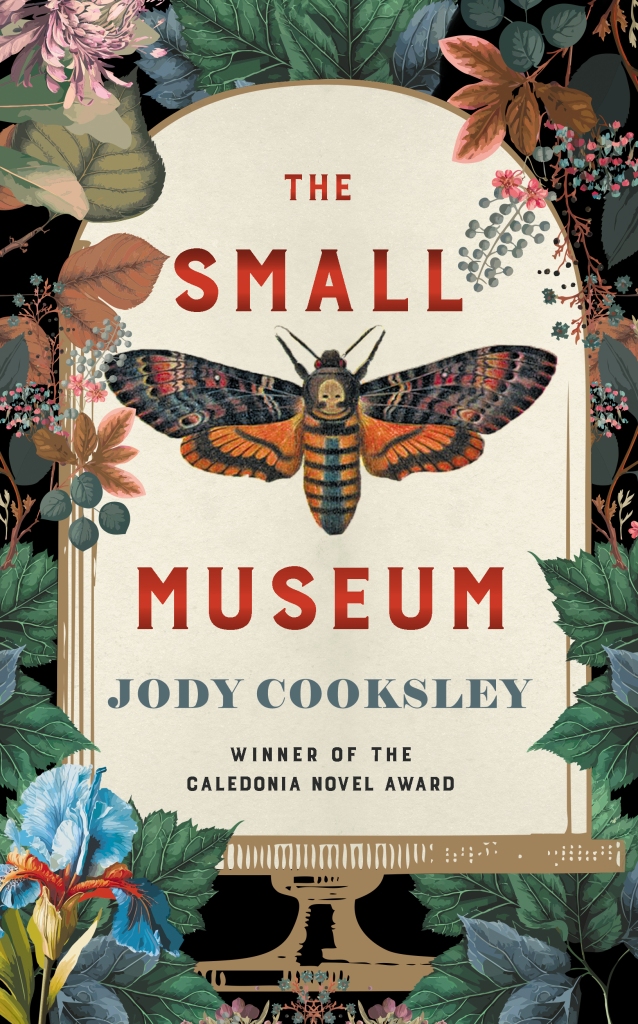
Book cover of The Small Museum by Jody Cooksley

London, 1873. Madeleine Brewster’s marriage to Dr Lucius Everley was meant to be the solution to her family’s sullied reputation. After all, Lucius is a well-respected collector of natural curiosities, his ‘Small Museum’ of bones and things in jars is his pride and joy, although kept under lock and key. His sister Grace’s philanthropic work with fallen women is also highly laudable. However, Maddie is confused by and excluded from what happens in what is meant to be her new home.

Maddie’s skill at drawing promises a role for her though when Lucius agrees to let her help him in making a breakthrough in evolutionary science, a discovery of the first ‘fish with feet’. But the more Maddie learns about both Lucius and Grace, the more she suspects that unimaginable horrors lie behind their polished reputations. Framed for a crime that would take her to the gallows and leave the Everleys unencumbered, Maddie’s only hope is her friend Caroline Fairly. But will she be able to put the pieces together before the trial reaches its fatal conclusion?

Format: Hardcover (320 pages) Publisher: Allison & Busby
Publication date: 16th May 2024 Genre: Historical Fiction

Find The Small Museum on Goodreads

Purchase The Small Museum from Bookshop.org [Disclosure: If you buy books linked to our site, we may earn a commission from Bookshop.org, whose fees support independent bookshops]


My Review

The author has created a ‘small museum’ of her own, in this case a literary one, by bringing together all the elements you could wish for in a Victorian age historical mystery. In particular, it incorporates the macabre interest in the collection and display of anatomical curiosities as well as more outlandish theories about the evolution of species circulating at the time.

Poor Maddie, married off to Lucius in order to try to restore her family’s social standing following the ‘disgrace of her sister Rebecca, is pretty much a lamb to the slaughter. She cannot understand Lucius’ coldness towards her nor the fact that she is kept pretty much a prisoner in her new home which is run with ruthless efficiency by housekeeper, Mrs Barker. Lucius is invariably absent, either visiting patients or attending scientific meetings, so Maddie’s is a lonely existence, made worse by unsettling little things, such as the unexplained rearrangement of objects or the strange sounds she hears in the night. Could it be her imagination? Everyone seems anxious to convince her it is. Have a cup of cocoa and an early night, dear…

Maddie makes touching attempts to show interest in Lucius’s work in the hope of gaining his attention but it’s only when her artistic skill seems likely to assist his work that she gains a modicum of value in his eyes. Unfortunately, it will be a long time until she discovers what her real value to him is, and when she – and the reader – does, it’s positively shocking. Maddie badly needs a friend and Caroline Fairly proves a particularly steadfast one, along with Maddie’s maid, Tizzy, who risks her own wellbeing if she is discovered.

The book has a generous role call of villains. I’d single out Lucius’s sister, Grace, whose knack for gliding into rooms unexpectedly reminded me of Mrs Danvers in Daphne du Maurier’s Rebecca. She willingly goes along with the gaslighting of Maddie whilst at the same time cultivating an air of philanthropy through her involvement in a home for fallen women (reminiscent of the establishment in Stacey Halls’s The Household). Then there are the Barkers, the Eversleys’ loyal retainers, a persistent malign prescence and whom, one suspects, know all the family’s dirty secrets. And, of course, there’s Lucius himself who for a long time seems to be just a coldly obsessive man determined to prove a theory he has developed. But what lengths will he go to in pursuit of that proof?

I particularly liked the use of chapter headings that describe some of the often quite macabre ‘curiosities’ in Lucius’s collection and the way the author subtly insinuated some of these into the story. I was fascinated to learn that some were inspired by actual exhibits in the Hunterian Museum in London.

The Small Museum is a chilling and immersive historical mystery generously infused with elements of Gothic fiction.

In three words: Creepy, dramatic, atmospheric
Try something similar: Things in Jars by Jess Kidd


About the Author

Author Jody Cooksley
Photo credit: Lillian Spibey

Jody Cooksley studied literature at Oxford Brookes University and has a Masters in Victorian Poetry. Her debut novel The Glass House was a fictional account of the life of nineteenth-century photographer, Julia Margaret Cameron. The Small Museum, Jody’s third novel, won the 2023 Caledonia Novel Award.

Jody is originally from Norwich and now lives in Cranleigh, Surrey.

Connect with Jody
Website | X | Instagram