Book Review – The Best of Intentions by Caroline Scott

About the Book

1932: When gardener Robert Bardsley arrives at Anderby Hall, an Elizabethan manor house in the Gloucestershire countryside, it is home to ‘Greenfields’, a community of artists and idealists.

Robert has been employed to revive Anderby’s famous roses and restore the topiary garden, but he also soon befriends the other residents: from colourful neighbour Trudie, who makes a formidable cocktail and keeps her late-fiancé’s ashes on the mantelpiece, to composer Daniel, recovering from the horrors of the Great War. The only person he can’t win over is Anderby’s schoolteacher, Faye, who finds him . . . perfectly vexing.

But just as Robert starts to feel at home, the residents discover that the old orchard has been sold to a property developer who has plans for an estate of Tudorbethan bungalows. Can they find a way to keep their creative community alive or will the new housing development put an end to the spirit of Greenfields?

Format: Paperback (416 pages) Publisher: Simon & Schuster
Publication date: 17th July 2025 Genre: Historical Fiction

Find The Best of Intentions on Goodreads

Purchase The Best of Intentions from Bookshop.org [Disclosure: If you buy books linked to our site, we may earn a commission from Bookshop.org, whose fees support independent bookshops]

My Review

Gwendoline is the driving force behind the Greenfields community, centred around the now rather rundown Anderby Hall. The manor house has proved to be a money pit, eating up most of Gwendoline’s fortune. However it’s not just a place to pursue her ideals but somewhere she has a very personal connection to because of its use as a military hospital for wounded soldiers of the First World War. In particular, the restoration of the gardens to their former glory is something dear to her heart. More pragmatically, she hopes charging people to view the garden might be a way to restore the community’s economic fortunes. However not everyone feels this accords with Greenfield’s values, prinicipally Faye, Anderby’s schoolteacher.

Robert is excited at taking on the project of restoring the garden but arrives at Anderby with a degree of trepidation because he has something in his past he would rather not be discovered. Unfortunately Teddy, Gwendoline’s husband, is pretty good at sniffing out secrets and using them to his advantage. Robert finds himself drawn to Faye but wonders if he can overcome her animosity towards him.

I had Teddy down as a bounder from the start. I struggled to see what Gwendoline saw in him as he seemed more interested in spending her money than anything else. I can’t say I was upset when he got his just desserts, even if it was in an unexpectedly dramatic way.

For me, Daniel was the most fully rounded character. Still struggling with memories of the terrible things he experienced in the First World War, he finds solace in spending time in the grounds of Anderby, particularly in its ancient orchard. I could really appreciate his dismay at the prospect of its destruction to make way for a new housing estate.

Gwendoline’s decision to sell land to housing developers sets the community at odds. For some it’s simply too far from their original ideals putting the whole Greenfields project at risk. But perhaps it’s also an opportunity for a reset, to acknowledge that change is inevitable and must be embraced, allowing the book to end on an uplifting note.

I definitely recommend reading the Author’s Note which provides historical background and sources of inspiration for some aspects of the book. For example, the rise of utopian communities in the wake of the First World War and the explosion in housebuilding in order to fulfil Lloyd George’s promise of ‘a fit country for heroes to live in’. The author also points out some interesting parallels with contemporary issues.

I enjoyed The Best of Intentions but, if I’m honest, missed the emotional intensity of the author’s previous books, particularly The Photographer of the Lost and When I Come Home Again.

I received a review copy courtesy of Simon & Schuster via NetGalley.

In three words: Amiable, engaging, touching
Try something similar: Small Bomb at Dimperley by Lissa Evans

About the Author

After completing a PhD in History, at the University of Durham, Caroline Scott worked as a researcher in Belgium and France. She has a particular interest in the experience of women during the First World War, in the challenges faced by the returning soldier, and in the development of tourism and pilgrimage in the former conflict zones. Caroline lives in southwest France and is now writing historical fiction for Simon & Schuster UK and William Morrow.

Connect with Caroline
Twitter | Goodreads

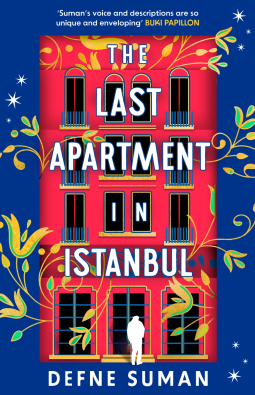
Book Review – The Last Apartment in Istanbul by Defne Suman

About the Book

I was writing to her, so that she would know me not as this old person whose joints creaked when he rose from a chair, but as the real the man who dreamt, deceived, envied, loved…

Pericles Drakos has lived in the exquisite Circle Building for all of his seventy-five years. From its lofty windows, he has seen his little corner of Istanbul shift and transform. But as the area has become increasingly gentrified, Pericles has retreated into its shadowy corners. And when the pandemic hits, his isolation deepens.

But when Leyla, a sparky and beautiful thirty-something moves in, Pericles is enthralled. And when he discovers Leyla is a writer, he decides to put his own pen to paper and record his own fraught that of a Greek man subjected to the politics of oppression and intimidation in twentieth-century Turkey.

Format: Hardcover (400 pages) Publisher: Apollo
Publication date: 3rd July 2025 Genre: Historical Fiction

Find The Last Apartment in Istanbul on Goodreads

Purchase The Last Apartment in Istanbul from Bookshop.org [Disclosure: If you buy books linked to our site, we may earn a commission from Bookshop.org, whose fees support independent bookshops]

My Review

Although a Turkish citizen, Pericles Drakos is Greek Orthodox by descent. He’s lived in the same magnificent but now rather dilapidated apartment building, known as The Circle, all his life. Now the developers have moved into the area and are intent on removing the occupants, using whatever means necessary. They want to demolish the building to make way for luxury apartments. The Circle is one of the few remaining buildings left standing in this part of Istanbul, previously the hub of the Greek Orthodox community. As we learn more about Pericles’ life, the Istanbul authorities’ attempt to destroy this historic part of the city seems an echo of the Turkish government’s past attempts to expel Greek Christians from Turkey and to erase their culture by changing the names of streets and buildings.

The narrative moves between the present day, at the outset of the Covid pandemic, as Pericles and the remaining residents of The Circle attempt to resist the attempts of the developers, and his memories of past events, some very traumatic. I have to admit this aspect of Turkey’s history, the forced expulsion of Greeks, the confiscation of their property and the violence visited on the non-Muslim minority – Greeks, Armenian and Jews – was completely new to me. Pericles’ experience of feeling like an outcast in the city of his birth over the years is neatly mirrored in the present day by the quarantine restrictions that sees residents confined to the building.

Pericles is a complex character. Although he’s lived through and witnessed some terrible events, he’s not a saint. He falls in love impulsively and is deceitful. He is self-centered, often prioritising his own desires over the needs of others or his responsibilities. He owned a pharmacy but at one point also a share in a night club in the basement of The Circle run by a shady individual who dealt in drugs. Despite this, the author makes Pericles a very human figure, flawed but still possessing some good qualities.

An example of Pericles’ impulsive nature is when he sees a young woman called Leyla being shown around the vacant ground floor apartment. Instantly he becomes determined she must have the apartment, accepting a price below market value. Does she remind him of other women he has known or does he, even at seventy-five, feel a physical attraction towards her? Does he simply yearn for friendship with someone who possesses the energy of youth? Whatever, when Pericles learns Leyla is a writer he decides she is the perfect person to turn the notes he has been scribbling down about his life into a polished memoir. She teases out more detail, especially about his emotional response to the things he has witnessed. In fact, it’s unclear if what we’re reading is his original recollections or her embellished version. At one point, Pericles even comes up with the idea that Leyla should write his story as a novel, noting ‘we’d just need to change the names of the people and the streets’. But then he reflects, ‘who among those I’ve named in my story was still alive? Nobody.’

The Last Apartment in Istanbul is the well-crafted story of a man and of a city. The author describes in unsparing detail the brutal expulsions of the Greek community in the 1950s and 1960s, and the impact of the diaspora: families separated, often for years, unable – or unwilling – to return. My only reservation was the book’s ending seemed a little too neat but others may disagree.

I received a review copy courtesy of Head of Zeus via NetGalley.

In three words: Immersive, emotional, dramatic
Try something similar: The Silence of Scheherazade by Defne Suman

About the Author

Defne Suman was born in Istanbul and grew up on Buyukada Island. She gained a Masters in sociology from the Bosphorus University and then worked as a teacher in Thailand and Laos, where she studied Far Eastern philosophy and mystic disciplines. She later continued her studies in Oregon, USA and now lives in Athens with her husband. Her books include The Silence of Scheherazade and At The Breakfast Table. Her work is translated to many languages all around the world.

Connect with Defne
Website | Facebook | Instagram | X/Twitter