#BookReview #Ad Skelton’s Guide to Blazing Corpses by David Stafford

Skelton's Guide to Blazing CorpsesAbout the Book

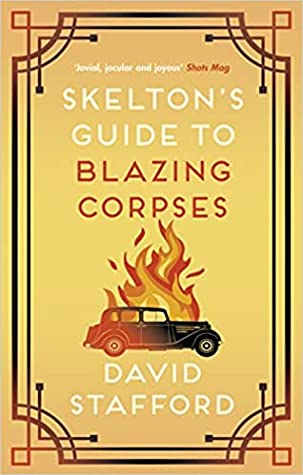
Guy Fawkes Night, 5th November, 1930. Bonfires are blazing, rockets burst. In a country lane, revellers discover a car that has been set on fire. At first, they assume that this is the work of vandals taking the Guy Fawkes spirit a little too far, sitting at the wheel is a body, charred beyond recognition.

The initial assumption is that the owner of the car, Mr Harold Musgrave, a successful travelling salesman has taken his own life in a particularly grisly act of self-immolation. The post-mortem, however, reveals that Mr Musgrave was either unconscious or dead before the fire was lit. When Tommy Prosser, a local criminal, is charged with the murder, barrister Arthur Skelton believes him to be innocent, so sets out to ensure justice is served.

Format: ebook (296 pages)                Publisher: Allison & Busby
Publication date: 20th October 2022 Genre: Historical Fiction, Crime

Find Skelton’s Guide to Blazing Corpses on Goodreads

Purchase links 
Bookshop.org 
Disclosure: If you buy a book via the above link, I may earn a commission from Bookshop.org, whose fees support independent bookshops

Hive | Amazon UK 
Links provided for convenience only, not as part of an affiliate programme


My Review

Skelton’s Guide to Blazing Corpses is the latest in the author’s historical crime series featuring barrister Arthur Skelton. Links from the titles will take you to my reviews of the previous books in the series – Skelton’s Guide to Domestic Poisons and Skelton’s Guide to Suitcase Murders.  

Set in the 1930s, Skelton’s Guide to Blazing Corpses sees Arthur Skelton, assisted by his trusty clerk Edgar Hobbes, juggling the defence of Tommy Prosser, accused of the murder and immolation of vacuum cleaner salesman Harold Musgrave, with a number of other cases. One of the joys of the series is the glimpses of these cases whose unlikely subject matter, such as the difference between ‘knickerbockers’ and ‘plus fours’, turn out to be loosely based on actual cases (as the Author’s Note reveals). I particularly liked Arthur’s joy at being able to utter the word ‘lavatory’ in open court – not once but twice – in relation to another case.

Fans of the series will be delighted by the return of characters from the previous books, such as Skelton’s cousin and prolific correspondent, Alan, who along with his sister Norah, travels the country in a caravan spreading ‘the joy of Jesus’. What’s particularly clever is the way the author uses Alan’s experiences to highlight the impact of the Depression on ordinary people. It’s a time of low wages, traditional industries closing down, ill health caused by poor housing, and families struggling to put food on the table. So completely different from now then…

I was also overjoyed by the return of Rose Critchlow now working as an articled clerk for the solicitors who provide most of Arthur’s work. During her trip to Heidelberg in Germany to secure a vital piece of evidence she witnesses the first signs of the malevolent influence of the Nazis that will eventually culminate in the outbreak of the Second World War. 

It’s not all doom and gloom though because one of the lovely features of the series is the humour, whether that’s Edgar’s newly acquired obsession with Czech cubist furniture design, the secret of the perfectly pressed trouser or the humiliation of a pompous opponent by Arthur’s formidable wife, Mila. Arthur and Mila’s affectionate banter is a lot of fun too.

After an exciting and dramatic conclusion to the case of the blazing corpse, the end of the book sees Arthur rather disillusioned with the justice system and the inequality he witnesses on a daily basis. Will the man the newspapers have dubbed ‘The Who Refuses to Lose’ give up? I hope not.

Skelton’s Guide to Blazing Corpses is a delightful, ingenious historical crime mystery, and a great addition to the series.

I received a review copy courtesy of Allison & Busby via NetGalley. Do check out their website to see the wonderful range of books they publish.

In three words: Witty, entertaining, clever

Try something similar: Ghosts of the West by Alec Marsh 


David StaffordAbout the Author

David Stafford began his career in theatre. He has written countless dramas, comedies and documentaries including two TV films with Alexei Sayle, Dread Poets Society with Benjamin Zephaniah, and, with his wife, Caroline, a string of radio plays and comedies including The Brothers, The Day the Planes Came and The Year They Invented Sex as well as fibwe biographies of musicians and showbusiness personalities. Fings Ain’t Wot They Use T’Be – The Life of Lionel Bart was chosen as a Radio 4 Book of the Week and made into a BBC Four TV documentary. 

Connect with David
Twitter 

#BookReview #Ad The Darlings of the Asylum by Noel O’Reilly

The Darlings of the AsylumAbout the Book

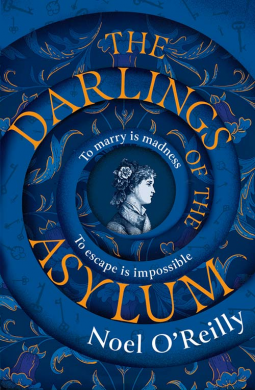
To marry is madness. To escape is impossible.

In 1886, a respectable young woman must acquire a husband. Violet Pring’s scheming mother has secured a desirable marriage proposal from an eligible Brighton gentleman. But Violet does not want to marry. She longs to be a professional artist and live on her own terms.

Violet’s family believes she is deranged and deluded, so she is locked away in Hillwood Grange against her will. In her new cage, Violet faces an even greater challenge: she must escape the clutches of a sinister and formidable doctor and set herself free.

Format: ebook (381 pages)                  Publisher: HQ
Publication date: 8th December 2022 Genre: Historical Fiction

Find The Darlings of the Asylum on Goodreads

Purchase links 
Bookshop.org 
Disclosure: If you buy a book via the above link, I may earn a commission from Bookshop.org, whose fees support independent bookshops

Hive | Amazon UK 
Links provided for convenience only, not as part of an affiliate programme


My Review

The Darlings of the Asylum joins the list of historical novels I’ve read in which young women are prevented from pursuing their chosen career, displaying their talents or exercising any independence over their lives by the expectations of family or society. In this case, Violet Pring’s ambition is to become a professional artist. Actually, ambition isn’t quite the right word. Violet’s need to express herself and unleash her vivid imagination is part of her psyche. It’s the thing she lives for and when engaged in drawing or painting she can often lose herself for hours on end in a kind of artistic frenzy. And her paintings, full of sexual imagery, are certainly not the sort of thing genteel ladies of that time are expected to produce. 

What Violet definitely doesn’t want is to marry as her mother, in particular, is anxious for her to do. Violet fears that, if she does, even to someone as seemingly understanding as her friend Felix, creating art will be viewed as nothing more than a pastime to be fitted in between tedious domestic duties and meaningless social calls. Violet is encouraged in her artistic ambitions by her art tutor, Miss Fanshaw, a woman who has managed to carve out the sort of independent life for herself Violet would like to emulate, and by rakish artist, Wilf Lilley, who praises Violet’s unconventional, unrestrained style of painting.

When Violet’s artistic impulses are frustrated, her extreme reaction, as well as the nature of her paintings, sees her diagnosed with ‘moral insanity’ and committed to Hillwood Grange Lunatic Asylum (known to the inmates as Hellwood). There she is exposed to the malevolent ministrations of the utterly hateful Dr. Harold Rastrick, a man who displays a perverted misogyny, is a believer in eugenics and carries out foul experiments on a group of female inmates, the ‘darlings’ of the book’s title. At one point, he even ponders the use of vivisection ‘if done humanely’. He is an absolute monster, representing in an extreme way the sort of vile attitudes towards people with mental conditions, learning difficulties and physical disabilities in this period. In fact, these attitudes persisted into the 20th century as we know only too well. Indeed some might argue they still do. As a person with epilepsy (thankfully controlled through medication) it was particularly shocking to see epileptics included in the category of ‘incurables’, ‘freaks of nature’ and ‘imbeciles’. 

I confess that for some time I struggled to empathise with Violet although of course I was appalled by the treatment she, and others, receive at the hands of Dr. Rastrick.  Violet’s unwavering focus on achieving her own desires means she fails to appreciate until quite late in the book the harm she has unwittingly caused. And although I could understand her desire for freedom, that didn’t mean I felt comfortable about the way she achieves it. However, what I did think was clever is how Violet’s artistic talent enables her to create portraits of her fellow inmates that reflect their individual characters and their humanity, in stark contrast to the ‘identikit’ photographs taken by Dr. Rastrick in which the women resemble ‘ghosts of themselves’.

The Darlings of the Asylum is rich in atmosphere and there’s a real Gothic flavour to the depiction of Hillwood Grange. It’s a dark tale of obsession and the desire for self-expression.  

I received an advance review copy courtesy of HQ via NetGalley.

In three words: Atmospheric, intense, disquieting

Try something similar: The Deception of Harriet Fleet by Helen Scarlett


About the Author

Noel O’Reilly was a student on the New Writing South Advanced writing course. He has worked as a journalist and editor at the international business media company RBI, and is now a freelance writer. His first novel is Wrecker and The Darlings of the Asylum is his second. He lives in Sheffield.

Connect with Noel
Twitter