
This is a longer version of a review that first appeared on the Henley Standard website. It is based on notes I took during the event and my own recollections. Any errors in recording views expressed during the discussion are my own.
Henley Life journalist, Cindy Burrowes, started by asking Victoria about her connection with Greece given so many of her books are set there. Victoria said, although she has no blood connection, when she’s in Greece she has an instinctive sense of being ‘home’, a feeling she can’t quite explain.
She joked she blames her passion for Greece on Bognor Regis after too many childhood holidays spent on a pebble beach looking at a brown sea. Going to the Greek island of Paros for the first time in 1976 had been a ‘revelatory experience’ and, since then, she has gone to Greece every year, has a house there and even learned Greek.
Victoria considers any immersion in a country has to involve learning the language, especially since she’s writing about 20th century history and many of the people who lived through the events she’s describing don’t speak English. Learning Greek has enabled her to chat to such people and do book tours throughout Greece. Victoria reckons she’s been to more obscure places in Greece than most people who live there
Victoria’s latest book, Those Who Are Loved, is set during the Nazi occupation of Greece and the Civil War that followed. It was a dark time in the country’s history that many Greeks are still unwilling to talk about. There were terrible events – famine, the devastation of areas of the country. Nothing that appears in the book was made up or exaggerated. Greece suffered a catastrophic war and Victoria feels it is miraculous the country has got back to where it is.
Cindy asked about the title of the book. Victoria explained it came fairly late but she wanted a title that expressed positivity, the idea that ultimately there is a redemption and that those who are loved and remembered never really die. The line comes from a poem written by revered Greek poet, Yannis Ritsos, which in turn was inspired by a 1936 photograph of a mother grieving for her dead son who was shot by police during protests by tobacco workers. (The audience was able to see the photograph along with others depicting many of the places Victoria visited during her research for the book.)
Although the storyline of the book covers a period from 1930s to the present day, Victoria revealed she often doesn’t start at the beginning when writing but may perhaps begin with an idea for the middle or the ending. In the case of this book, it started with a visit to a place – the Temple of Poseidon at Cape Sounion. (Lord Byron carved his name on one of the pillars there, she said.) In the background was a dark piece of land, an uninhabited island that she was told was used to house between twenty and thirty thousand Communist prisoners after the Civil War. Victoria started to research the subject and discovered women were also sent there in the 1940s and 1950s.
Seven years later she finally managed to visit the island as, although it’s not far from the mainland, it’s inaccessible except by private boat. Victoria found it full of remnants of its time as a torture camp, including an amphitheatre where prisoners were lectured. As with her previous books, the inspiration for the story came from going to a place that’s full of, if not exactly ghosts, then memories and untold stories.
Cindy observed that Victoria’s books educate the reader about Greek history, such as events in Smyrna. Victoria said it’s something Greeks don’t go into great detail about, referring to it only as the ‘catastrophe’. However, it was a turning point in Greek history that Victoria wrote about in her earlier book, The Thread. In 1922, the city was razed to the ground and one million of its Greek population fled west to Greece. The population of Greece at the time was three to four million so this represented a massive influx of refugees, most of whom came with nothing. Cindy said she understood many of them took to boats to travel to the Greek islands. Victoria confirmed, ironically given recent events, a large number went to Lesbos where they were put in camps. The majority of the immigrants were left wing which led to a military dictatorship to control growing unrest.
Cindy asked how much of Victoria’s research is carried out in the UK and how much in Athens. Victoria said she does a lot in Athens and visiting various sites mentioned in the book. However, most of her reading research is done in the London Library using their online archive. For example she found a PhD thesis about the famine in 1941. It would be no more than a line in a history book but that thesis gave her so much colour.
Cindy wondered if the characters in her books are inspired by individuals she comes across in research. Victoria said she tends to completely make up characters as basing them on real people would be ‘creatively stultifying’ although she might be inspired by a face in a photograph. She joked she’s possessive about the people she invents as they’re with her for a long time when she’s writing a book. However, she confessed her villains might remind her of someone she’s met and disliked in real life and getting her revenge in that way is hugely satisfying.
Cindy asked where Victoria usually works. In the old days, Victoria said, she would have printed out photos but now she has them on her laptop for reference. Even if she doesn’t tell the reader everything about a character, she needs to know them herself. Cindy mentioned one character whose hair is described in detail. Victoria laughed and said the curls he had are a very important part of the plot and are based on a real person’s head of hair, although they don’t know that!
Had Victoria considered, Cindy wondered, setting a book in Athens? Victoria described it as an ‘extraordinary and complicated’ city, revealing the really interesting parts for her are those around the centre; the broken pavements, the crumbling buildings. Athens is chaotic but she finds the chaos and dereliction have a kind of beauty, remarking ‘For me, in every derelict building there’s a potential story. Why is that here? What’s the story behind this?’
Cindy said she loved how the book celebrates the Greek family, centred around the dining table. Victoria said she felt the dining table was the single most important piece of furniture in a Greek household – the place for sharing food even when they may be divided in other respects. She observed that, the Greeks being more demonstrative in arguments, a dining table should have a few dents in it.
 Audience questions included Victoria’s view on whether the Elgin Marbles should be returned to Greece (answer, possibly, if it is free to see them as it is currently in the British Museum) and what she reads when she’s not writing. Victoria said, as one of the judges of The Sunday Times Young Writer of the Year Award, she’s currently immersed in reading the submissions and excited about the extraordinary talent on display.
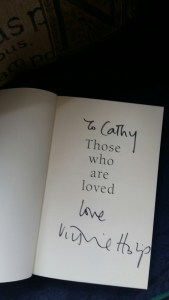
Afterwards, The Bell Bookshop team were on hand with copies of the book for audience members to purchase and have signed by Victoria. Now I’ve heard Victoria talk about the book (and had my copy signed), I can’t wait to read it.
 About the Book
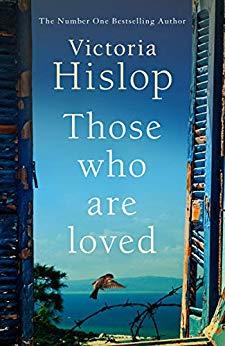
Those Who Are Loved is set against the backdrop of the German occupation of Greece, the subsequent civil war and a military dictatorship, all of which left deep scars.
Themis is part of a family bitterly divided by politics and, as a young woman, her fury with those who have collaborated with the Nazis, drives her to fight for the communists. She is eventually imprisoned on the notorious islands of exile, Makronisos and Trikeri, and has to make a life or death decision. She is proud of having fought, but for the rest of her life is haunted by some of her actions. Forty years after the end of the civil war, she finally achieves catharsis.
Victoria Hislop sheds light on the complexity of Greece’s traumatic past and weaves it into the dynamic tale of a woman who is both hero and villain, and her lifelong fight for justice.
 About the Author
Inspired by a visit to Spinalonga, the abandoned Greek leprosy colony, Victoria Hislop wrote The Island in 2005. It became an international bestseller and a 26-part Greek TV series. She was named Newcomer of the Year at the British Book Awards and is now an ambassador for Lepra.
Her affection for the Mediterranean then took her to Spain, and in the number one bestseller The Return she wrote about the painful secrets of its civil war. In The Thread, Victoria returned to Greece to tell the turbulent tale of Thessaloniki and its people across the twentieth century. Shortlisted for a British Book Award, it confirmed her reputation as an inspirational storyteller.
It was followed by her much-admired Greece-set collection, The Last Dance and Other Stories. Her fourth novel, The Sunrise, was published to widespread acclaim, and was a Sunday Times number one bestseller. Victoria Hislop’s last book, Cartes Postales from Greece, is fiction illustrated with photographs. It was a Sunday Times bestseller in hardback and one of the biggest selling books of 2016.
Victoria divides her time between England and Greece. (Photo credit: Publisher author page)

 Al started by asking David why he’d decided to ‘let his photographs do the talking’. Describing Behind the Lens as a photo memoir rather than an autobiography, David said he’d always had an aversion to writing about himself. He’s played many different characters in his career – including Poirot, for which he always gets a round of applause when he drops into character (and did on this occasion too) – but in his words, “That’s not me”. David explained the aim of the book is for people get to know the man
 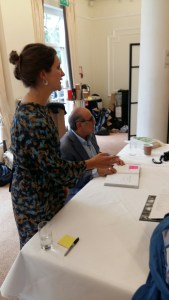 Audience questions included David’s favourite photographs in the book and his feelings about an age where just about everyone has a camera on their phone. Responding to the latter, he said, ‘If you’ve always got a camera with you, you’ve got a chance of turning banality into something artistic and special’. An answer characteristic of this thoughtful, eloquent and fascinating speaker.
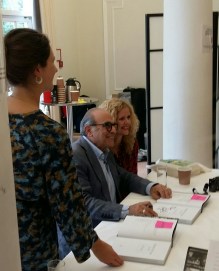 Afterwards audience members rushed to purchase the book and, like me, joined the long queue of people waiting to have David sign their copy, to exchange a few words with him, and, for a lucky few, to have their photograph taken with him.
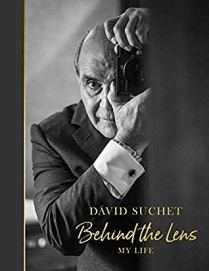 About the Book
 What Cathy Read Next...