
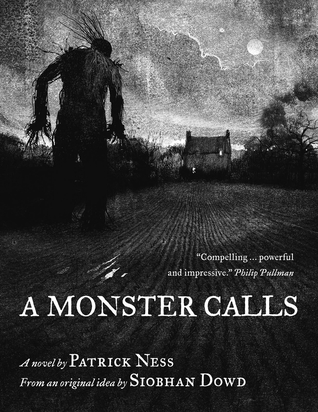
Book Review: A Monster Calls by Patrick Ness

monster

Heartbreaking tale about facing up to your worst fears

About the Book

Description (courtesy of Goodreads): ‘The monster showed up after midnight. As they do.’ But it isn’t the monster Conor’s been expecting. He’s been expecting the one from his nightmare, the one he’s had nearly every night since his mother started her treatments, the one with the darkness and the wind and the screaming… This monster is something different, though. Something ancient, something wild. And it wants the most dangerous thing of all from Conor. It wants the truth.


Book Facts

  • Format: Hardback
  • Publisher: Walker Books
  • No. of pages: 216
  • Publication date: 27th September 2011
  • Genre: Children’s Fiction

My Review (5 out of 5)

This is a book I shall remember for a long time that works on so many different levels. Yes, it’s categorised as a book for children and the way the story is told is accessible for a child. In the edition I read, the wonderful illustrations add to this accessibility. But the fact that it has also been embraced by adults is testament to the skill of the writer in communicating a message to which anyone who has ever faced the actuality or prospect of loved one can relate.

It seems to me the monster represents Conor’s fears and anger about his mother’s illness and the prospect of losing her that he finds so hard to face. But also his guilt that he can’t save her and guilt at the agonising ‘truth’ the monster says he must face up to.  So much guilt, that Conor actually craves punishment.

‘He was going to be punished. It was finally going to happen. Everything was going to make sense again…Punishment was coming.’

The tales the monster tells convey the message that there are other ways of looking at things, that people can’t be divided into good and evil and that their intentions and feelings may be hidden and contrary to their public face.  Could Conor have got it wrong about his awful Grandma after all? Of the many striking scenes is that in his Grandmother’s house when Conor unleashes his pent-up anger – and gets a surprising reaction.

Apart from the book’s ending, I found one of the most moving aspects to be Conor’s sense of loneliness and isolation. Because people don’t know what to say to him, they say nothing, to the point where he feels as if he’s invisible.

As Conor’s mother says, ‘The green things of this world are just wondrous, aren’t they?’ and it’s so clever that the monster should be formed from a yew tree which is a source of drugs used to fight cancer.

A wonderful book.

This book forms part of my From Page to Screen Reading Challenge. I shall be doing a separate post with my comparison of the book and the film.

To buy a copy of A Monster Calls from Amazon.co.uk, click here

In three words: Powerful, moving, involving


NessAbout the Author

Patrick Ness, an award-winning novelist, has written for England’s Radio 4 and Sunday Telegraph and is a literary critic for The Guardian. He has written many books, including the Chaos Walking Trilogy, The Crash of Hennington, Topics About Which I Know Nothing, and A Monster Calls. He has won numerous awards, including the Guardian Children’s Fiction Prize, the Booktrust Teenage Prize, and the Costa Children’s Book Award. Born in Virginia, he currently lives in London.

Visit Patrick’s website
Follow Patrick on Twitter

From Page to Screen: Runaway/Julieta

About the Book: Runaway by Alice Munro

Runaway is a collection of stories about love and betrayal. It includes three stories about a woman named Juliet – ‘Chance’, ‘Soon’ and ‘Silence’. ‘Chance’ introduces us to Juliet, a rather introverted young woman, who is travelling to visit a married man, Eric Porteous, she met in a chance encounter on a train six months earlier.   ‘Soon’ is set several years later when Juliet has given birth to a daughter, Penelope, by Eric. On this occasion she is travelling to her parents’ home. Whilst there Juliet becomes unsettled by her father’s admiration for Irene, employed to help in the house since Juliet’s mother, Sara, is an invalid. ‘Silence’ moves us on almost twenty years. Juliet is again travelling, this time to see her daughter, Penelope, who has been staying on an island retreat for six months. However, when she gets there, Juliet is told her daughter has left and the retreat leader is either unable or unwilling to reveal her whereabouts.   Juliet reflects on what might have caused this breach.

Read my review of the book here.

About the Film: Julieta (2016)

Julieta is written and directed by Pedro Almodovar inspired by three short stories from the collection Runaway by Alice Munro.   The film is in Spanish with subtitles. It stars Emma Suarez as the adult Julieta, Adriana Ugarte as the young Julieta and Daniel Grao as Xoan.

More information about the film can be found here.

Book v Film

In Julieta, Almodovar transposes the location of the story from Canada to Madrid, Spain, changes the names of the characters and alters the sequence of events. In a Guardian interview, Almodovar admitted, ‘It’s not a faithful adaptation, but once I moved it to Spain, I had to make it really mine’. He also explains his decision to have two different actresses play the young and older Julieta.

Almodovar effectively reverses the order of the stories by starting with the older Julieta’s chance encounter with an old friend of her estranged daughter who gives her the news that her daughter, Antia (Penelope in Runaway), is living in Switzerland with her three children. Almodovar introduces a boyfriend, Lorenzo, for the older Julieta who she is about to move to Portugal to live with. However, having learned about her daughter, Julieta decides to stay in Madrid and return to the apartment where they once lived in case Antia should try to get in touch.

Using the device of Julieta writing a journal, a lengthy flashback sequence takes the viewer back to Julieta’s first meeting with Antia’s father, Xoan (Eric in Runaway), on a train – the starting point of Munro’s first story, ‘Chance’. The encounter follows largely the sequence of events in ‘Chance’ but Julieta’s character is not the introverted, unsure character created by Munro.   In fact, Xoan and Julieta’s relationship is immediately more intense than in the book.

As in Munro’s story, Julieta travels to Xoan’s home prompted by a letter from him that she takes as an invitation. In Xoan’s absence, she is greeted by his housekeeper, played with great humour by Almodovar stalwart, Rossy de Palma. Xoan returns and he and Julieta begin a relationship. The film skips forward to the start of Munro’s second story, ‘Soon’.   Events largely follow the original story although the nature of Julieta’s mother’s illness is different and Almodovar chooses to spell out the relationship between Julieta’s father and the assistant, which is left ambiguous in the book.

For those who have not read the stories or seen the film, I will not reveal what happens next except that we eventually find Julieta and Antia living in an apartment in Madrid. It is at this point that Almodovar manages the transition between the actresses playing the younger and older Julieta. In a cinematic flourish, a towel is removed from Julieta’s head to reveal the older actress (as featured on the film’s poster).

Moving on to the final story, ‘Silence’, again the film is largely faithful to the narrative. There are some moving and evocative scenes showing Julieta’s reaction to the estrangement from her daughter although the mental affect on Julieta is more extreme than in the book.  Unlike the book, the film ends on a note that suggests a more positive future.

The Verdict

Julieta is a stylish movie with engaging performances, clearly inspired by but not wedded to the events in Munro’s three short stories. I feel Almodovar’s Julieta is a more dynamic, less introverted character than Munro’s Juliet and the film, although very emotional and dramatic at points, has a slightly more positive outlook. The film makes good use of its locations and Madrid in particular looks wonderful. I found the book a little bleak so on this occasion I think the film wins out over the book.


What do you think? Have you read the book or seen the film?